All species › Swifts › Swifts › Alpine Swift
Alpine Swift | Tachymarptis melba
Alpengierzwaluw | Vencejo Real
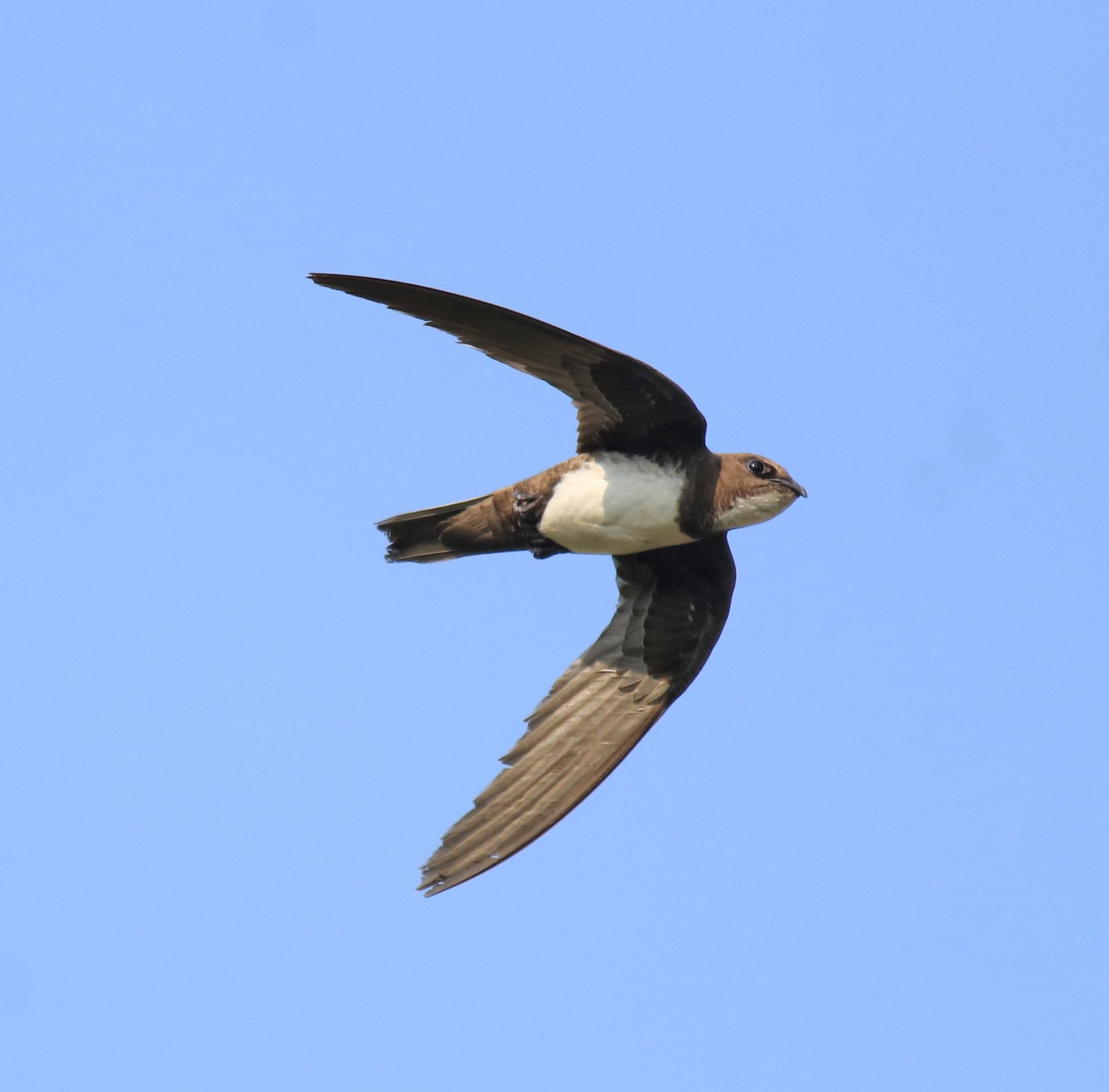
The Alpine Swift is the largest swift in the region: a powerful brown flier with a white belly and white throat, hunting high over mountains and cliffs on fast, swishing beats and long glides. An endemic African subspecies breeds in rock crevices in the region.
Voice
A loud, rolling trill that rises and falls in pitch, tititititi-ti-ti-teee, often in chorus from groups hunting around the breeding cliff; lower and fuller than the screams of smaller swifts.
Recording: Esperanza Poveda — CC BY-NC-SA 4.0 · converted to mono · xeno-canto
Identification
About 21 cm, with a wingspan of around 57 cm, much bulkier than any other swift except Mottled Swift. Upperparts, breast band, flanks and undertail coverts are earth brown; the throat and a large belly patch are bright white. The wings are very long and sickle-shaped, the tail short and slightly forked. The wingbeat is slower and deeper than in smaller swifts, so that at distance the bird can recall a small falcon. The sexes are alike; juveniles have pale feather fringes.
Confusion species
Mottled Swift (Tachymarptis aequatorialis) is the same size but all brown, lacking the white belly. Smaller swifts such as African Black Swift (Apus barbatus) and Common Swift (Apus apus) are darker, with a longer, more deeply forked tail and no white belly. The white belly patch between the dark breast band and undertail coverts is decisive in a good view.
Habitat
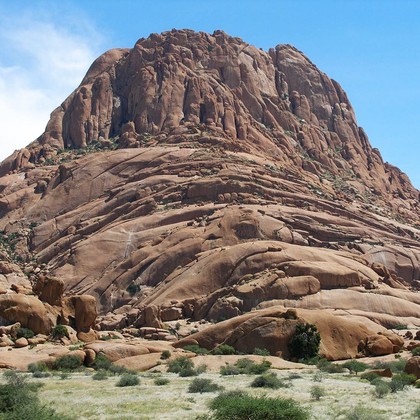
High mountains, sheer cliffs, gorges and rocky coasts, and beyond that any airspace where insects gather, often many kilometres from the breeding site and over grassland, woodland or water. It breeds colonially in crevices in rock faces and sometimes in dam walls or tall buildings; the nest is a cup of feathers and plant down bound with saliva.
Where the bird is most at home, classified by the vegetation units of southern Africa.

Range and movements
The African breeding population occurs in the mountains of the Western and Eastern Cape, the Drakensberg of Lesotho and KwaZulu-Natal, further north in Mpumalanga and Limpopo, on the Namibian escarpment and in the highlands of Zimbabwe, Malawi and Angola; beyond these it may wander over lowland anywhere in the region. European migrants winter mainly in East and West Africa and probably reach the region only in small numbers. Outside the region the species breeds from southern Europe and north-west Africa to India, and in East Africa and Madagascar.
- Resident
- Summer visitor (c. Oct–Mar)
- Winter visitor (c. Apr–Sep)
- Passage (Mar–Apr, Oct–Nov)
- dark = core range, pale = thinly spread
How and when to look
At mountain passes and gorges, such as in the Drakensberg, the Cederberg or on the Cape passes, groups can often be seen in summer racing noisily along the cliff face. Ahead of a storm they come low over valleys and reservoirs. In any swift flock, check the largest and slowest-flying birds.
Conservation status
Not threatened, with a very large range and stable numbers. Cliff breeding sites are not very vulnerable; declines in insects due to agricultural pesticides may reduce food supply.
Scientific name
Tachymarptis melba | (Linnaeus, 1758)
Linnaeus described the species in 1758 as Hirundo Melba; because it was later moved to another genus, the author and year stand in brackets. The genus Tachymarptis was introduced in 1922 by Roberts. Tachymarptis is Greek, from takhus 'fast' and marptis 'seizer', after the bird that takes its prey from the air in swift flight. melba is of uncertain origin; possibly a short form of melanoalba, from Greek melas 'black' and Latin albus 'white', after the brown-and-white plumage. The specimen the first description was based on came from Gibraltar.