All species › Swifts › Swifts › Mottled Spinetail
Mottled Spinetail | Telacanthura ussheri
Baobabgierzwaluw | Vencejo de Baobab
The Mottled Spinetail is a dark, compact spinetail with a short square tail and broad, paddle-shaped wings. As its Dutch name, 'baobab swift', suggests, in the region it is almost everywhere tied to hollow baobabs, in which it roosts and breeds.

Voice
Rather quiet. A soft, high twitter, tsweet or tsi-tsi-tsi, mainly around the roost and nest tree at dusk.
Recording: Louis A. Hansen — CC BY-NC-SA 3.0 · converted to mono · xeno-canto
Identification
About 14 cm. Largely sooty brown, with a mottled, grey-scaled throat and breast. A narrow white band crosses the rump, and a second, still narrower white band crosses the lower belly just in front of the vent; the latter is diagnostic but visible only in good light. The tail is short and square, with protruding shaft spines. The wings are broad in the hand and pinched at the base. Flight is slower and more fluttering than in Apus swifts, interspersed with short glides. The sexes are alike.
Confusion species
Böhm's Spinetail (Neafrapus boehmi) is much smaller, virtually tailless and white-bellied. Little Swift (Apus affinis) also has a white rump and a square tail, but the rump patch is broader, the throat is clean white rather than mottled, the underparts are black without a belly band, and the flight is faster on narrower wings.
Habitat
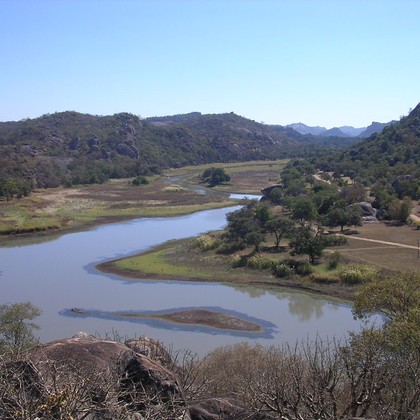
Hot lowland woodland and mopane with baobabs, river valleys with riverine forest, and open country around villages. It hunts flying insects, often in mixed flocks with other swifts and swallows. It breeds and roosts in hollow baobabs, sometimes also in wells, mine shafts or buildings; the nest is a half-cup of plant material glued with saliva to the inner wall.
Where the bird is most at home, classified by the vegetation units of southern Africa.


Range and movements
The north and north-east of the region: Mozambique south to the Limpopo, the Zambezi Valley and lowveld of Zimbabwe, the extreme north-east of South Africa (the Pafuri area), Malawi, Zambia and Angola. Beyond the region in a broad belt across sub-Saharan Africa, from Senegal to Kenya and Tanzania.
- Resident
- Summer visitor (c. Oct–Mar)
- Winter visitor (c. Apr–Sep)
- Passage (Mar–Apr, Oct–Nov)
- dark = core range, pale = thinly spread
How and when to look
Hollow baobabs are the key: at sunset the birds fly in and out through a crack or hole in the trunk. In the Kruger Park best around Pafuri and along the Luvuvhu; elsewhere in the Zambezi and Luangwa valleys regularly in mixed swift flocks over the river.
Conservation status
Not threatened and widespread, although local in the region. It depends on old hollow trees, so the felling of baobabs and elephant damage to them cost breeding sites locally.
Scientific name
Telacanthura ussheri | (Sharpe, 1870)
Sharpe described the species in 1870 as Chaetura ussheri; because it was later moved to another genus, the author and year stand in brackets. The genus Telacanthura was introduced in 1918 by Mathews. Telacanthura comes from Greek telos, 'end', akantha, 'thorn', and oura, 'tail' — for the spine-like tips of the tail feathers. ussheri honours Herbert Taylor Ussher (1836–1880), British colonial administrator on the Gold Coast (now Ghana) and bird collector. The specimen the first description was based on came from Fort Victoria, Ghana.