All species › Owls › Typical owls › Pearl-Spotted Owlet
Pearl-Spotted Owlet | Glaucidium perlatum
Geparelde dwerguil | Mochuelo Perlado
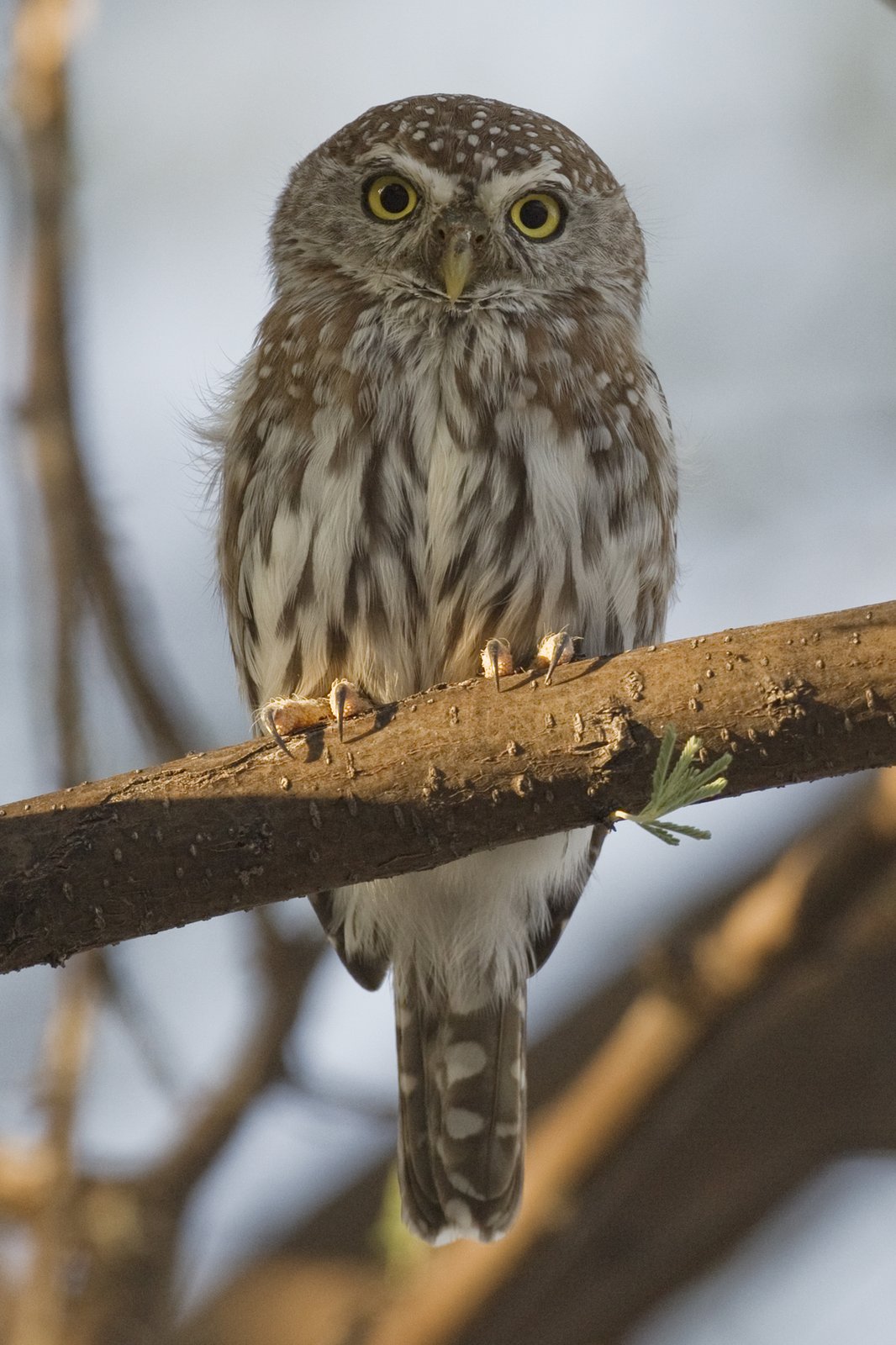
The Pearl-Spotted Owlet is a small, round-headed owl without ear tufts, dotted with white spots, and one of the few owls in the region that is also active by day. On the back of its head it carries two black spots rimmed with white, a 'false face' that is thought to deter attackers from behind.
Voice
A rising series of whistles, tu-tu-tu-tu-tu-tu, increasing in pitch and volume and ending in a series of descending, drawn-out notes, tseeu tseeu tseeu. It calls both by day and by night. Birders often imitate the song, and small passerines respond vigorously with alarm calls.
Recording: Marc Languy — CC BY-NC-SA 4.0 · converted to mono · xeno-canto
Identification
17–20 cm. Upperparts warm grey-brown, crown and nape finely spotted white, back and wing-coverts with larger white droplets. The tail is fairly long with rows of white spots. The underparts are white with broad rufous-brown streaks. The face is round with a faint disc and white eyebrows; the eyes are yellow. Two black 'eye spots' rimmed white on the nape. The sexes are alike, the female slightly larger. Juveniles have a less spotted crown. It wags its tail from side to side when excited; flight is fast and undulating, low between the trees.
Confusion species
African Barred Owlet Glaucidium capense is larger, with a finely barred head and back lacking white spots, a white line along the scapulars and a spotted rather than streaked belly. African Scops Owl Otus senegalensis is grey with bark-like markings, has ear tufts and is strictly nocturnal. The false eyes on the nape are diagnostic of Pearl-Spotted Owlet.
Habitat
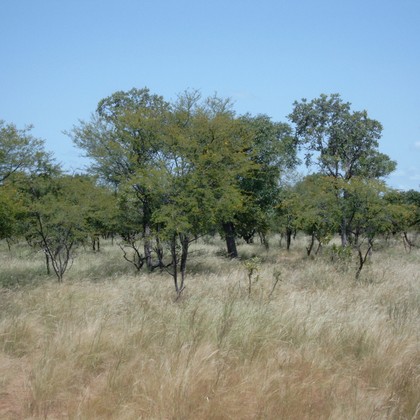
Open and semi-open savanna with scattered large trees: thornveld, mopane, miombo and mixed woodland, and riverine woodland along dry rivers. It avoids closed forest, bare desert and treeless grassland. It hunts from a perch for large insects, small mammals, lizards and birds, at times larger than itself. It breeds in old woodpecker and barbet holes or natural tree cavities.
Where the bird is most at home, classified by the vegetation units of southern Africa.


Range and movements
Common in the savanna belt: Angola (except the northern forest and the coastal desert), Zambia, Malawi, Mozambique, Zimbabwe, Botswana, northern and central Namibia, and northern and eastern South Africa south to northern KwaZulu-Natal and Eswatini. It is absent from the Cape, the Karoo, the highveld and Lesotho. Beyond the region it inhabits the savannas of sub-Saharan Africa from Senegal to Ethiopia and Kenya.
- Resident
- Summer visitor (c. Oct–Mar)
- Winter visitor (c. Apr–Sep)
- Passage (Mar–Apr, Oct–Nov)
- dark = core range, pale = thinly spread
How and when to look
Play or whistle the song in savanna with large trees and watch how tits, bulbuls and white-eyes react: their combined alarm often points to where the owlet sits. It also perches in the open by day and turns its head, showing the false eyes. Early spring, when pairs call intensively, is the best time.
Conservation status
Not threatened, common and widespread. It persists in grazed and lightly degraded woodland as long as old trees with cavities remain. The removal of dead and hollow trees and poisoning through insect control are local threats.
Scientific name
Glaucidium perlatum | (Vieillot, 1817)
Vieillot described the species in 1817 as Strix perlata; because it was later moved to another genus, the author and year stand in brackets. The genus Glaucidium was introduced in 1826 by Boie. Glaucidium is Greek glaukidion 'little owl' or 'owlet', a diminutive of glaux 'owl'. perlatum is modern Latin for 'pearled', for the white spots on the head, back and tail. The specimen the first description was based on came from Senegal.