All species › Owls › Typical owls › African Barred Owlet
African Barred Owlet | Glaucidium capense
Kaapse dwerguil | Mochuelo del Cabo
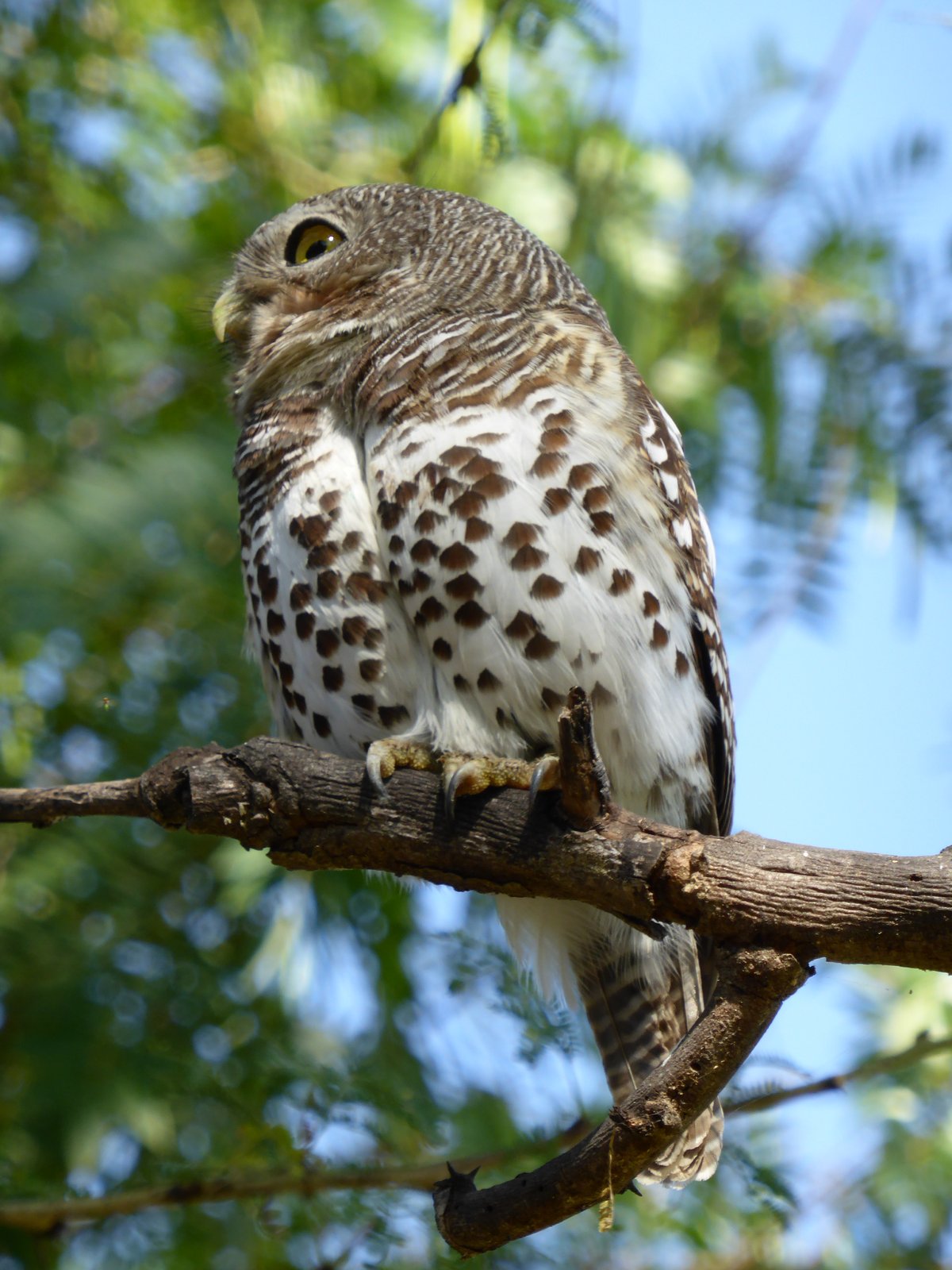
The African Barred Owlet is a stocky, round-headed owl without ear tufts, with a finely barred head and back. It is shyer and more tied to woodland than Pearl-Spotted Owlet, and is mainly noticed by its purring call at dusk.
Voice
A soft, purring kerrr-kerrr-kerrr in a slow series, and a series of two- or three-syllabled whistles, prrrup-prrrup, that increases in volume. It calls mainly at dusk and in the first part of the night, sometimes also by day.
Recording: JJSUN — CC BY-NC-SA 4.0 · shortened to the first 60 s, mono · xeno-canto
Identification
20–22 cm. Head, nape and back warm brown with fine pale bars; a conspicuous white line along the scapulars. The wings have pale spots on the coverts and the tail is narrowly barred pale. The breast is barred brown, the belly white with rows of dark arrowhead or droplet spots. The face is round with white eyebrows and yellow eyes; false eyes on the nape are weak or absent. The sexes are alike. Birds from the Okavango and Zambezi are greyer and less rufous than those from eastern South Africa.
Confusion species
Pearl-Spotted Owlet Glaucidium perlatum is smaller and slimmer, with white spots instead of barring on head and back, a streaked belly and clear black false eyes on the nape. African Scops Owl Otus senegalensis is smaller, grey and has ear tufts.
Habitat
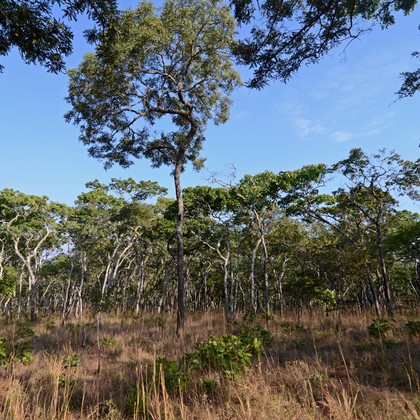
Riverine woodland and the edges of coastal and lowland forest, rich miombo and moist mixed woodland with tall trees and dense undergrowth. By day it hides in thick foliage. It hunts large insects, small birds, rodents and lizards. It breeds in natural tree cavities and old woodpecker holes.
Where the bird is most at home, classified by the vegetation units of southern Africa.


Range and movements
The east and north of the region: coastal and lowland forest of the Eastern Cape and KwaZulu-Natal, the Mpumalanga lowveld, Mozambique, eastern and northern Zimbabwe including the Zambezi valley, the Okavango Delta and Chobe area of Botswana, the Zambezi Region of Namibia, Zambia, Malawi and eastern Angola. Beyond the region it reaches Tanzania, coastal Kenya and southern DR Congo.
- Resident
- Summer visitor (c. Oct–Mar)
- Winter visitor (c. Apr–Sep)
- Passage (Mar–Apr, Oct–Nov)
- dark = core range, pale = thinly spread
How and when to look
Visit riverine woodland at nightfall, for instance in the Okavango, along the Zambezi or in the coastal forests of KwaZulu-Natal, and listen for the purring kerrr-kerrr. The bird responds well to a brief imitation and then comes to an open branch. Passerines mobbing noisily in dense woodland may also betray a roosting owlet.
Conservation status
Not threatened, but locally scarce in the south and sensitive to the clearing of coastal and riverine forest. The isolated population in the Eastern Cape and KwaZulu-Natal is small and depends on the remaining forest fragments.
Scientific name
Glaucidium capense | (Smith, 1834)
Smith described the species in 1834 as Noctua Capensis; because it was later moved to another genus, the author and year stand in brackets. The genus Glaucidium was introduced in 1826 by Boie. Glaucidium is Greek glaukidion 'little owl' or 'owlet', a diminutive of glaux 'owl'. capense means 'of the Cape', after the Cape Colony in South Africa, where the species was described. The specimen the first description was based on came from South Africa.