All species › Owls › Typical owls › African Scops Owl
African Scops Owl | Otus senegalensis
Afrikaanse dwergooruil | Autillo Africano
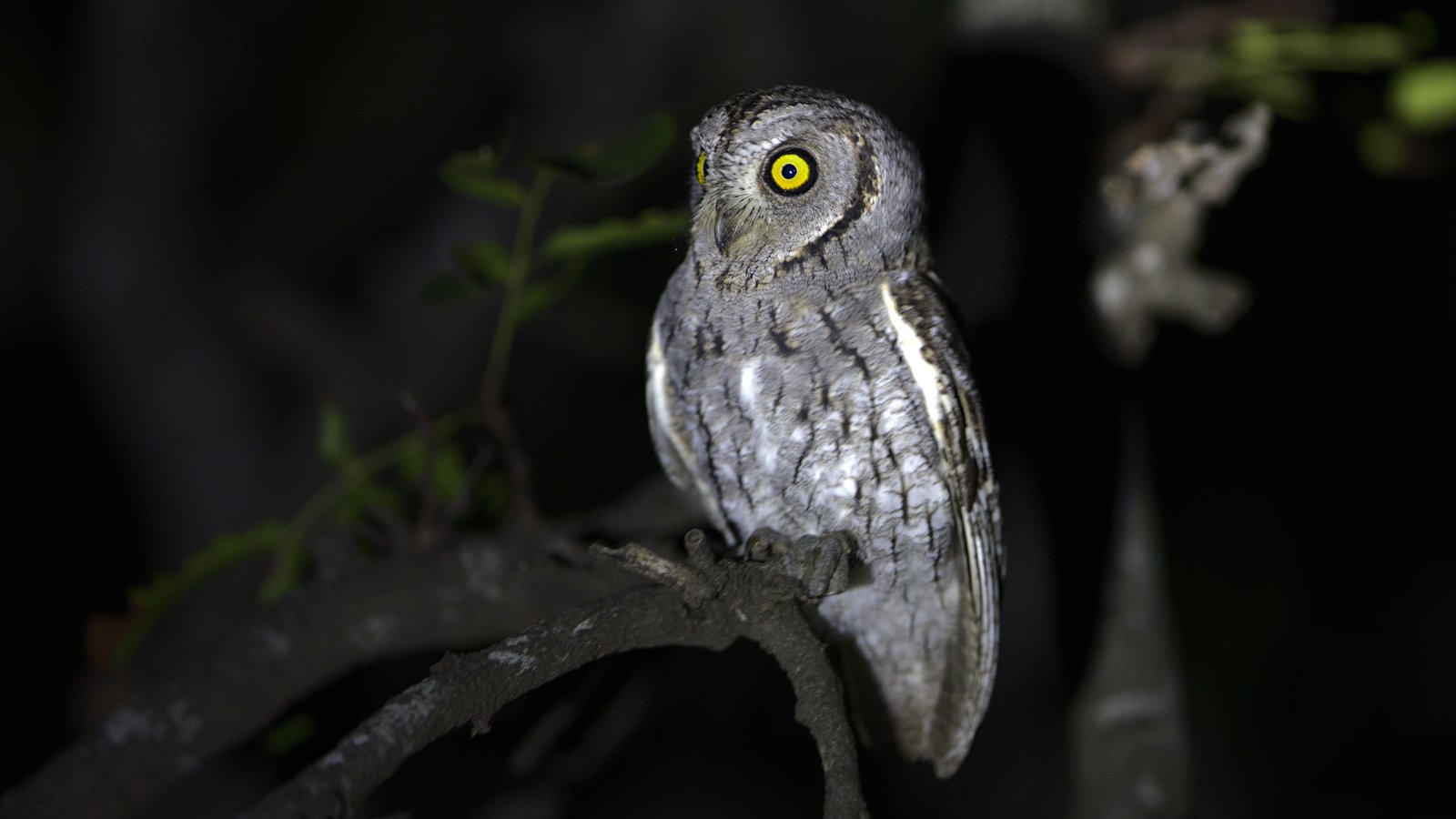
The African Scops Owl is the smallest owl in the region: a slim grey owl with short ear tufts and a plumage that matches tree bark exactly. By day it sits upright against a trunk and is then almost invisible; at night it betrays itself with its frog-like call.
Voice
A short, rolling, frog-like prrrp, repeated every five to eight seconds, sometimes all night. Pairs answer each other at a slightly different pitch. The sound is hard to locate and is often taken for a frog or an insect.
Recording: JJSUN — CC BY-NC-SA 4.0 · converted to mono · xeno-canto
Identification
15–18 cm. The plumage is grey or grey-brown, densely mottled and finely streaked like bark, with a row of white spots along the scapulars. The ear tufts are short and are raised when alarmed, when the bird also draws itself tall and thin. The facial disc is grey with a dark rim; the eyes are yellow. Grey and browner birds occur. The sexes are alike. The legs are feathered to the toes.
Confusion species
Southern White-Faced Owl Ptilopsis granti is much larger, with a white face rimmed black and orange eyes. Pearl-Spotted Owlet Glaucidium perlatum and African Barred Owlet Glaucidium capense have round heads without ear tufts and are browner, with spots or barring rather than bark-like patterning.
Habitat
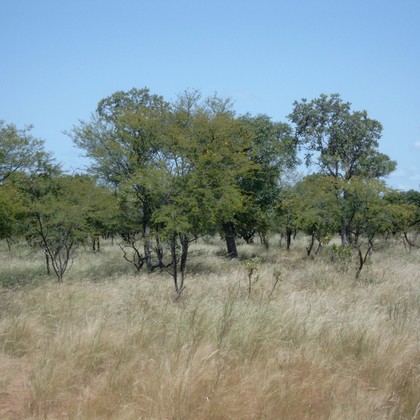
Dry and semi-arid savanna, thornveld, mopane and mixed woodland, also riverine woodland and large wooded gardens; it avoids closed forest and treeless country. It feeds mainly on large insects, spiders and scorpions, caught from a low perch. It breeds in natural tree cavities.
Where the bird is most at home, classified by the vegetation units of southern Africa.


Range and movements
Widespread through the savannas of the region: Angola, Zambia, Malawi, Mozambique, Zimbabwe, Botswana, northern and central Namibia, and northern and eastern South Africa south to KwaZulu-Natal and Eswatini, with extensions along the rivers of the Northern Cape. It is absent from the south-western Cape, the Karoo, the treeless highveld and Lesotho. Beyond the region it occurs across most of Africa south of the Sahara.
- Resident
- Summer visitor (c. Oct–Mar)
- Winter visitor (c. Apr–Sep)
- Passage (Mar–Apr, Oct–Nov)
- dark = core range, pale = thinly spread
How and when to look
After sunset in savanna with large trees, listen for the regular prrrp. Approach the sound quietly and then search the trunk and thicker branches with a lamp: the bird often sits low, close against the trunk. By day a roost can sometimes be found because passerines mob it.
Conservation status
Not threatened and common in suitable woodland. It is sensitive to the felling of large trees with cavities and to insecticides that reduce its food supply. Many birds are killed by traffic while hunting insects along roads.
Scientific name
Otus senegalensis | (Swainson, 1837)
Swainson described the species in 1837 as Scops Senegalensis; because it was later moved to another genus, the author and year stand in brackets. The genus Otus was introduced in 1769 by Pennant. Otus is Latin for 'eared owl', borrowed from the Greek ōtos, from ous 'ear'. senegalensis means 'from Senegal'; the type specimen came from neighbouring Gambia. The specimen the first description was based on came from Senegal (type from Gambia).