All species › Owls › Typical owls › Southern White-Faced Owl
Southern White-Faced Owl | Ptilopsis granti
Zuidelijke witwangdwergooruil | Autillo Cariblanco Sureño
The Southern White-Faced Owl is a medium-sized, grey, eared owl with a bright white face framed by a broad black rim and vivid orange eyes. When threatened it can make itself strikingly thin and tall, or instead puff itself up with spread wings, depending on the size of the intruder.

Voice
A fast, bubbling series of short notes ending in a longer hoot, bu-bu-bu-bu-hoooo, often given alternately by the pair. When disturbed it also bill-snaps and hisses.
Recording: Yoann Blanchon — CC BY-NC-SA 4.0 · shortened to the first 60 s, mono · xeno-canto
Identification
22–26 cm. Upperparts pale grey, finely streaked and vermiculated dark; a row of white spots along the scapulars. The underparts are pale grey with fine dark shaft streaks. The face is white, framed by a broad black rim; the eyes are orange to orange-red. The ear tufts are of medium length, grey with black tips. The sexes are alike. Juveniles have a greyish face with a less sharply defined rim and yellow eyes.
Confusion species
African Scops Owl Otus senegalensis is much smaller, with a grey face and yellow eyes. Spotted Eagle-Owl Bubo africanus is much larger and browner, with barred underparts. The white face with its black rim and the orange eyes are unique in the region.
Habitat
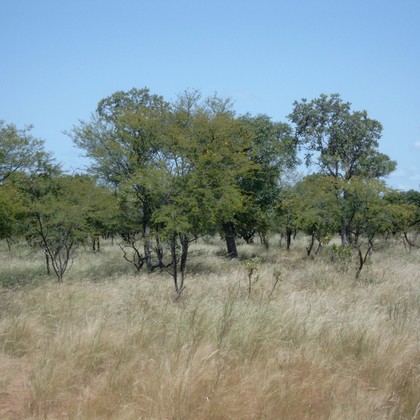
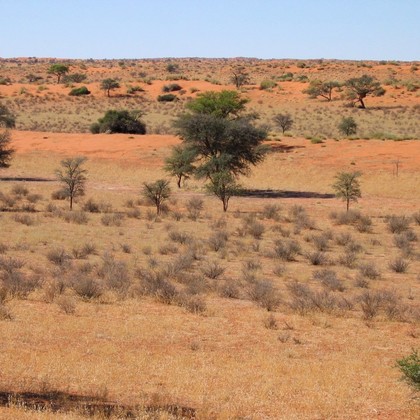
Dry savanna and thornveld, especially acacia stands and Kalahari thornveld, also mopane and riverine woodland along dry rivers. It hunts rodents, small birds, reptiles and large insects, often from a low perch at the edge of a clearing. It breeds in old stick nests of other birds, in tree holes or in a tree fork.
Where the bird is most at home, classified by the vegetation units of southern Africa.

Range and movements
The dry north and west of the region: Namibia (except the Namib), Botswana, the Kalahari of the Northern Cape, North West, Limpopo, the Mpumalanga lowveld and northern KwaZulu-Natal, and further Eswatini, Zimbabwe, Mozambique, Zambia, Malawi and southern and central Angola. Beyond the region it ranges north to Tanzania, Kenya, Uganda and southern DR Congo.
- Resident
- Summer visitor (c. Oct–Mar)
- Winter visitor (c. Apr–Sep)
- Passage (Mar–Apr, Oct–Nov)
- dark = core range, pale = thinly spread
How and when to look
In the Kalahari and the thornveld of northern Namibia the bird often roosts by day on a low branch close to the trunk of an acacia; check dense, shady trees around camps and waterholes carefully. At night it comes to the lights of campsites to hunt. The bubbling duet is heard mostly in spring.
Conservation status
Not threatened and fairly common in dry savanna. The loss of large trees to wood-cutting and overgrazing, road kills and poisoning by rodenticides are local threats.
Scientific name
Ptilopsis granti | (Kollibay, 1910)
Kollibay described the species in 1910 as Pisorhina leucotis granti; because it was later moved to another genus, the author and year stand in brackets. The genus Ptilopsis was introduced in 1848 by Kaup. Ptilopsis comes from Greek ptilon, 'feather', and opsis, 'face' — for the striking, white, black-rimmed facial disc of these owls. granti honours William Robert Ogilvie-Grant (1863–1924), curator of birds at the British Museum, who was the first to point out the distinct southern taxon (The Ibis, 1906). The specimen the first description was based on came from Namibia.