All species › Owls › Typical owls › Marsh Owl
Marsh Owl | Asio capensis
Afrikaanse velduil | Búho Moro
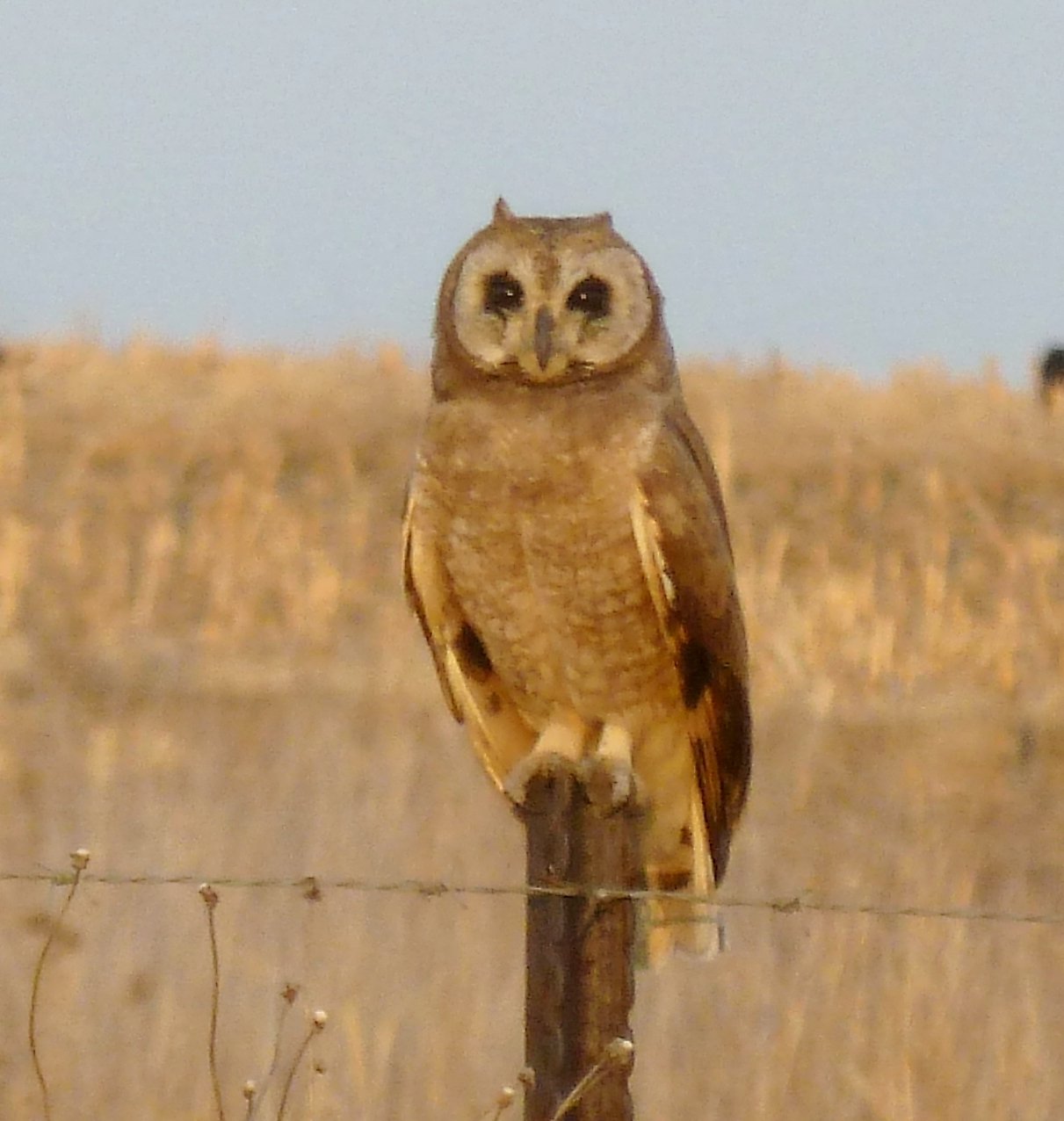
The Marsh Owl is a medium-sized, plain dark brown owl of open grassland and marsh, with a pale facial disc, dark eyes and small ear tufts. It often hunts at dusk or on overcast days, flying low and buoyantly over the grass.
Voice
A harsh, rasping kraaak, like tearing cloth, mainly in flight and around the nest. When disturbed at the nest it also gives a hoarse croak, and during display flights the male claps its wings.
Recording: Tony Archer — CC BY-NC-SA 4.0 · converted to mono · xeno-canto
Identification
31–38 cm. Upperparts and breast plain dark earth-brown, belly paler and finely barred. The facial disc is pale brown with dark patches around the eyes; the eyes are dark brown. The ear tufts are short and set close together, often barely visible. In flight the long wings stand out, with a pale ochre patch at the base of the primaries, dark carpal patches and a barred wingtip. The sexes are alike. Flight is slow and floating, with the wings in a shallow V.
Confusion species
African Grass Owl Tyto capensis is darker above and paler below, with a white heart-shaped face, black eyes and long, pale legs; it hunts mainly in full darkness. Western Barn Owl Tyto alba is much paler, golden-buff and white. Spotted Eagle-Owl Bubo africanus is larger, with yellow eyes and long ear tufts, and rarely hunts over open grassland.
Habitat
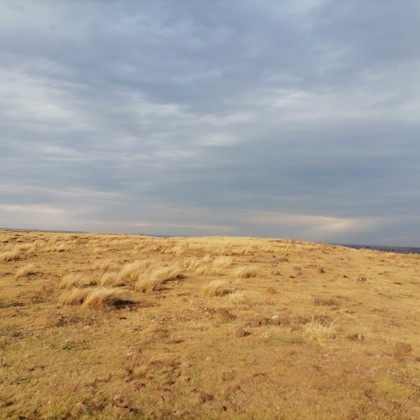
Moist grassland, vleis, marsh margins, reedbeds and floodplains, as well as damp parts of farmland; it avoids woodland and dry country. It hunts low over the grass for rodents, large insects and small birds. It nests on the ground in tall grass or among sedges; by day it also rests on the ground and is flushed only at close range.
Where the bird is most at home, classified by the vegetation units of southern Africa.

Range and movements
Widespread but local: the highveld and eastern grasslands of South Africa, Lesotho and Eswatini, the coastal plain of the Western and Eastern Cape, the Zimbabwe highveld, the Okavango and Makgadikgadi in Botswana, northern Namibia, and the great floodplains of Zambia, Malawi, Mozambique and Angola. It is absent from the arid west. Beyond the region it is scattered across sub-Saharan Africa, Madagascar and a small area of Morocco.
- Resident
- Summer visitor (c. Oct–Mar)
- Winter visitor (c. Apr–Sep)
- Passage (Mar–Apr, Oct–Nov)
- dark = core range, pale = thinly spread
How and when to look
Drive at nightfall along moist grassland or a vlei on the highveld and watch for a dark owl floating low over the grass like a harrier; it often perches on a roadside post. In some places dozens of birds gather after a rodent outbreak. Take care when walking through tall grass, where nests lie on the ground.
Conservation status
Not threatened and locally common. Numbers decline through the drainage of vleis, intensive grazing and the burning of grassland during the breeding season. Rodent poisons and road traffic also take a toll.
Scientific name
Asio capensis | (Smith, 1834)
Smith described the species in 1834 as Otus Capensis; because it was later moved to another genus, the author and year stand in brackets. The genus Asio was introduced in 1760 by Brisson. Asio is the Latin name of a horned or eared owl. capensis means 'of the Cape', after the Cape Colony in South Africa, where the species was described. The specimen the first description was based on came from South Africa.