All species › Owls › Typical owls › Cape Eagle-Owl
Cape Eagle-Owl | Bubo capensis
Kaapse oehoe | Búho del Cabo
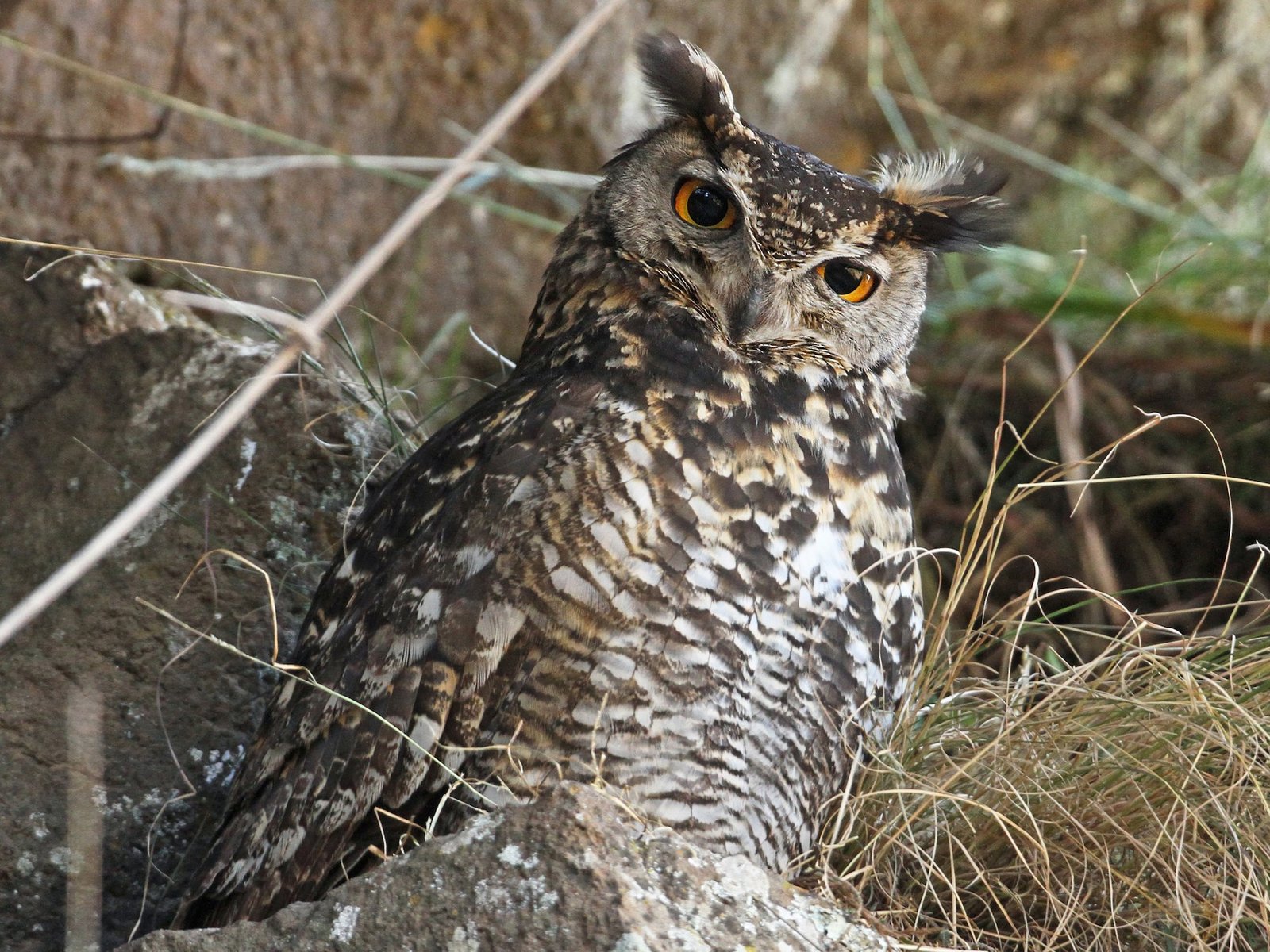
The Cape Eagle-Owl is a large, powerful owl of mountains and rocky gorges, with orange eyes, long ear tufts and coarse dark blotches on the breast. It resembles the far commoner Spotted Eagle-Owl but is more heavily built, with larger feet and talons.
Voice
A deep, powerful call of two or three notes, HOOO-hoo, stressed on the first, lower and louder than that of Spotted Eagle-Owl. The female calls higher. When disturbed at the nest it gives a barking wak-wak and snaps its bill.
Recording: Ranive — CC BY-NC-SA 4.0 · converted to mono · xeno-canto
Identification
48–58 cm. Upperparts dark warm brown with pale and ochre spots. The breast is white to ochre-buff with large dark brown blotches at the sides; the belly is coarsely barred dark. The facial disc is rufous-brown with a black rim; the eyes are orange to orange-yellow. The ear tufts are long and erect. The legs are heavily feathered, with large toes and talons. The female is clearly larger than the male. Birds from Zimbabwe northwards are larger and darker than those from the Cape.
Confusion species
Spotted Eagle-Owl Bubo africanus is smaller and slimmer, usually yellow-eyed, with fine, regular barring below and no coarse breast blotches; however, Spotted Eagle-Owls with orange-tinged eyes occur and cause confusion. Verreaux's Eagle-Owl Ketupa lactea is larger and pale grey, with dark brown eyes and pink eyelids.
Habitat
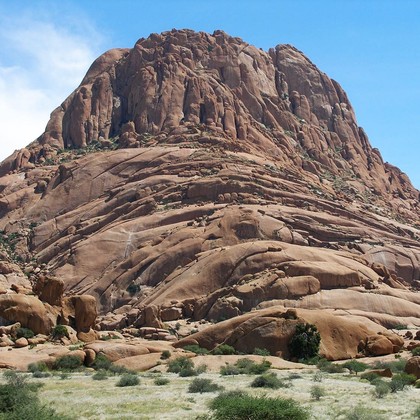
Rocky hills, gorges, cliffs and mountain slopes, from fynbos and Karoo to montane grassland; also rocky savanna with koppies. It takes mainly medium-sized mammals such as dassies, rock rats and hares, as well as francolins and doves. It nests on a ledge, in a rock cavity or among boulders on a steep slope.
Where the bird is most at home, classified by the vegetation units of southern Africa.

Range and movements
Local in mountainous parts of the region: the Cape Fold Mountains and Karoo ranges, the Drakensberg, Lesotho, the eastern escarpment and the mountains of Limpopo, Eswatini, southern Namibia, south-eastern Botswana, the Matobo and eastern highlands of Zimbabwe, the adjacent part of Mozambique and the plateaus of Malawi and Zambia. Beyond the region it occurs in the highlands of East Africa north to Kenya and Ethiopia.
- Resident
- Summer visitor (c. Oct–Mar)
- Winter visitor (c. Apr–Sep)
- Passage (Mar–Apr, Oct–Nov)
- dark = core range, pale = thinly spread
How and when to look
At dusk, find a steep gorge or cliff in the Karoo, the Drakensberg or the Matobo and listen for the deep double hoot. The bird often perches on a prominent rock to look around. By day, white droppings and pellets containing dassie bones below a ledge give away a roost.
Conservation status
Not threatened, but everywhere at low density and poorly known. Collisions with power lines and fences, poisoning and disturbance by climbers and recreation are the main reported causes of death.
Scientific name
Bubo capensis | Smith, 1834
Smith described the species in 1834 and placed it straight away in the genus where it still stands. The genus Bubo was introduced in 1805 by Duméril. Bubo is the Latin word for the eagle-owl. capensis means 'of the Cape'; the first specimen came from near Cape Town. The specimen the first description was based on came from near Cape Town, South Africa.