All species › Owls › Typical owls › Spotted Eagle-Owl
Spotted Eagle-Owl | Bubo africanus
Afrikaanse oehoe | Búho Africano
The Spotted Eagle-Owl is the commonest large owl of southern Africa: a grey-brown eagle-owl with yellow eyes, long ear tufts and finely barred underparts. It occurs from savanna and rocky hills to the gardens and parks of large cities.

Voice
A soft, hollow hooting: the male gives a two-note hoo-hoo and the female answers with three notes, hoo-hoo-hoo, the middle one higher. Pairs often duet. When disturbed it bill-snaps and hisses; young beg with a hoarse hiss.
Recording: Charles Hopkins — CC BY-NC-SA 4.0 · converted to mono · xeno-canto
Identification
43–50 cm. Upperparts grey-brown with white and dark flecks; a row of white spots on the scapulars. The underparts are white to pale grey, finely and evenly barred grey-brown, with some dark blotches on the upper breast. The facial disc is pale grey with a black rim; the eyes are yellow. The ear tufts are long and often held erect. A rarer rufous form occurs, with warmer brown markings and sometimes orange-yellow eyes. The female is larger than the male.
Confusion species
Cape Eagle-Owl Bubo capensis is larger and more robust, with orange eyes, coarse dark blotches on the breast and coarser barring on the belly; it is tied to mountains and gorges. Verreaux's Eagle-Owl Ketupa lactea is much larger and paler grey, with dark brown eyes and pink eyelids. Marsh Owl Asio capensis is smaller and plain dark brown, with dark eyes and short ear tufts.
Habitat
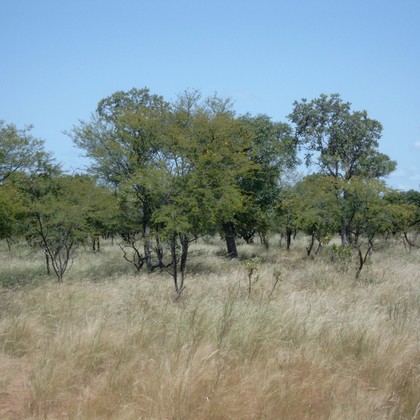
Almost all open and semi-open habitats with some cover: savanna, thornveld, rocky hills and gorges, Karoo, woodland edges and farmland, and also gardens, parks and industrial areas in towns. It avoids only closed forest. Its diet is highly varied: large insects, rodents, birds, reptiles and amphibians. It nests on the ground among rocks, in a tree hole, an old nest, or on a building or window box.
Where the bird is most at home, classified by the vegetation units of southern Africa.


Range and movements
Distributed across almost the entire region, from the Cape to Angola, Zambia and Malawi, including Lesotho, Eswatini and the fringes of the Namib; scarcer in the dense forests of the north and east. Beyond the region it ranges north to Kenya, Uganda, southern DR Congo and Gabon.
- Resident
- Summer visitor (c. Oct–Mar)
- Winter visitor (c. Apr–Sep)
- Passage (Mar–Apr, Oct–Nov)
- dark = core range, pale = thinly spread
How and when to look
A night drive along a dirt road often produces an eagle-owl sitting on the track or on a post. In cities such as Johannesburg and Pretoria it nests on buildings and in window boxes, and sits on roofs and lamp posts in the evening. The duet can be heard all year, most often in winter and early spring.
Conservation status
Not threatened, common and well adapted to people. Many birds die in traffic, in collisions with wires and fences and through rodenticide poisoning; in some areas they are also persecuted because of superstition.
Scientific name
Bubo africanus | (Temminck, 1821)
Temminck described the species in 1821 as Strix africana; because it was later moved to another genus, the author and year stand in brackets. The genus Bubo was introduced in 1805 by Duméril. Bubo is the Latin word for the eagle-owl. africanus is Latin for 'African'. The specimen the first description was based on came from Cape of Good Hope.