All species › Owls › Typical owls › Pel's Fishing Owl
Pel's Fishing Owl | Scotopelia peli
Pels visuil | Cárabo Pescador Común
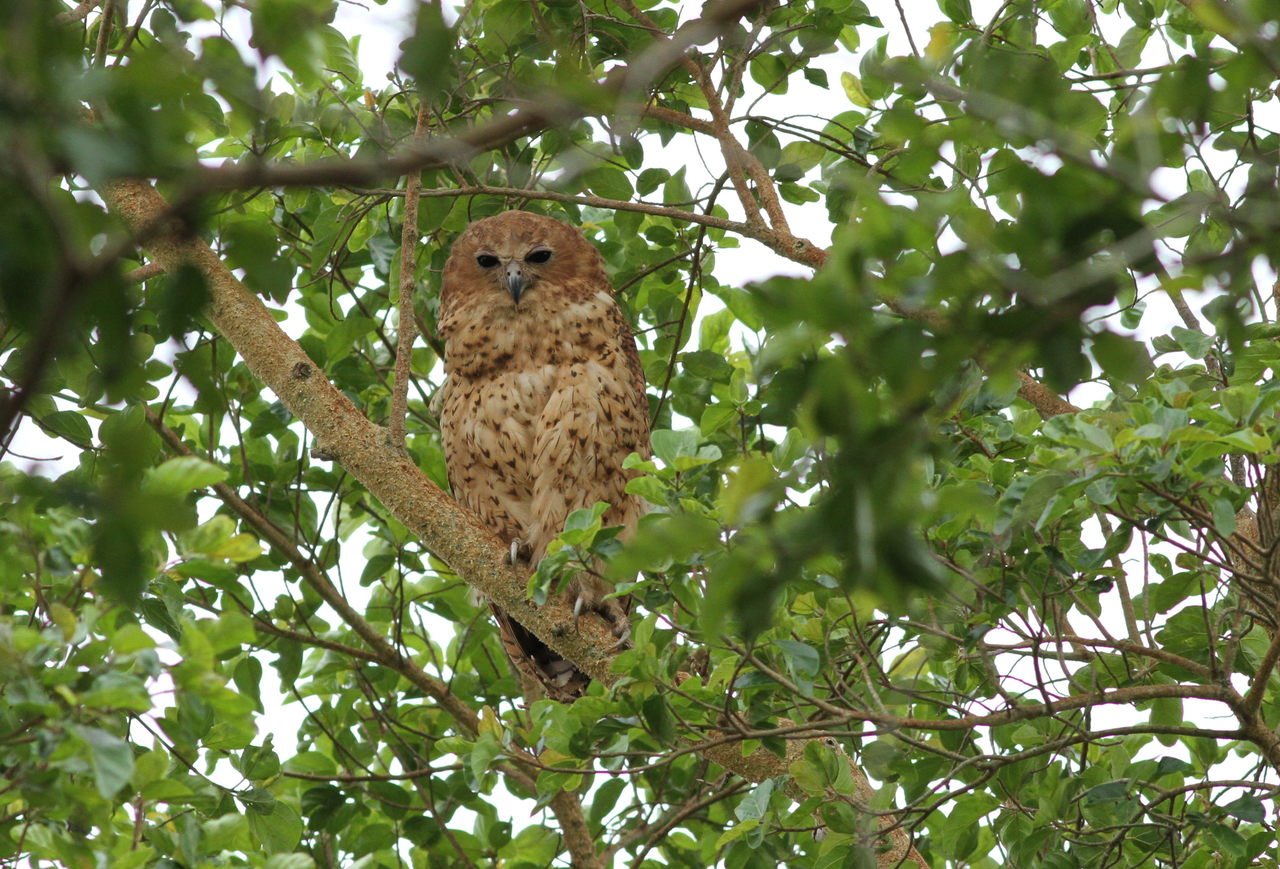
Pel's Fishing Owl is a large, rufous owl without ear tufts that catches fish at night from rivers and lagoons. For many birders it is one of the most sought-after species in southern Africa: shy, tied to tall riverine forest and hidden by day in the dense canopy.
Voice
A very deep, humming hoot, hoommm-hut, audible over a great distance, mainly in the first part of the night; pairs duet. There is also a long, plaintive, rising wail, wheeeuuu, given by young and females, often taken for another animal around the campfire.
Recording: Francesco Barberini — CC BY-NC-SA 4.0 · converted to mono · xeno-canto
Identification
55–63 cm, wingspan well over one and a half metres. The whole plumage is warm rufous to orange-brown, finely barred dark above and paler below with small dark arrowhead spots. The head is large and round, without true ear tufts, but loose head feathers often give it a shaggy, flattened look. A distinct facial disc is lacking; the eyes are large and blackish brown. The legs are bare and pale yellow, with rough, spiny toes for gripping fish. The female is slightly larger and paler. Juveniles are paler and downier.
Confusion species
Vermiculated Fishing Owl Scotopelia bouvieri, only in northern Angola and adjacent Zambia, is smaller, paler and clearly streaked rather than barred. Verreaux's Eagle-Owl Ketupa lactea is grey, finely vermiculated and has ear tufts and pink eyelids. The size, rufous colour and round head without ear tufts otherwise make Pel's Fishing Owl unmistakable.
Habitat
Large perennial rivers, lagoons and swamps lined with tall riverine forest of figs, ebonies and other large trees. It hunts from a low branch over the water and snatches fish of 100 to 2,000 grams just below the surface; it also takes frogs and crabs. It nests in a hollow in a large tree or a broad tree fork.
Where the bird is most at home, classified by the vegetation units of southern Africa.


Range and movements
Local along large rivers: the Okavango Delta and the Linyanti and Chobe rivers in Botswana and the Zambezi Region of Namibia, the Zambezi including the Kariba and Mana Pools floodplains, the Luangwa and Kafue in Zambia, the Shire in Malawi, the rivers of Mozambique, eastern Angola, and in South Africa the north of Kruger National Park (Luvuvhu, Limpopo) and sporadically northern KwaZulu-Natal. Beyond the region it is scattered along rivers from West to East Africa.
- Resident
- Summer visitor (c. Oct–Mar)
- Winter visitor (c. Apr–Sep)
- Passage (Mar–Apr, Oct–Nov)
- dark = core range, pale = thinly spread
How and when to look
The best-known sites are the Okavango Panhandle near Shakawe, the lagoons of the Okavango Delta, Mana Pools, the Luangwa and Pafuri in Kruger National Park. By day, have a local guide take you to a known roost tree and look up at the thick horizontal branches. At night the deep hoot carries across the water, and a hunting bird can be searched for along the bank with a dim lamp.
Conservation status
Not threatened globally, but listed as endangered in South Africa because of its small number of pairs. It is vulnerable to the loss of tall riverine forest to felling, elephants and fire, to reduced river flow from dams and irrigation, and to disturbance and net fishing.
Scientific name
Scotopelia peli | (Bonaparte, 1850)
Bonaparte described the species in 1850 as Strix peli; because it was later moved to another genus, the author and year stand in brackets. The genus Scotopelia was introduced in 1850 by Bonaparte. Scotopelia combines Greek skotos, 'darkness', with the epithet of Strix peli, the fishing owl for which the genus was erected — a 'nocturnal Pel's owl'. peli honours Hendrik Severinus Pel (1818–1876), governor of the Dutch Gold Coast (now Ghana) from 1840 to 1850, who collected and prepared birds there. The specimen the first description was based on came from Ashanti, Ghana.