All species › Owls › Typical owls › Vermiculated Fishing Owl
Vermiculated Fishing Owl | Scotopelia bouvieri
Kleine visuil | Cárabo Pescador Vermiculado
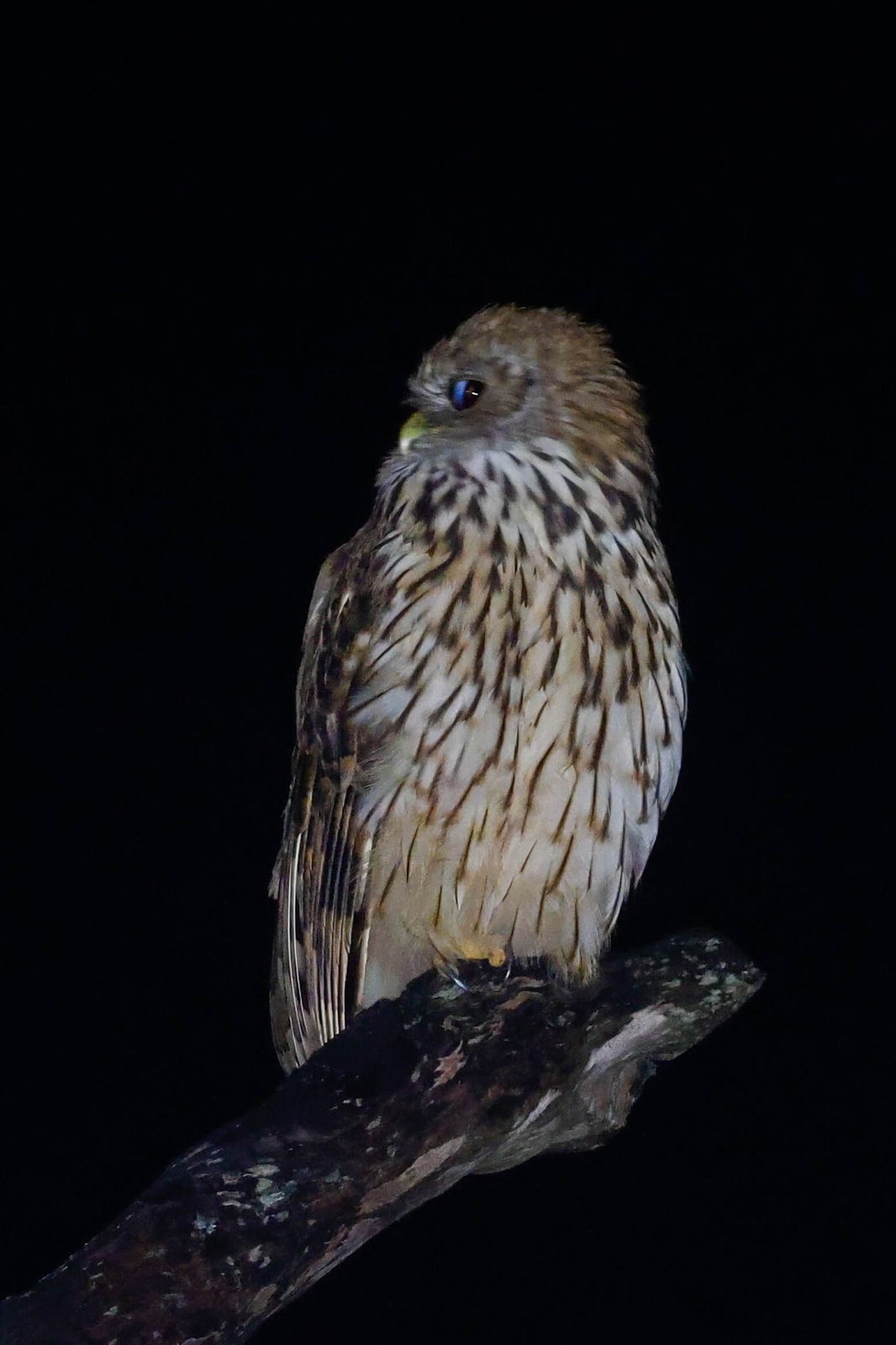
The Vermiculated Fishing Owl is a medium-sized, earless owl of rivers in the Central African rainforest, known in the region only from Angola. It is smaller, paler and more finely marked than Pel's Fishing Owl, and one of the least known owls in Africa.
Voice
A deep, growling krooo-oo and a series of low, descending hoots that recall a dove or an eagle-owl. The female has a higher, hoarse begging call; a whistled eeeuh has also been described. Calls mainly in the first part of the night.
Recording: Dries Van de Loock — CC BY-NC-SA 4.0 · converted to mono · xeno-canto
Identification
46–51 cm. Rufous to cinnamon-brown above with fine dark wavy lines (vermiculation), white to creamy white below with sharp, narrow dark brown streaks on breast and belly. The head is round and without ear tufts, but the loose crown feathers can give a shaggy, rather square head. The eyes are dark brown, the bill yellowish horn and the unfeathered legs pale yellow. The sexes are alike. Juveniles are whiter and downier, with a pale head.
Confusion species
Pel's Fishing Owl Scotopelia peli is much larger and heavier, warm rufous with arrowhead spots and barring below instead of streaks. African Wood Owl Strix woodfordii is smaller, with a clear facial disc and white eyebrows, and barred underparts. Spotted Eagle-Owl Bubo africanus has ear tufts and yellow eyes.
Habitat
Slow-flowing rivers and streams with overhanging trees in lowland rainforest and gallery forest, including narrow forest streams too small for Pel's Fishing Owl. It hunts fish, frogs and crabs from a low branch over the water, and also takes insects and small mammals on the bank.
Where the bird is most at home, classified by the vegetation units of southern Africa.

Range and movements
In the region only in northern and north-western Angola, in the gallery forests of the Congo fringe and the northern escarpment forests; its status in the far north-west of Zambia is unclear. Beyond the region it occurs through the Central African rainforest, from southern Nigeria and Cameroon through Gabon and both Congos to the Central African Republic, with isolated records farther east.
- Resident
- dark = core range, pale = thinly spread
How and when to look
A bird to plan a trip for: find a quiet forest river with plenty of overhanging branches in northern Angola and listen after dusk for the low growling call. Search the bank slowly with a torch; the bird sits low and close to the water. By day it roosts hidden in dense foliage and is then almost impossible to find.
Conservation status
Not threatened on the Red List, but poorly known and seldom seen; true numbers and distribution have hardly been studied. Logging along rivers, pollution and disturbance of watercourses by mining, and the loss of rainforest are possible threats.
Scientific name
Scotopelia bouvieri | Sharpe, 1875
Sharpe described the species in 1875 and placed it straight away in the genus where it still stands. The genus Scotopelia was introduced in 1850 by Bonaparte. Scotopelia combines Greek skotos, 'darkness', with the epithet of Strix peli, the fishing owl for which the genus was erected — a 'nocturnal Pel's owl'. bouvieri honours the French zoologist and natural-history dealer Aimé Bouvier (1844–1919). The specimen the first description was based on came from Lopé, Ogooué River, Gabon.