All species › Passerines › Larks › Botha's Lark
Botha's Lark | Spizocorys fringillaris
Botha's leeuwerik | Alondra de Botha
Botha's Lark is one of South Africa's rarest birds: a small, unobtrusive lark confined to high-altitude, short-grazed grassland of the eastern highveld. Its entire world range covers a handful of districts in Mpumalanga and the Free State.

Voice
The call, often in flight, is a disyllabic, slightly hoarse chee-ree or cheep. The song is a simple series of a few repeated notes, given in a short, low fluttering display flight or from the ground. Not loud; often goes unheard in the often strong wind on the high plateau.
No recording with a suitable Creative Commons licence is available for this species yet.
Identification
12–13 cm. Small and stocky, with a short tail and a short, conical bill that is pale pink to flesh-coloured. The upperparts are blackish with clear pale edges, giving a heavily scaled, almost black-and-brown back pattern. The crown is dark-streaked, with a pale supercilium. The underparts are pale, with a buff wash and fine dark streaks across the breast and flanks, grading to a white belly. The outer tail feathers are white and show well on take-off. Sexes alike.
Confusion species
Pink-Billed Lark Spizocorys conirostris, which shares the area, is warmer rufous-buff below, less heavily scaled above and lacks pure white outer tail feathers. Rudd's Lark Heteromirafra ruddi of the same grasslands is larger, with a big head, a pale crown stripe and a stubby tail, and sings in a high, prolonged display flight. African Pipit Anthus cinnamomeus is slimmer, long-tailed and thin-billed. Female sparrow-larks hardly occur in this high grassland.
Habitat
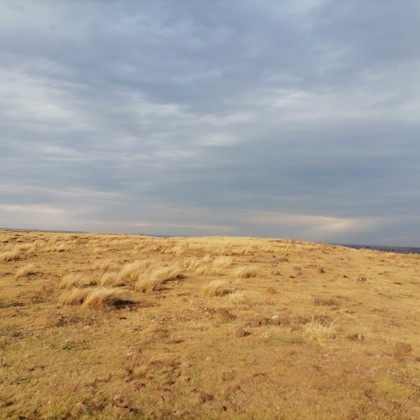
Short, heavily grazed grassland on high plateaus and ridges above about 1,600 m, often where livestock or game keep the grass short. It avoids tall, undisturbed grass and cropland, and is absent from plantations. It forages on the ground for seeds and insects.
Where the bird is most at home, classified by the vegetation units of southern Africa.
Range and movements
Endemic to South Africa. Confined to the high-altitude grassland of south-eastern Mpumalanga, including around Wakkerstroom, Volksrust, Amersfoort, Ermelo and Chrissiesmeer, and the adjacent north-eastern Free State. It occurs nowhere else in the world.
- Resident
- Summer visitor (c. Oct–Mar)
- dark = core range, pale = thinly spread
How and when to look
Wakkerstroom is the classic site; a local guide knows the pastures where the species is present year-round. Go early in the morning, while it is still calm, and walk quietly over short-grazed grassland. When small larks flush, look for the white tail sides and the blackish back. Keep to tracks and respect private land; most sites are on farms.
Conservation status
Endangered. The total population is small and declining. Highveld grassland has largely been converted to cropland and timber plantations, and mining (especially coal) fragments the remaining habitat. The species depends on grazed grassland; both overgrazing and the loss of grazing make it unsuitable. Protection on private farms is essential.
Scientific name
Spizocorys fringillaris | (Sundevall, 1850)
Sundevall described the species in 1850 as Alauda fringillaris; because it was later moved to another genus, the author and year stand in brackets. The genus Spizocorys was introduced in 1872 by Sundevall. Spizocorys comes from the Greek spiza, 'finch', and korudos, 'crested lark' — for the short, finch-like bill of these small larks. fringillaris means 'finch-like', from the Latin fringilla, 'finch' — for the small, finch-like bill. The specimen the first description was based on came from north of the Drakensberg, former Transvaal, South Africa.