All species › Passerines › Larks › Pink-Billed Lark
Pink-Billed Lark | Spizocorys conirostris
Roodsnavelleeuwerik | Alondra Piquirrosa
Pink-Billed Lark is a small, stocky lark with a short, conical pink bill that shuffles through short grassland in pairs or small groups. It is inconspicuous and quiet, and is often only noticed when a small party flushes at one's feet.

Voice
The call is a soft, high chee-chee or tweet, often given on take-off. The song, in a fluttering display flight or from the ground, is a short series of thin, twittering notes, tsee-tsee-tsiu. Not conspicuous; practically inaudible in wind.
Recording: Dawie de Swardt — CC BY-NC-SA 4.0 · converted to mono · xeno-canto
Identification
12–13 cm. Small, round and short-tailed, with a short, thick, conical bill that is pink to flesh-coloured. The upperparts are brown with dark streaks and pale edges; the crown is streaked, with a pale supercilium and a dark malar stripe that give the face a weak pattern. The underparts are warm buff to rufous-buff, with fine streaks on the breast and a pale throat. The tail is dark with pale outer edges. Sexes alike. The birds creep crouched between grass tufts and freeze when threatened.
Confusion species
Botha's Lark Spizocorys fringillaris of the high-altitude grasslands of Mpumalanga and the north-eastern Free State is more heavily black-scaled above, paler below and has clearly white outer tail feathers. Stark's Lark Spizocorys starki has a crest, is much paler and lives on bare gravel plains. Female sparrow-larks, such as Grey-Backed Sparrow-Lark Eremopterix verticalis, have a heavier, greyer bill and a dark belly patch. Red-Capped Lark Calandrella cinerea is larger, with a rufous crown and breast patches and white underparts.
Habitat
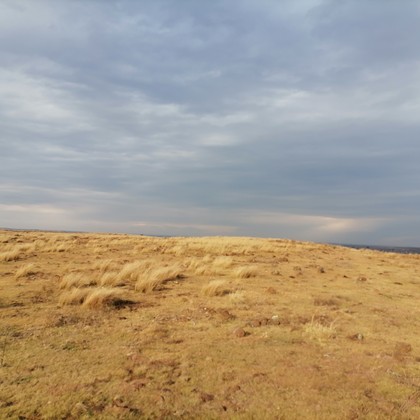
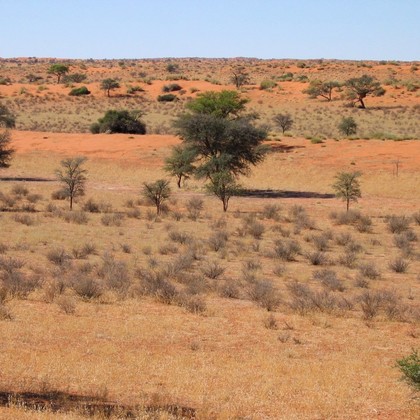
Short, open grassland, often grazed or recently burnt, and the grassland and sandy plains of the Kalahari with tussock grasses. On the highveld also on fallow fields. It forages on the ground for grass seeds and small insects.
Where the bird is most at home, classified by the vegetation units of southern Africa.
Range and movements
Endemic to southern Africa. In South Africa on the highveld of the Free State, Gauteng, Mpumalanga and North West Province, and in the eastern Northern Cape; locally in Lesotho. Also in the Kalahari of Botswana and eastern and central Namibia, and on the grassy plains of western Zambia (including the Liuwa Plain). In dry years it appears nomadically outside its usual areas.
- Resident
- Summer visitor (c. Oct–Mar)
- Winter visitor (c. Apr–Sep)
- Passage (Mar–Apr, Oct–Nov)
- dark = core range, pale = thinly spread
How and when to look
Walk slowly through short grazed or recently burnt highveld grassland and watch for small parties that fly up low and drop again a little further on. Listen for the soft, high call on take-off. Around Wakkerstroom and Amersfoort compare carefully with Botha's Lark: check the tail sides and the pattern of the back.
Conservation status
Not threatened; locally common, but hard to census because of its nomadic habits. Conversion of grassland to cropland and afforestation with alien trees have reduced its habitat on the highveld.
Scientific name
Spizocorys conirostris | (Sundevall, 1850)
Sundevall described the species in 1850 as Alauda conirostris; because it was later moved to another genus, the author and year stand in brackets. The genus Spizocorys was introduced in 1872 by Sundevall. Spizocorys comes from the Greek spiza, 'finch', and korudos, 'crested lark' — for the short, finch-like bill of these small larks. conirostris comes from the Latin conus, 'cone', and rostrum, 'bill' — for the short, conical (pink) bill. The specimen the first description was based on came from north of the Drakensberg, former Transvaal, South Africa.