All species › Passerines › Larks › Stark's Lark
Stark's Lark | Spizocorys starki
Starks leeuwerik | Alondra de Stark
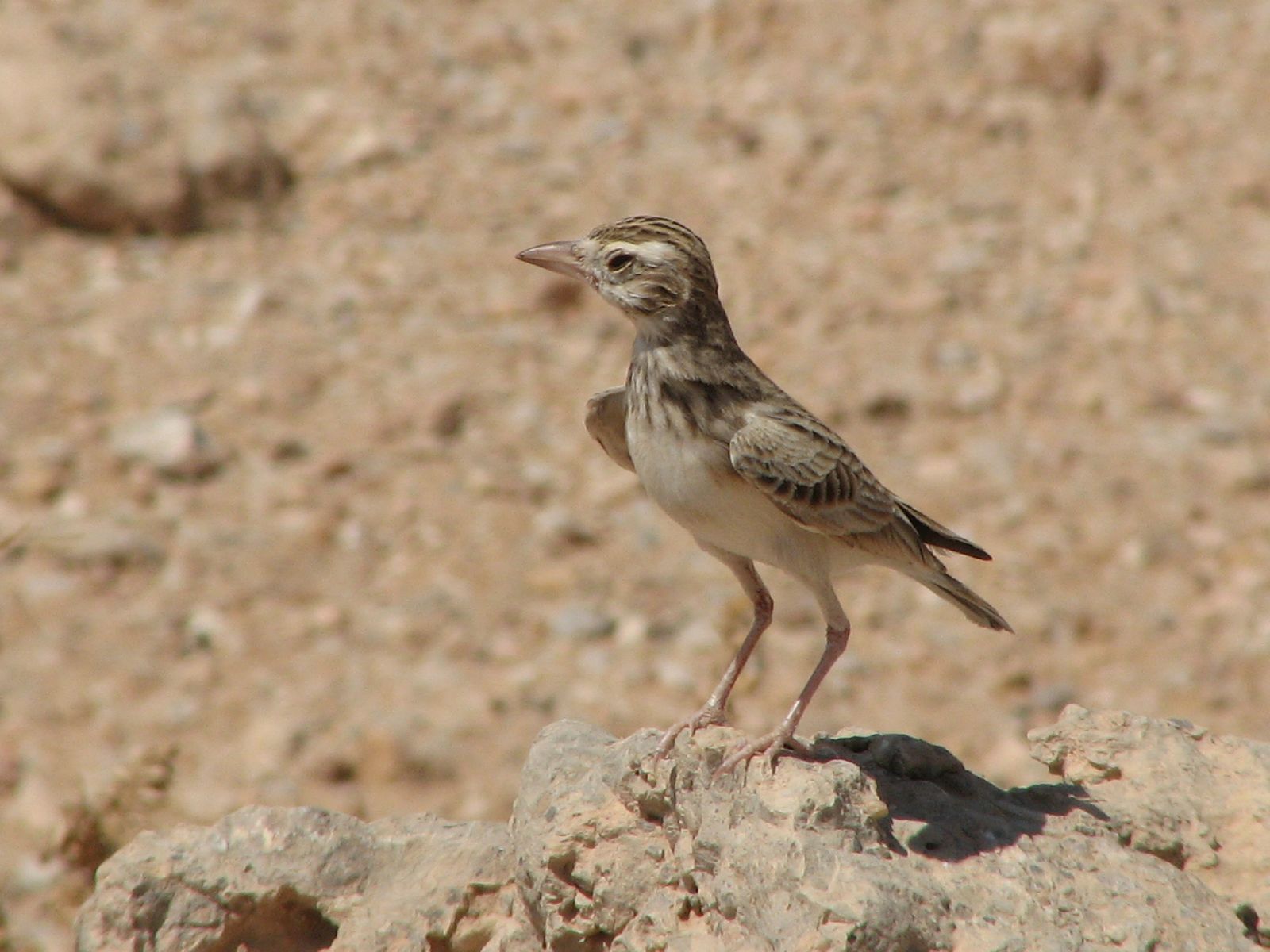
Stark's Lark is a small, pale lark with a prominent pointed crest and a conical pink bill, almost invisible on the gravel plains of the Namib and the western Karoo. It lives in flocks that wander to places where rain has fallen, and often breeds there within a few weeks.
Voice
The song is usually given in a high display flight: the bird circles high above the plain with an irregular, chirping and twittering song of short notes. The call in flight and on take-off is a soft, dry chree or cheep-cheep, heard continuously from flocks.
Recording: Ken Behrens — CC BY-NC-SA 4.0 · converted to mono · xeno-canto
Identification
13–14 cm. Small and rather slim, with a short tail and a conical, pale pink to horn bill. The crown bears a long, pointed crest that still protrudes from the back of the head when flattened. The upperparts are pale sandy-grey with fine dark streaks, matching the ground. The face is pale with a pale eye-ring and little marking; the underparts are white with a faint buff wash and fine streaks on the breast. The outer tail feathers are white. Sexes alike; juveniles are spotted above.
Confusion species
Pink-Billed Lark Spizocorys conirostris lacks a crest, is warmer rufous-buff below and lives in grassland. Sclater's Lark Spizocorys sclateri of the stony plains of Bushmanland and southern Namibia is darker, with a heavy bill and a dark teardrop mark below the eye. Grey-Backed Sparrow-Lark Eremopterix verticalis, often in mixed flocks, has a thicker bill and dark underparts in the male; the female has a black belly patch. Red-Capped Lark Calandrella cinerea is larger, with a rufous crown and rufous breast patches.
Habitat
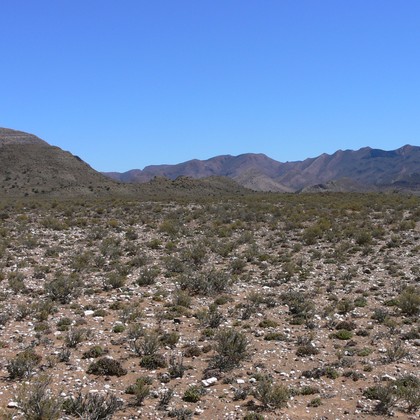
Bare gravel and stony plains with sparse short grass and dwarf shrubs in the Namib and pro-Namib, and open plains in the dry Nama Karoo. After rain it gathers in large numbers on plains with fresh grass. It drinks regularly at livestock water points.
Where the bird is most at home, classified by the vegetation units of southern Africa.

Range and movements
Near-endemic to the west of southern Africa: most of Namibia, especially the Namib, the pro-Namib and the central plateau, north to south-western Angola (Namibe), and south to Bushmanland and the north-west of the Northern Cape in South Africa. In wet years it irrupts into south-western Botswana and further east in the Northern Cape. Not known outside the region.
- Resident
- Summer visitor (c. Oct–Mar)
- Winter visitor (c. Apr–Sep)
- Passage (Mar–Apr, Oct–Nov)
- dark = core range, pale = thinly spread
How and when to look
After rain, search the gravel plains along the roads through the Namib, for example between Walvis Bay and the Namib-Naukluft or around Aus, and check flocks of small larks and sparrow-larks at water points in the morning. The crest and the pale pink bill are the best features on the ground. On hot days the birds stand in the shade of a stone or post.
Conservation status
Not threatened. The range is large and largely uninhabited; numbers fluctuate strongly with rainfall, but there is no sign of a lasting decline. Mining and climate change are possible future threats.
Scientific name
Spizocorys starki | (Shelley, 1902)
Shelley described the species in 1902 as Calandrella starki; because it was later moved to another genus, the author and year stand in brackets. The genus Spizocorys was introduced in 1872 by Sundevall. Spizocorys comes from the Greek spiza, 'finch', and korudos, 'crested lark' — for the short, finch-like bill of these small larks. starki honours the English physician and ornithologist Arthur Cowell Stark (1846–1899), who collected the species and was killed during the siege of Ladysmith. The specimen the first description was based on came from Wilson's Fountain, Great Namaqualand, Namibia.