All species › Passerines › Thrushes › Boulder Chat
Boulder Chat | Pinarornis plumosus
Steenspringer | Zorzal Roquero
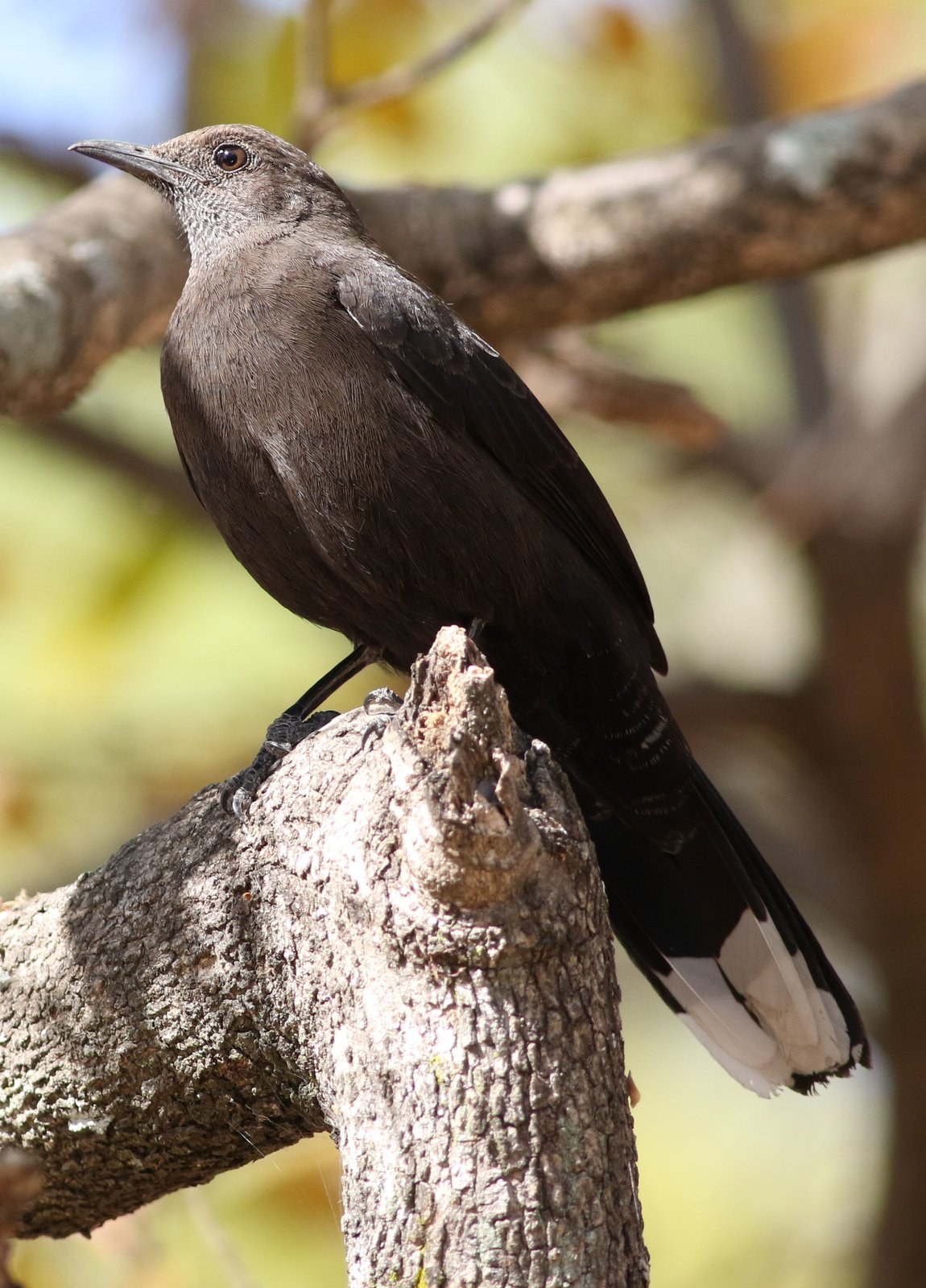
The Boulder Chat is a large, dark, thrush-like bird of wooded granite kopjes that bounds over boulders in long hops, raising and fanning its tail. It is the only member of its genus and is almost confined to southern Africa, with Zimbabwe at its core.
Voice
A loud, clear, penetrating whistle, whee-eet, and a series of squeaky, creaking notes, sometimes likened to an unoiled door. Pairs call back and forth. The alarm is a hard, clicking tchak. The song is a slow series of whistles, mainly in the early morning.
Recording: Rick Nuttall — CC BY-NC-SA 4.0 · shortened to the first 60 s, mono · xeno-canto
Identification
23–25 cm. A slim, long-tailed bird, entirely brownish-black with a slightly fluffy look to the back and flanks. The outer tail feathers have broad white tips, most obvious when the tail is fanned on landing. The wing coverts and inner flight feathers show small white edges and spots, which can form a narrow pale wing line. Bill and legs are black. The female is slightly browner and duller than the male; juveniles are browner with faint pale spotting. Behaviour is characteristic: running and hopping over rocks with the tail raised and half-spread, and often heard long before it is seen.
Confusion species
Mocking Cliff Chat (Thamnolaea cinnamomeiventris) shares the same rocks, but the male has a chestnut belly and undertail coverts and a white shoulder patch, and the female is grey with a rufous belly. Southern Black Flycatcher (Melaenornis pammelaina) is smaller, glossy blue-black with no white in tail or wing, and sits quietly on a branch, sallying for insects. Arrow-Marked Babbler (Turdoides jardineii) also moves through kopjes in noisy groups, but is grey-brown with white arrowhead marks and a yellow-and-red eye.
Habitat
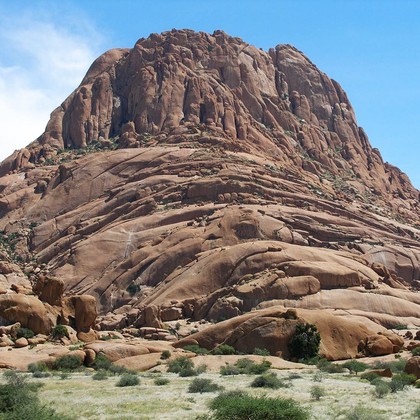
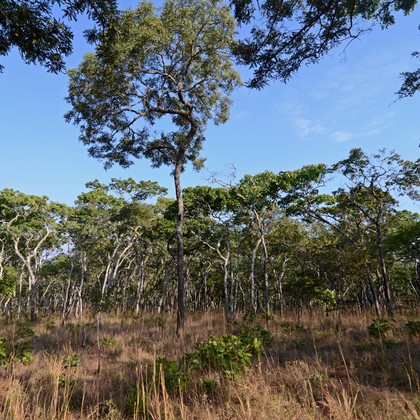
Granite kopjes, whaleback granite domes (dwalas) and hills strewn with large boulders in miombo and other dry woodland, preferably where trees and shrubs grow between the rocks. Searches for arthropods and small lizards under and between boulders and in leaf litter, sometimes sallies from a rock or hovers clumsily at foliage. The cup nest is placed under a boulder, in a crevice between rocks or against a log. Abandons sites where vegetation becomes too dense.
Where the bird is most at home, classified by the vegetation units of southern Africa.
Range and movements
Almost endemic to the region, in three clusters: eastern Botswana and southern and western Zimbabwe (Matobo, Matabeleland); north-eastern Zimbabwe with adjacent western Mozambique (Tete, Manica); and eastern Zambia through the Luangwa Valley into western Malawi. Also locally in southern Zambia; a handful of records from the far north of South Africa along the Limpopo. Not found outside the region.
- Resident
- Summer visitor (c. Oct–Mar)
- Winter visitor (c. Apr–Sep)
- Passage (Mar–Apr, Oct–Nov)
- dark = core range, pale = thinly spread
How and when to look
Matobo National Park near Bulawayo is the classic site: walk past wooded kopjes in the early morning and listen for the clear whistles and creaking notes. Birds often show briefly on top of a boulder, tail raised, before bounding away. Sit still; curious pairs frequently come back.
Conservation status
Not threatened. The species is locally common in Zimbabwe, but its habitat is fragmented and tied to rock formations. Bush encroachment, including by invasive Lantana camara, makes kopjes unsuitable; fire and woodcutting around the rocks play a local role.
Scientific name
Pinarornis plumosus | Sharpe, 1876
Sharpe described the species in 1876 and placed it straight away in the genus where it still stands. He introduced the genus Pinarornis in that same work. Pinarornis combines the Greek pinaros, 'dirty, squalid', with ornis, 'bird' — for the dull, dark plumage of Boulder Chat. plumosus is Latin for 'feathered, downy', presumably for the soft, loose plumage. The specimen the first description was based on came from Matobo Hills, Zimbabwe (originally given in error as Victoria Falls).