All species › Passerines › Bushshrikes › Braun's Bushshrike
Braun's Bushshrike | Laniarius brauni
Angolafiskaal | Bubú de Braun
Braun’s Bushshrike is one of the least known birds of the region: a dark bushshrike with a chestnut crown and a vivid orange throat and breast, confined to a narrow belt of forest in northern Angola. After its description in 1939 it went unrecorded for decades; only this century has it become clear where and how it lives.

Voice
The call heard most often is a low, growling krrroh, repeated at regular intervals of a few seconds and delivered faster when excited. It also gives hard clicks in alarm and, in display flight, a series of dry clicks followed by melodious whistles. The repertoire closely resembles that of related bushshrikes and is not a reliable feature on its own.
Recording: Pritam Baruah — CC BY-NC-SA 4.0 · converted to mono · xeno-canto
Identification
17–19 cm. The crown and nape are chestnut; the rest of the upperparts, the wings and the tail are blackish, with a white stripe along the wing. The throat and breast are bright orange and contrast sharply with the white belly. The bill is heavy, black and hooked, and the eye is dark. The sexes are nearly alike. Juveniles are duller and browner, with finely barred, pale yellowish underparts. It keeps low and hidden in dense undergrowth.
Confusion species
Gabela Bushshrike Laniarius amboimensis, of the Cuanza Sul escarpment further south, also has a chestnut crown but is entirely white below, without orange. Tropical Boubou Laniarius major has a black crown and is white or softly pink below. Pink-Footed Puffback Dryoscopus angolensis is smaller and grey and white below, with pink legs.
Habitat
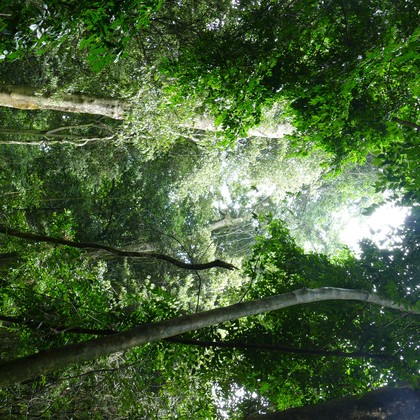
Secondary forest, forest edge and gallery forest on the northern escarpment, roughly between 600 and 900 m. The species tolerates some disturbance and also occurs in forest thinned for coffee, as long as a dense understorey of shrubs and lianas remains. It forages on or just above the ground, mainly for insects.
Where the bird is most at home, classified by the vegetation units of southern Africa.

Range and movements
Endemic to northern Angola: a belt of forest some 150 km long in Cuanza Norte and Uíge provinces, with records around Quiculungo, Roça Canzele, the rio Dange, Bolongongo and the Uíge and Quitexe area. It does not occur outside Angola.
- Resident
- dark = core range, pale = thinly spread
How and when to look
Year-round. In the morning, listen along forest tracks and coffee plantations with dense undergrowth for the regularly repeated growling call; if you stand still and wait, the bird sometimes appears briefly on a low branch. The orange breast shows up surprisingly well in the gloom of the understorey. A visit to this part of Angola calls for good local guidance.
Conservation status
Endangered. The range is very small and the species depends on forest understorey, which is being cleared on a large scale for farming, charcoal and the expansion of plantations. Where the understorey is removed completely, the bird disappears. There are no protected areas within its range.
Scientific name
Laniarius brauni | Bannerman, 1939
Bannerman described the species in 1939 and placed it straight away in the genus where it still stands. The genus Laniarius was introduced in 1816 by Vieillot. Laniarius comes from the Latin lanius, 'butcher', the same root as for the true shrikes — for the hooked bill and the habit of impaling prey on thorns. brauni honours the German collector R. H. Braun, who collected birds in Angola. The specimen the first description was based on came from Quicolungo, Angola.