All species › Passerines › Swallows and martins › Brazza's Martin
Brazza's Martin | Phedinopsis brazzae
Brazza's zwaluw | Golondrina del Congo
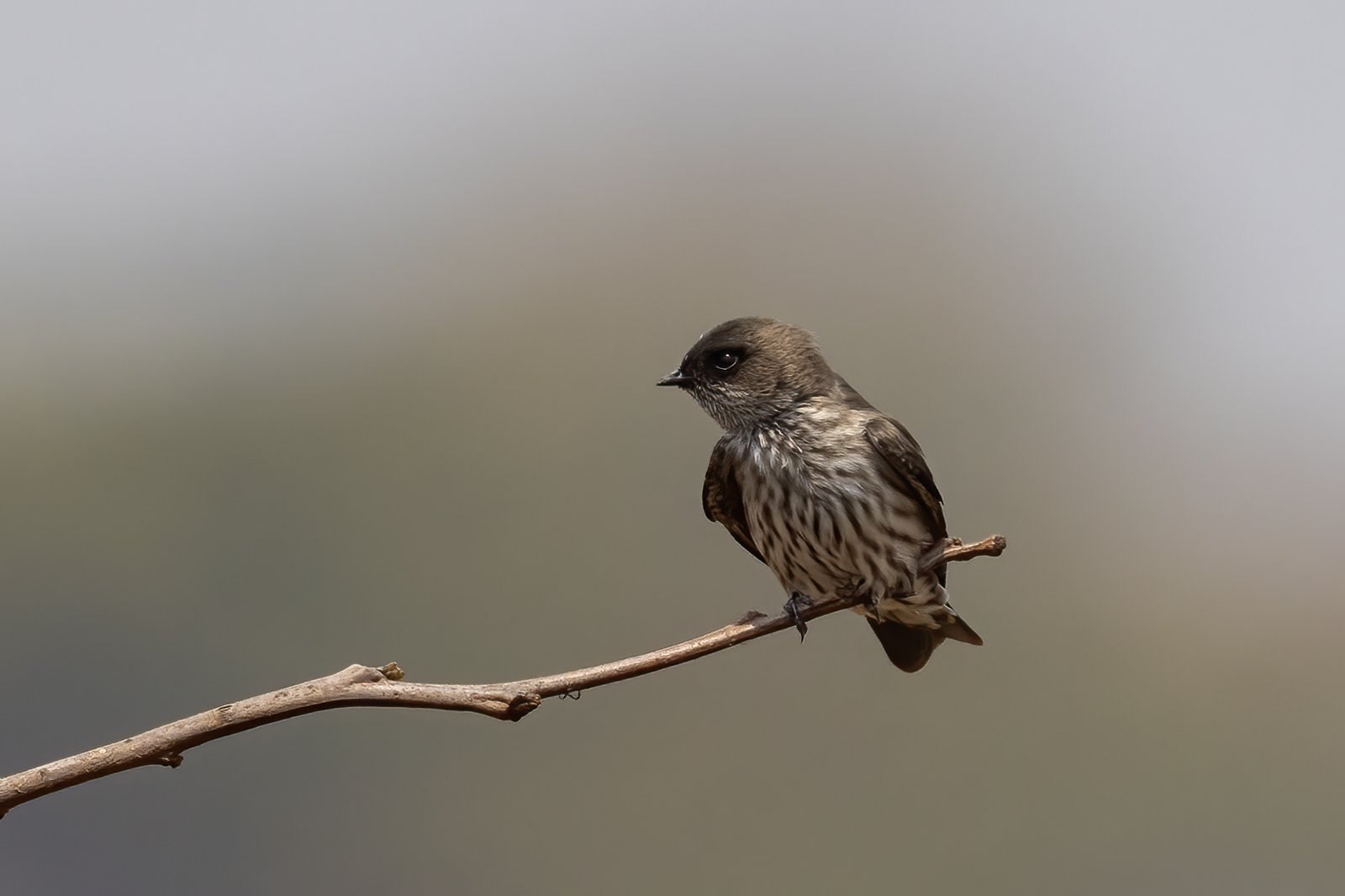
Brazza's Martin is a small, inconspicuous martin of the rivers of the Congo Basin, with streaked underparts and a square tail. Within the region it occurs only in northern Angola, and it is one of the least-known swallows in Africa.
Voice
The song starts with a few short notes that speed up and run into a complex buzzing sound, sometimes followed by a few soft clicks. In flight it calls a soft chip.
Recording: Wayne Paes — CC BY-NC-SA 4.0 · converted to mono · xeno-canto
Identification
11–12 cm; small and compact, with a square tail. Upperparts grey-brown, head slightly darker. Underparts white with sharp blackish-brown streaks on the throat and breast, fewer towards the belly; undertail coverts white. Underwing dark grey-brown. The sexes are alike; juveniles have paler, more diffuse breast streaks and rufous to buff fringes to the feathers of the upperparts.
Confusion species
The Brown-Throated Martin Riparia paludicola has a plain brown, unstreaked throat and breast and a notched tail. The Sand Martin Riparia riparia has a white throat and an unstreaked brown breast band. The Banded Martin Neophedina cincta is much larger, with a brown breast band and a small white eyebrow. The Mascarene Martin Phedina borbonica is also streaked, but larger and heavier, and occurs only as a winter visitor in the east of the region.
Habitat
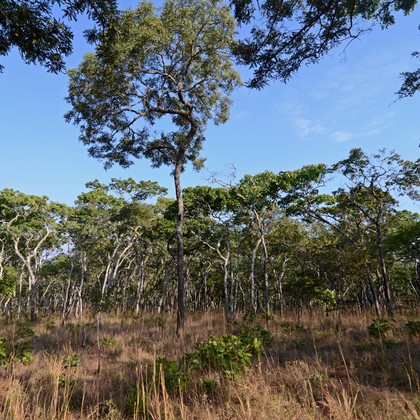
Tropical lowland rivers with steep sandy banks, in which it digs its nest tunnel; it hunts over the river and adjacent savanna. On the plateaux also in broad, grassy river valleys through woodland. It breeds at the end of the dry season (July–October), before the rivers flood.
Where the bird is most at home, classified by the vegetation units of southern Africa.

Range and movements
Within the region only in northern and north-eastern Angola, along rivers of the Congo Basin. Beyond the region in DR Congo and Republic of the Congo; one possible record in south-eastern Gabon.
How and when to look
In northern Angola, search along rivers with steep sandy banks for small brown martins hunting low over the water. The best chance is in the dry season, when the birds are active at their nest tunnels in the banks; a good view of the streaked breast and square tail is needed.
Conservation status
Not threatened, but poorly known. It depends on undisturbed riverbanks for nesting; sand mining and changes in river courses can threaten breeding colonies locally.
Scientific name
Phedinopsis brazzae | (Oustalet, J-FÉ, 1886)
Oustalet, J-FÉ described the species in 1886 as Phedina Brazzae; because it was later moved to another genus, the author and year stand in brackets. The genus Phedinopsis was introduced in 1971 by Wolters. Phedinopsis combines the genus name Phedina with the Greek opsis, 'appearance' — a martin resembling Phedina. brazzae honours the Italian-born French explorer Pierre Savorgnan de Brazza (1852–1905), later governor-general of the French Congo, who collected the first specimen. The specimen the first description was based on came from Nganchu on the Congo River, Republic of the Congo.