All species › Kingfishers, bee-eaters and rollers › Rollers › Broad-Billed Roller
Broad-Billed Roller | Eurystomus glaucurus
Breedbekscharrelaar | Carraca Picogorda
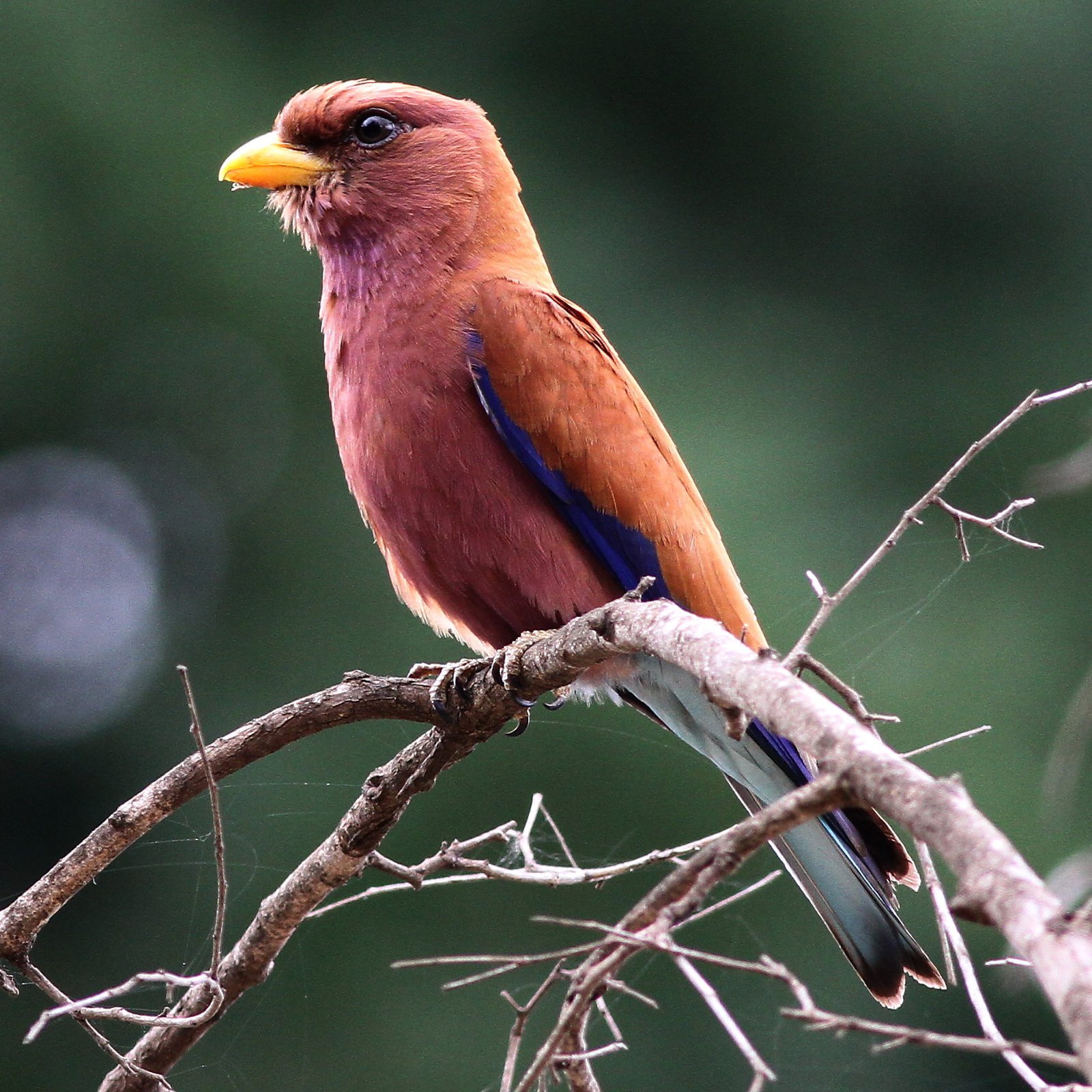
The Broad-Billed Roller is a stocky, cinnamon-brown roller with a broad, bright yellow bill that arrives from the north to breed in the region during the summer months. It perches upright on high dead branches and becomes most active at dusk, hawking swarming termites in the air.
Voice
A hard, hoarse and chattering series, krrrr-krrrr-kik-kik-kik, and a rasping gaa-gaa, often laughing in quality. Very noisy at dusk, when small groups hunt together, and during the display flight around the nest tree.
Recording: Jonathan Onongo — CC BY-NC-SA 4.0 · converted to mono · xeno-canto
Identification
About 28 cm, with a large head and a short, very broad yellow bill. The upperparts are warm cinnamon-brown, the underparts lilac to purplish, the undertail coverts and tail pale blue to turquoise with a dark terminal band. The flight feathers are dark blue. The tail is slightly forked. The sexes are alike. Juveniles are duller, with greenish-blue, brown-mottled underparts and a black-tipped bill. In flight it looks dark and falcon-like, with long wings and fast, at times tumbling movements.
Confusion species
Blue-Throated Roller (Eurystomus gularis), only in northern Angola, is smaller, with purple-blue underparts and a defined blue-violet throat patch. The Coracias rollers, such as Lilac-Breasted Roller (Coracias caudatus) and Purple Roller (Coracias naevius), are larger, paler blue or streaked below and have a dark bill. At dusk the silhouette can suggest a small falcon, but the yellow bill and constant cackling give it away.
Habitat
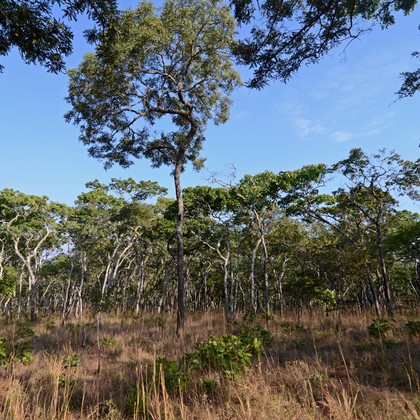
Tall trees along rivers, gallery forest, open miombo and mopane woodland near water, marsh edges and palm savanna. It hawks flying insects from a high perch, especially at emergences of termites and ants, sometimes in groups of dozens of birds. It nests in cavities in tall trees.
Where the bird is most at home, classified by the vegetation units of southern Africa.

Range and movements
A breeding visitor to the north and east of the region: Angola, Zambia, Malawi, Mozambique, Zimbabwe (mainly the Zambezi valley, the east and the lowveld), northern Botswana (Okavango Delta, Linyanti and Chobe), north-eastern Namibia (Zambezi and Kavango) and north-eastern South Africa (northern Kruger, rarer south to northern KwaZulu-Natal). Beyond the region it occurs across almost all of tropical Africa, partly as a resident, with a separate population on Madagascar.
- Resident
- Summer visitor (c. Oct–Mar)
- Winter visitor (c. Apr–Sep)
- Passage (Mar–Apr, Oct–Nov)
- dark = core range, pale = thinly spread
How and when to look
From November to March along the big rivers: the Chobe, the Okavango Delta, the Zambezi and the Luangwa valley. Sit in late afternoon near tall dead trees by the water; when termites emerge after rain several birds often appear, hawking in the air with loud chattering.
Conservation status
Not threatened and fairly common in the north of the region. The species depends on tall trees with cavities along rivers; clearance of riverine forest and the loss of large trees to elephant damage limit nest sites locally. Scarce at the southern edge of its range in South Africa.
Scientific name
Eurystomus glaucurus | (Müller, 1776)
Müller described the species in 1776 as Coracias glaucurus; because it was later moved to another genus, the author and year stand in brackets. The genus Eurystomus was introduced in 1816 by Vieillot. Eurystomus comes from the Greek eurystomos, 'wide-mouthed', from eurys, 'broad', and stoma, 'mouth' — for the short, very broad bill with which these rollers catch insects in flight. glaucurus comes from the Greek glaukos, 'blue-grey', and oura, 'tail' — for the bluish tail. The specimen the first description was based on came from Madagascar.