All species › Parrots › Parrots › Brown-Headed Parrot
Brown-Headed Parrot | Poicephalus cryptoxanthus
Bruinkoppapegaai | Lorito Cabecipardo
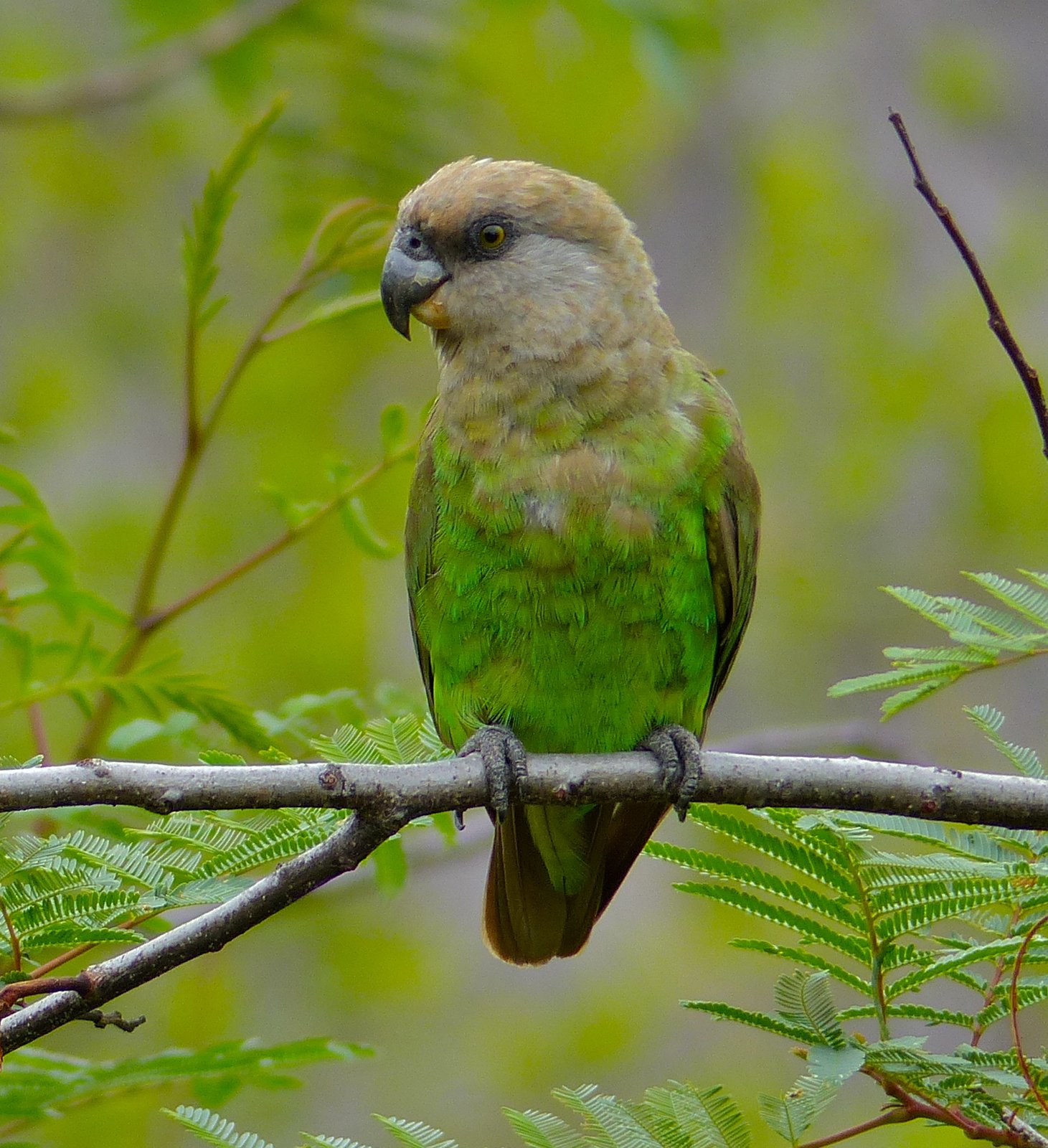
The Brown-Headed Parrot is a small green parrot with a brownish-grey head, a bird of the warm lowveld of eastern southern Africa. It draws attention mainly through its high calls and the bright yellow underwing when a pair flies fast over the woodland.
Voice
A high, piercing skweek-skweek and a hard chee-chee-chee, mainly in flight; softer twittering and whistled notes when perched. The call is sharper and higher than that of Meyer's Parrot.
Recording: Bobby Wilcox — CC BY-NC-SA 4.0 · converted to mono · xeno-canto
Identification
About 23 cm, with a short tail and a large head. The head and neck are brownish grey, the rest of the body grass-green, yellower on the belly and rump; the mantle and wing coverts are somewhat darker olive-green. The underwing coverts are bright yellow, a feature visible only in flight or when a bird stretches; there is no yellow at the bend of the wing. The upper mandible is pale blue-grey, the lower mandible paler; the iris is strikingly pale yellow. The sexes are alike; juveniles have a dark iris and a duller, greener head.
Confusion species
Meyer's Parrot (Poicephalus meyeri) is largely brown rather than green, with yellow shoulders and often a yellow crown band, a blue-green belly and an orange-red iris; it lives further west, although the two overlap locally in Zimbabwe and Mozambique. Cape Parrot (Poicephalus robustus) is much larger, with a heavy bill and red patches on the bend of the wing and the thighs, and lives in mist forest. Lilian's Lovebird is much smaller, with an orange-pink face.
Habitat
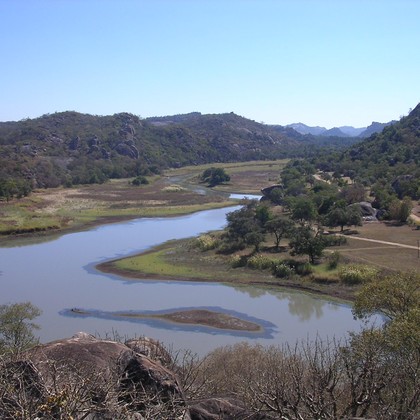
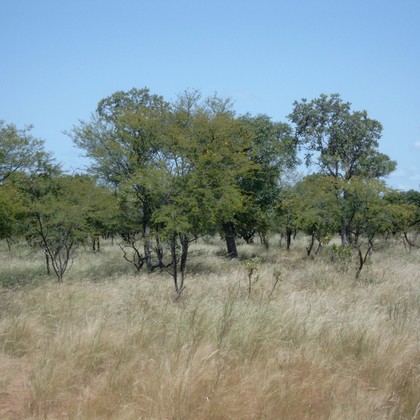
Warm, low-lying woodland and savanna: mixed woodland, acacia savanna, mopane and especially riverine forest with tall trees such as wild figs, jackalberry and ebony. It eats seeds, fruit, nuts, flowers and nectar, including those of boer-bean and coral trees. It drinks daily. It nests in tree holes, often old woodpecker or barbet holes.
Where the bird is most at home, classified by the vegetation units of southern Africa.

Range and movements
The east of the region: the lowveld of Limpopo and Mpumalanga including the Kruger National Park, the lowveld of Eswatini and north-eastern KwaZulu-Natal to Ndumo, almost all of Mozambique, south-eastern Zimbabwe along the Save and Limpopo, and southern Malawi. Beyond the region along the coast and in the interior of Tanzania to south-eastern Kenya.
- Resident
- Summer visitor (c. Oct–Mar)
- Winter visitor (c. Apr–Sep)
- Passage (Mar–Apr, Oct–Nov)
- dark = core range, pale = thinly spread
How and when to look
Common in the Kruger National Park, especially in riverine forest along the Sabie, Olifants and Luvuvhu; listen for high calls above the treetops and watch for the yellow underwings of passing pairs. Pafuri and the riverine forest around Punda Maria give good chances. Perched birds are hard to see because of their green colour; wait at fruiting trees and at drinking places.
Conservation status
Not threatened and common over most of its range. Outside protected areas old trees with nest holes are disappearing, and the species is trapped locally for the cage-bird trade. In South Africa it depends largely on the Kruger National Park and adjoining reserves.
Scientific name
Poicephalus cryptoxanthus | (Peters, 1854)
Peters described the species in 1854 as Psittacus (Poiocephalus) cryptoxanthus; because it was later moved to another genus, the author and year stand in brackets. The genus Poicephalus was introduced in 1837 by Swainson. Poicephalus comes from the Greek poikilos, 'mottled, variegated', and kephale, 'head' — for the strongly contrasting head pattern of these parrots. cryptoxanthus comes from the Greek kruptos, 'hidden', and xanthos, 'yellow' — for the yellow underwing, visible only in flight. The specimen the first description was based on came from Inhambane, Mozambique.