All species › Passerines › Batises and wattle-eyes › Brown-Throated Wattle-Eye
Brown-Throated Wattle-Eye | Platysteira cyanea
Bruinkeellelvliegenvanger | Batis Carunculado Gorgipardo
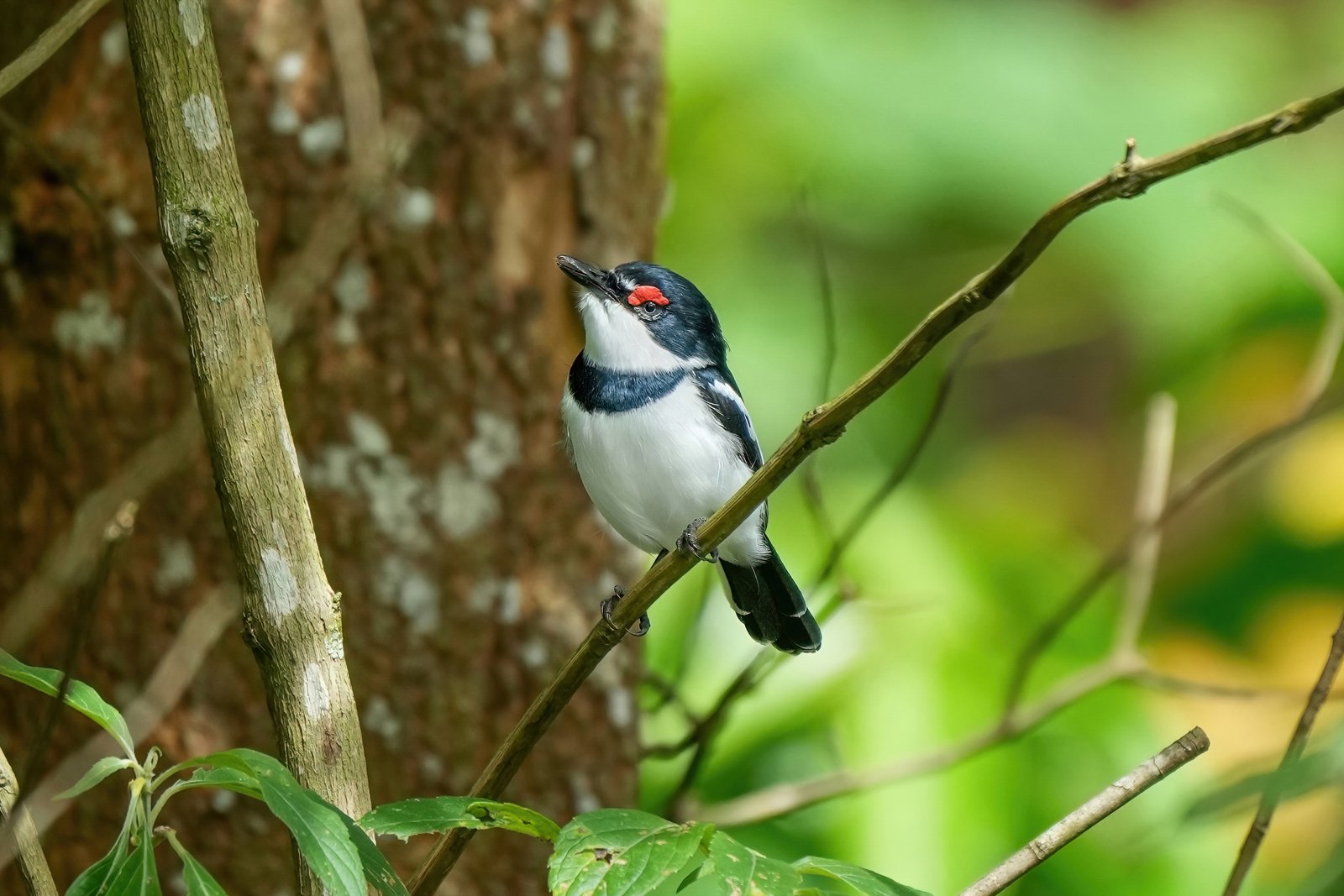
The Brown-Throated Wattle-Eye is one of the best-known forest-edge birds of West and Central Africa, but within the region it is found only in northern Angola. It is a lively black-and-white bird with a bright red wattle above the eye; the female gives the species its name with her chestnut throat.
Voice
A clear whistled series of three to six notes, descending or up and down, wee-wee-woo, often duetted by the pair, and harsh, grating chak calls when agitated. It makes a clapping wing noise in flight.
Recording: Jonathan Onongo — CC BY-NC-SA 4.0 · converted to mono · xeno-canto
Identification
13 cm. The male is glossy blue-black above, with a narrow white wing stripe, and white below with a sharply defined black breast band. The female has a greyer head and back, a dark chestnut throat and upper breast and otherwise white underparts. Both sexes have a large, bright red eye wattle. Juveniles are brownish above with a rusty wash on the breast and a small, dull wattle.
Confusion species
Black-Throated Wattle-Eye Platysteira peltata is very similar; the male has a narrower breast band and lacks the white wing stripe, and the female has a black rather than chestnut throat. White-Fronted Wattle-Eye Platysteira albifrons of western Angola has a white forehead. Batises such as Angola Batis Batis minulla are smaller, with a yellow eye and no wattle.
Habitat
Forest edges, secondary forest, gallery forest along rivers, wooded gardens and dense thickets in moist savanna. It forages in the middle and lower strata, gleaning insects from leaves and catching them in short sallies. Usually in pairs.
Where the bird is most at home, classified by the vegetation units of southern Africa.

Range and movements
Within the region only in northern Angola, mainly in Cabinda and the north-western provinces, with scattered localities further east; not recorded in Zambia. Elsewhere widespread from Senegal east to South Sudan, Ethiopia and western Kenya.
How and when to look
Year-round. Search forest edges and wooded village gardens in Cabinda or northern Angola. The whistled duet is often the first sign; at close range the red eye wattle is unmistakable.
Conservation status
Not globally threatened; common in most of its range and tolerant of forest disturbance. Within the region it is limited to a small border area and is therefore seldom seen here.
Scientific name
Platysteira cyanea | (Müller, 1776)
Müller described the species in 1776 as Muscicapa cyanea; because it was later moved to another genus, the author and year stand in brackets. The genus Platysteira was introduced in 1830 by Jardine & Selby. Platysteira comes from the Greek platus, 'broad', and steira, 'ship's keel' — for the broad, flattened bill. cyanea comes from the Greek kuaneos, 'dark blue', for the blue-black sheen on the upperparts. The specimen the first description was based on came from Senegal.