All species › Passerines › Batises and wattle-eyes › White-Tailed Shrike
White-Tailed Shrike | Lanioturdus torquatus
Tapuitklauwier | Laniotordo
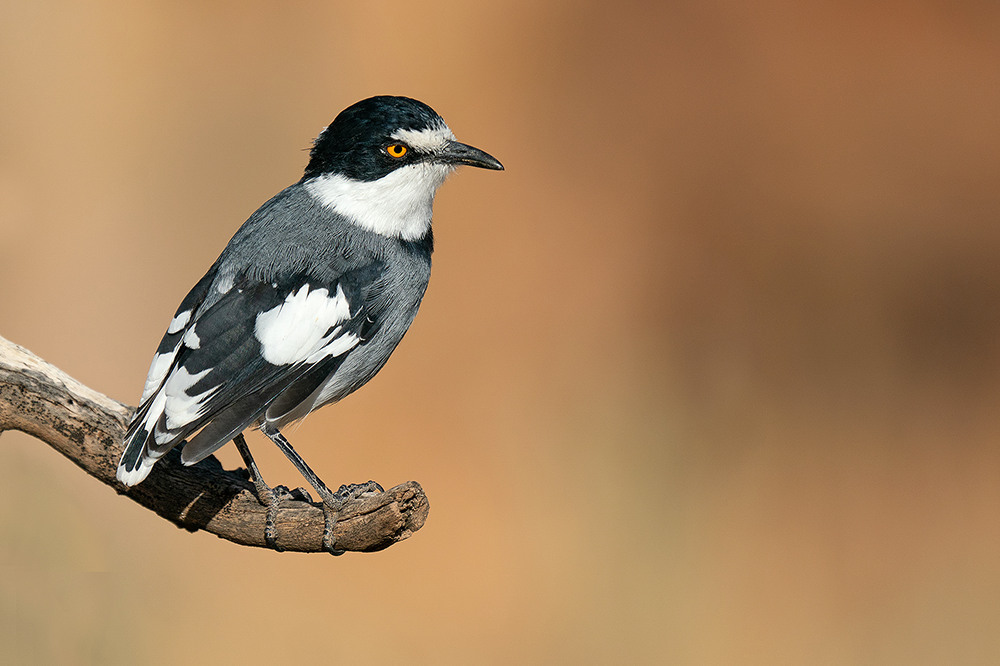
The White-Tailed Shrike is one of the most characteristic birds of arid north-western Namibia: an upright, long-legged black, white and grey bird with a tiny white tail that hops over the ground like a thrush. It is almost endemic to Namibia and south-western Angola and forms a genus of its own among the wattle-eyes and batises of the family Platysteiridae.
Voice
Loud and conspicuous: clear, penetrating whistles, kwoo-kwoo or pew-weeh, often by several birds at once, mixed with clicking and grating notes. Groups keep in constant contact with soft calls.
Recording: Arnon Dattner — CC BY-NC-SA 4.0 · converted to mono · xeno-canto
Identification
15 cm. Crown, face and nape are black, with a white supercilium and white at the base of the bill. The back is pale grey, the wings black with a broad white wing stripe. The underparts are white with a broad black breast band. The tail is very short, white with a black base, and shows well in flight. The legs are long and bluish-grey, the eye pale and the bill short and black. The sexes are alike. Juveniles are browner on the head and back, with a faint breast band.
Confusion species
Rarely confused, given its shape and short white tail. Southern Fiscal Lanius collaris is larger, lacks the breast band and has a long black tail. Pririt Batis Batis pririt has a similar pattern but is much smaller, keeps to bushes and has a longer black tail. Brubru Nilaus afer has rufous flanks and forages in tree canopies.
Habitat
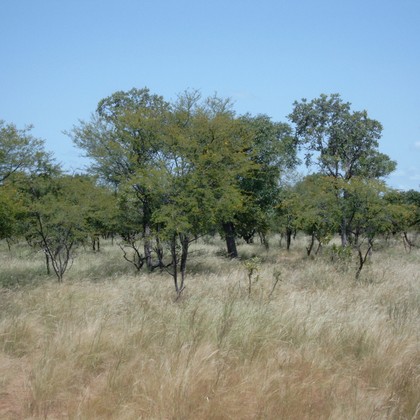
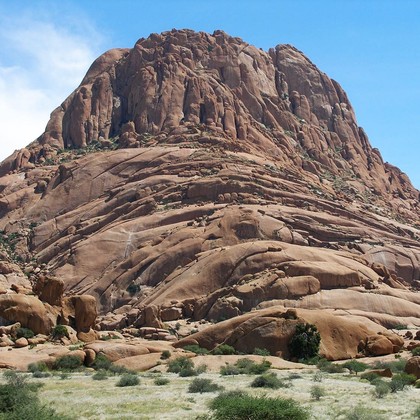
Dry savanna and scrub on hills and plains, especially mopane and acacia woodland with open, stony ground, to the edge of the Namib and into the rocky hills of the escarpment. It forages in groups of three to six on the ground and in low bushes, running and hopping quickly between the stems in search of insects, and often joins mixed flocks.
Where the bird is most at home, classified by the vegetation units of southern Africa.

Range and movements
Within the region confined to central and north-western Namibia, from the Khomas Highlands and Erongo north through Damaraland and the Kaokoveld to the Kunene, and to south-western Angola in Namibe, Huíla and Benguela. It does not occur outside these two countries.
- Resident
- Winter visitor (c. Apr–Sep)
- Passage (Mar–Apr, Oct–Nov)
- dark = core range, pale = thinly spread
How and when to look
Year-round; a target species on any trip to Namibia. The Etosha area (especially the western camps and Hobatere), the Erongo Mountains and the Waterberg are good sites. Listen for the clear whistles and then look low among the bushes; the short white tail and thrush-like stance give the bird away at once.
Conservation status
Not threatened. Common within its rather small range, which consists largely of extensively grazed land with little settlement. No major threats are known, although overgrazing can degrade the shrub layer locally.
Scientific name
Lanioturdus torquatus | Waterhouse, 1838
Waterhouse described the species in 1838 and placed it straight away in the genus where it still stands. He introduced the genus Lanioturdus in that same work. Lanioturdus combines the genus names Lanius, 'shrike', and Turdus, 'thrush' — for this stocky little bird that seems to have something of both. torquatus is Latin for 'collared', for the black band across the breast. The specimen the first description was based on came from inland from Walvis Bay, Namibia.