All species › Passerines › Batises and wattle-eyes › Chestnut Wattle-Eye
Chestnut Wattle-Eye | Dyaphorophyia castanea
Witstuitlelvliegenvanger | Batis Carunculado Castaño
The Chestnut Wattle-Eye is a small, compact wattle-eye with an almost absent tail, a bird of the Central African rainforest that reaches the region only in northern Angola and the far north-west of Zambia. Male and female differ strikingly; both have a purple eye wattle.

Voice
A series of hard, dry clicks and chak calls, often in quick rhythm, and loud clapping and whirring wing noises in flight. Also soft whistles and a croaking kwek-kwek.
No recording with a suitable Creative Commons licence is available for this species yet.
Identification
10 cm, round and very short-tailed. The male has a glossy black head, a grey to blackish back, a white rump and white underparts with a broad black breast band. The female has a grey head, a warm chestnut back, throat and breast, a white belly and likewise a white rump. Both sexes have a purple fleshy wattle above the eye. Juveniles resemble the female but are duller and more rusty.
Confusion species
Yellow-Bellied Wattle-Eye Platysteira concreta is green above and yellow below. Brown-Throated Wattle-Eye Platysteira cyanea and Black-Throated Wattle-Eye Platysteira peltata are slimmer, with a longer tail, a white wing stripe and a red eye wattle. Batises such as Angola Batis Batis minulla have a yellow or orange eye without a wattle.
Habitat
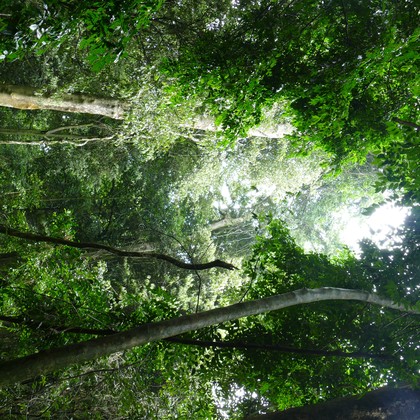
Moist lowland forest and gallery forest, especially the middle strata and the understorey at forest edges, clearings and along streams. It forages actively among leaves and twigs for insects, often in mixed flocks.
Where the bird is most at home, classified by the vegetation units of southern Africa.

Range and movements
Within the region only in northern Angola, from Cabinda and Uíge east to the Lunda provinces, and in the far north-west of Zambia around Mwinilunga. Elsewhere widespread in the rainforest of West and Central Africa, from Sierra Leone to Uganda and western Kenya.
- Resident
- dark = core range, pale = thinly spread
How and when to look
Year-round. In Zambia the gallery forests near Mwinilunga and the source of the Zambezi offer the best chance. Listen for the clicking calls and wing-clapping in the mid-strata; the bird is busy and restless and often shows well briefly within a mixed flock.
Conservation status
Not globally threatened and common in the central rainforest. Within the region it is scarce and tied to small, fragmented forest patches under pressure from logging and cultivation.
Scientific name
Dyaphorophyia castanea | (Fraser, 1843)
Fraser described the species in 1843 as Platysteira castanea; because it was later moved to another genus, the author and year stand in brackets. The genus Dyaphorophyia was introduced in 1854 by Bonaparte. Dyaphorophyia is formed from the Greek diaphoros, 'different', and phuō, 'to produce' — probably because these wattle-eyes differ from related species. castanea is Latin for 'chestnut', for the female's chestnut plumage. The specimen the first description was based on came from Malabo, Bioko (Equatorial Guinea).