All species › Passerines › Batises and wattle-eyes › Angola Batis
Angola Batis | Batis minulla
Angolese vliegenvanger | Batis Angoleño
Angola Batis is a small batis of north-western Angola and the lower Congo basin. In the region it is confined to Angola, where it is locally common in gallery forest and dense thicket on the coastal plain and at the foot of the escarpment.

Voice
A series of high, squeaky notes, zee-zee-zee-zee-zee, which has been likened to a squeaky bicycle pump. Also dry chirps and wing-fripping.
Recording: Ken Behrens — CC BY-NC-SA 4.0 · converted to mono · xeno-canto
Identification
10 cm. The male has a blue-grey forehead and crown, a small white spot on the lores, a glossy black mask, a grey back, a white wing stripe and white underparts with a black breast band. The female is similar but has a chestnut breast band. The eye is yellow. Small, compact and short-tailed; it lives singly or in pairs.
Confusion species
Chinspot Batis Batis molitor is larger, with a distinct white eyebrow instead of a loral spot and, in the female, a chestnut chin spot. Margaret's Batis Batis margaritae of high-altitude forest and miombo inland is larger and longer-tailed, with a dark grey crown and back. Western Black-Headed Batis Batis erlangeri has a black crown. Pririt Batis Batis pririt of the arid south-west has spotted flanks in the male.
Habitat
Secondary and gallery forest, dense woodland dominated by Croton and adjacent thicket, locally also dry woodland and shady coffee plantations. It takes insects in short sallies from the middle stratum.
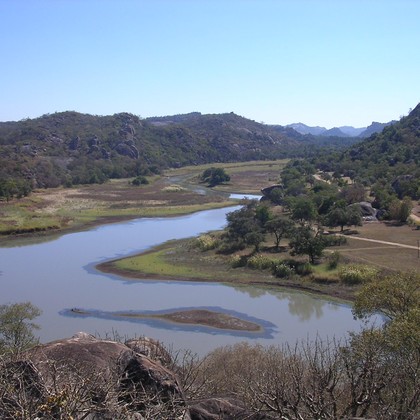
Where the bird is most at home, classified by the vegetation units of southern Africa.

Range and movements
In the region only in north-western and western Angola: from the lower Congo south through the coastal plain and the foot of the escarpment, at least to Quiçama National Park south of Luanda. Beyond the region in western DR Congo; its occurrence in south-eastern Gabon is unconfirmed.
- Resident
- dark = core range, pale = thinly spread
How and when to look
Year-round. Quiçama National Park, a few hours' drive from Luanda, is the most visited site, and the species is seen regularly on birding tours of Angola. Listen for the squeaky ‘bicycle pump’ series in dense thicket and gallery forest.
Conservation status
Not threatened; locally common within its small range. Forest and thicket around Luanda and along the escarpment are under pressure from charcoal production and cultivation.
Scientific name
Batis minulla | (Bocage, 1874)
Bocage described the species in 1874 as Platystira minulla; because it was later moved to another genus, the author and year stand in brackets. The genus Batis was introduced in 1833 by Boie. Batis is a Greek word for an unidentified worm-eating bird mentioned by Aristotle; Boie applied the name to these small African flycatchers in 1833. minulla is a Latin diminutive of minor, 'very small', for its tiny size. The specimen the first description was based on came from Bibala, Namibe Province, Angola.