All species › Passerines › Batises and wattle-eyes › Pririt Batis
Pririt Batis | Batis pririt
Priritvliegenvanger | Batis Pririt
Pririt Batis is the batis of the arid west: the thornveld of the Kalahari, the Karoo and Namibia. There it replaces Chinspot Batis, and the female in particular, with her evenly cinnamon throat and breast, is easy to recognise. The species is endemic to southern Africa.

Voice
A long, slowly descending series of dozens of whistles, chee-chee-choo-choo-choo…, going on far longer than the three-note whistle of Chinspot Batis. Also a rattling pri-rit, which gave the species its name, and grating chrr calls.
Recording: Lynette Rudman — CC BY-NC-SA 4.0 · converted to mono · xeno-canto
Identification
11–12 cm. The male has a grey crown and back, a white eyebrow, a black mask, a white wing stripe and a black breast band on white underparts; the flanks are spotted or streaked black. The female lacks a defined chin spot: throat and breast are evenly pale cinnamon to buff, grading into white on the belly. The eye is yellow. The tail is black with white edges.
Confusion species
Chinspot Batis Batis molitor has white, unspotted flanks, and the female has a sharply defined chestnut chin spot and breast band. Where the two meet, in eastern Botswana and north-western South Africa, hybrids occur. Angola Batis Batis minulla of north-western Angola is smaller, without spotted flanks, and lives in forest and dense thicket.
Habitat
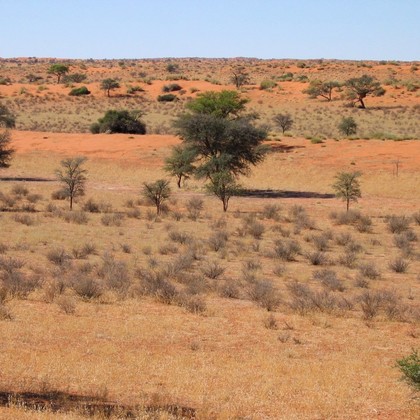
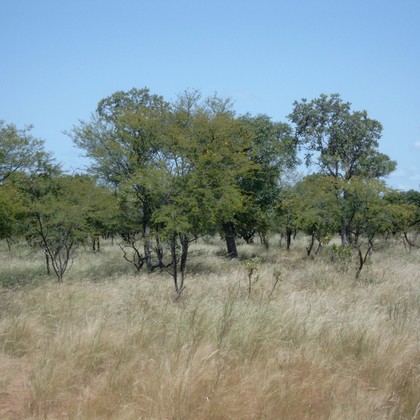
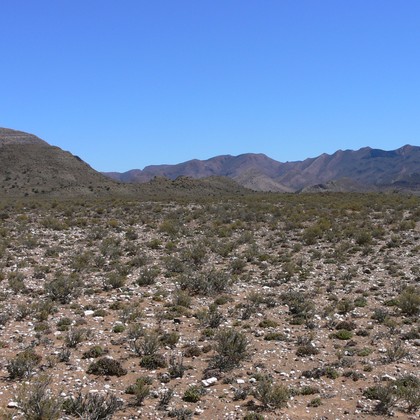
Dry acacia savanna and thornveld, scrub along dry riverbeds in the Karoo and Kalahari, and wooded edges of the Namib; often in camel thorn and other acacias. It searches for insects in canopies and bushes and hunts in short sallies.
Where the bird is most at home, classified by the vegetation units of southern Africa.
Range and movements
In south-western Angola, almost all of Namibia except the barren Namib, western and southern Botswana and western South Africa: the Northern Cape, western North West and the Free State, and the Karoo into the north of the Western and Eastern Cape. It does not occur outside southern Africa.
- Resident
- Summer visitor (c. Oct–Mar)
- Winter visitor (c. Apr–Sep)
- Passage (Mar–Apr, Oct–Nov)
- dark = core range, pale = thinly spread
How and when to look
Year-round. The trees in and around the camps and picnic sites of Kgalagadi Transfrontier Park, Augrabies and Etosha are reliable. Follow the long whistled series; the bird often sits low in a thorn bush and allows close views.
Conservation status
Not threatened; common in suitable thornveld. Locally it benefits from bush encroachment in the savanna; no significant threats are known.
Scientific name
Batis pririt | (Vieillot, 1818)
Vieillot described the species in 1818 as Muscicapa pririt; because it was later moved to another genus, the author and year stand in brackets. The genus Batis was introduced in 1833 by Boie. Batis is a Greek word for an unidentified worm-eating bird mentioned by Aristotle; Boie applied the name to these small African flycatchers in 1833. pririt is onomatopoeic, from Levaillant's name 'Le Pririt', for the bird's call. The specimen the first description was based on came from Somerset East, Eastern Cape, South Africa.