All species › Passerines › Waxbills › Brown Twinspot
Brown Twinspot | Clytospiza monteiri
Bruine druppelastrild | Estrilda Parda
The Brown Twinspot is a warm brown waxbill with a grey head and underparts full of white spots. Within the region it is a bird of the well-wooded north of Angola, at the southern edge of a range that reaches into West Africa.

Voice
A sharp, high tseet and a soft chirping as contact calls. The song is a varied series of high whistles, trills and buzzing notes.
Recording: Bram Piot — CC BY-NC-SA 4.0 · converted to mono · xeno-canto
Identification
12–13 cm, with a blackish bill. Head and nape are grey, back and wings plain dark brown, rump and uppertail coverts crimson; the tail is black. The whole underparts are warm rufous-brown and densely spotted with white. The male has a small red spot in the centre of the throat, the female a white one: the only difference between the sexes. Juveniles are plain brown without spots and with a greyer head. It forages in pairs or small groups on the ground at the edge of thickets and in tall grass.
Confusion species
Brown Firefinch (Lagonosticta nitidula) is smaller and brown with fine white speckling on the breast, but has a red face and throat instead of a grey head and a brown rather than crimson rump. African Firefinch (Lagonosticta rubricata) is redder below, without spots on the belly, and has a blue-grey bill. Dusky Twinspot (Euschistospiza cinereovinacea) is much darker, spotted only on the flanks, and lives in the highlands.
Habitat
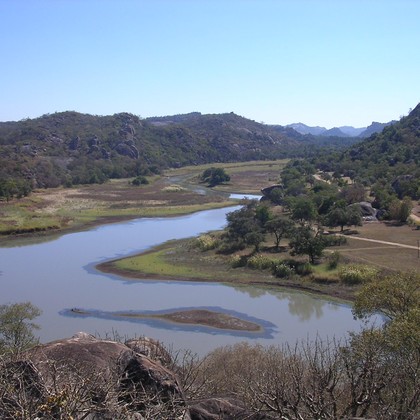
Gallery forest edges, the forest-savanna mosaic, thickets and tall grass along forest edges, abandoned fields and rank growth near villages. It forages on the ground for grass seeds and small insects, usually close to cover.
Where the bird is most at home, classified by the vegetation units of southern Africa.

Range and movements
Within the region only in northern Angola: Cabinda, Uíge, Cuanza Norte, Malanje, Lunda Norte and northern Cuanza Sul. Beyond the region from Nigeria and Cameroon east through the Central African Republic, DR Congo and South Sudan to Uganda and western Kenya.
How and when to look
In Angola the species is little recorded; most reports come from Uíge and from the escarpment forest edges of Cuanza Sul and Malanje. Walk road verges and tracks with tall grass at the edge of gallery forest and watch for small, dark birds that dart into the bushes with a flash of red rump.
Conservation status
Not threatened and locally common across its large range. Little is known about the Angolan population.
Scientific name
Clytospiza monteiri | (Hartlaub, 1860)
Hartlaub described the species in 1860 as Pytelia monteiri; because it was later moved to another genus, the author and year stand in brackets. The genus Clytospiza was introduced in 1896 by Shelley. Clytospiza comes from the Greek klutos, 'splendid, famous', and spiza, 'finch' — 'splendid finch', for the fine white spots on the dark plumage. monteiri honours the Portuguese mining engineer and naturalist Joaquim João Monteiro (1833–1878), who collected birds in Angola. The specimen the first description was based on came from Bembe, north-western Angola.