All species › Passerines › Starlings › Burchell's Starling
Burchell's Starling | Lamprotornis australis
Grote glansspreeuw | Estornino de Burchell
Burchell's Starling is the largest glossy starling of southern Africa: a heavy, long-tailed bird with long legs and a dark eye that forages mostly on the ground. It is virtually confined to the region and is a characteristic bird of the savannas of Kruger, the Kalahari and Botswana.

Voice
A low, guttural, rasping chatter, churr-churr-cherr-chork, often in duet or in groups; at dawn a noisy chorus of gurgling notes and whistles. The wings make an audible swish in flight.
Recording: African Bioacoustics Community — CC BY-NC-SA 4.0 · converted to mono · xeno-canto
Identification
30–34 cm, with a long, rounded and graduated tail, broad, rounded wings and long black legs. The plumage is dark glossy blue-green, with a purplish gloss on the breast and belly and darker, duller ear-coverts; small dark spots mark the wing-coverts. The eye is dark brown, the bill black. The sexes are alike; juveniles are duller, with less gloss. It flies on slow, heavy wingbeats that show off the broad wings and long tail.
Confusion species
Meves's Starling Lamprotornis mevesii also has a dark eye, but is smaller and slimmer, with a longer, tapering tail; it lives mainly in mopane and along the northern rivers. Greater Blue-Eared Starling Lamprotornis chalybaeus and Cape Starling Lamprotornis nitens are smaller, with a short tail and a yellow eye; Lesser Blue-Eared Starling Lamprotornis chloropterus also has a yellow eye and lives mainly in miombo. In Burchell's Starling, look for the combination of large size, long rounded tail, dark eye and lumbering flight.
Habitat
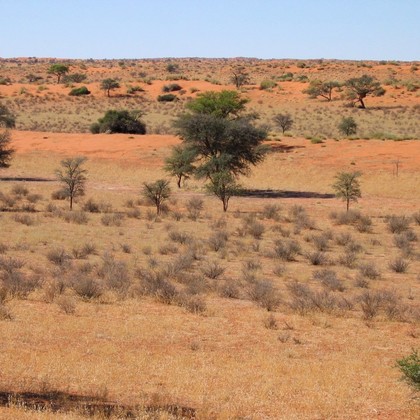
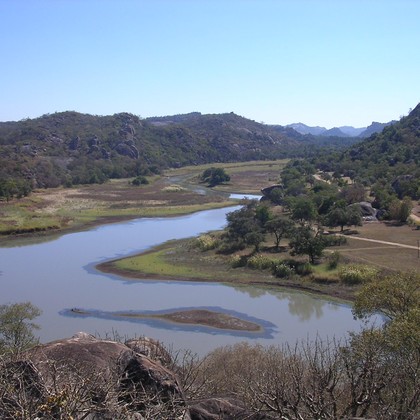
Dry, open savanna and woodland with tall trees, especially Kalahari thornveld, mopane, mixed woodland and open acacia savanna with a short sward, also around camps and lodges. It walks the ground with long strides in search of insects, especially termites and beetles, and eats fruit. It nests in tree holes, sometimes in poles.
Where the bird is most at home, classified by the vegetation units of southern Africa.

Range and movements
Virtually confined to the region: southern Angola, northern and eastern Namibia, most of Botswana, south-western Zambia, western and southern Zimbabwe, southern Mozambique (Limpopo valley) and in South Africa Limpopo Province, the Mpumalanga lowveld, North West and the northern Northern Cape. It does not occur outside the region.
- Resident
- Summer visitor (c. Oct–Mar)
- Winter visitor (c. Apr–Sep)
- dark = core range, pale = thinly spread
How and when to look
Year-round. In Kruger and the Kgalagadi it is one of the most frequently seen birds around camps and picnic sites; in Botswana it is common in Chobe, Moremi and the Central Kalahari. Its size and long tail make it stand out at once among other glossy starlings; in the north, where Meves's Starling occurs, check tail shape and proportions.
Conservation status
Not threatened, common and stable. It benefits from water points and camps in protected areas, but depends on old trees with cavities for breeding.
Scientific name
Lamprotornis australis | (Smith, 1836)
Smith described the species in 1836 as Megalopterus australis; because it was later moved to another genus, the author and year stand in brackets. The genus Lamprotornis was introduced in 1820 by Temminck. Lamprotornis comes from the Greek lampros, 'shining, brilliant', and ornis, 'bird' — for the metallic, iridescent plumage of the glossy starlings. australis is Latin for 'southern' — this glossy starling lives in southern Africa. The specimen the first description was based on came from country north of Kurrichane (near Zeerust), South Africa.