All species › Passerines › Starlings › Meves's Starling
Meves's Starling | Lamprotornis mevesii
Meves' glansspreeuw | Estornino de Meves
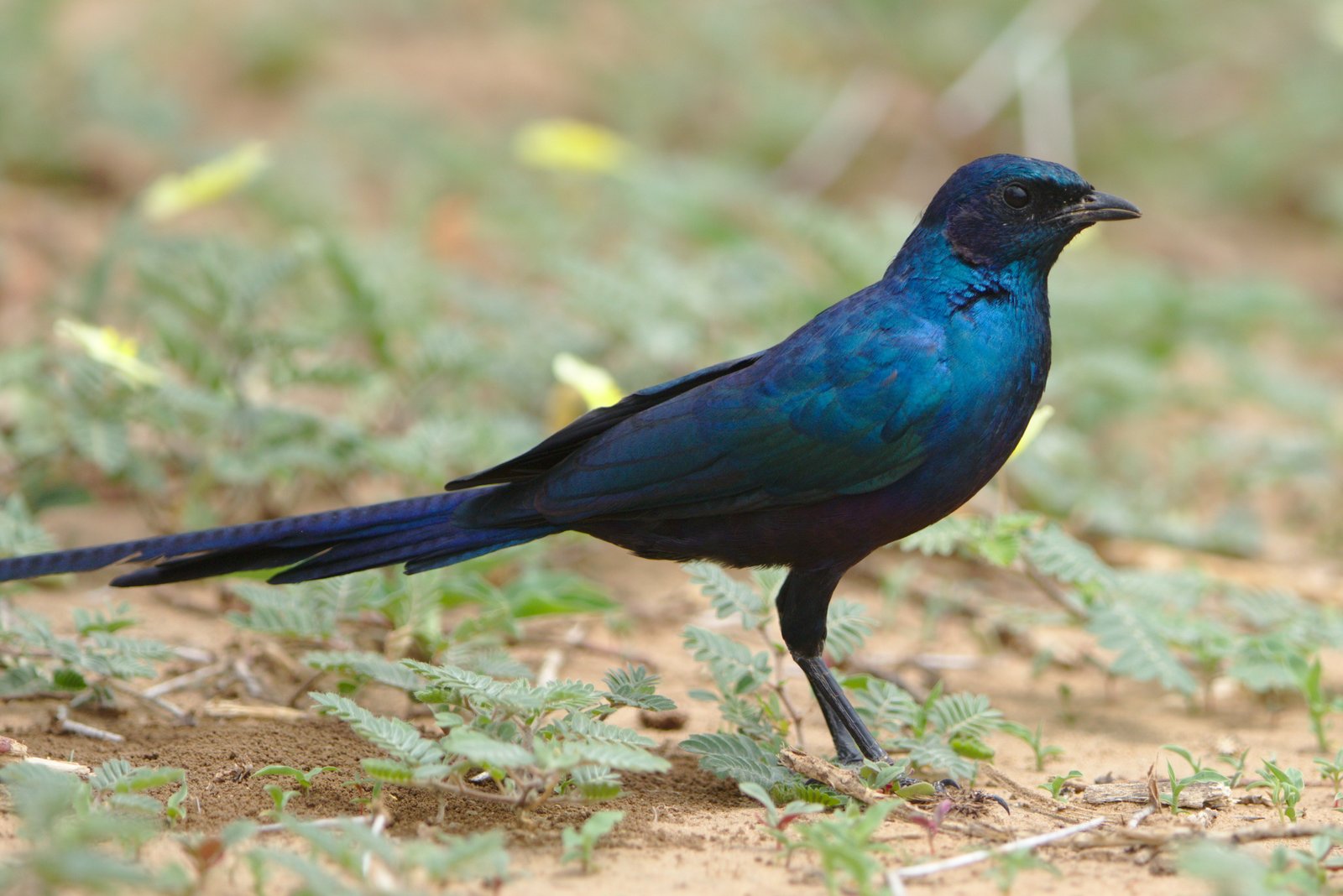
Meves's Starling is a slender dark glossy starling with a very long graduated tail that makes up more than half of its length. It is a characteristic bird of mopane woodland and the tall riverine forests along the large rivers of the north of the region, and almost endemic to southern Africa.
Voice
Less musical than the smaller glossy starlings. A hoarse nasal keeerrr, a rattling chatter churr-churr and, while foraging, a soft continuous chattering. Flocks call a great deal, especially on take-off and at the roost.
Recording: Ehren Eksteen — CC BY-NC-SA 4.0 · converted to mono · xeno-canto
Identification
30–35 cm, more than half of it tail. The plumage is dark violet-blue with a green and bronzy sheen on the mantle and wings; the head is duller and darker, almost blackish. The long tail is strongly graduated and tapers narrowly, with a purple gloss and faint dark cross-barring in good light. The eye is dark brown; bill and legs are black. The sexes are alike; juveniles are duller, with less gloss and a shorter tail. The silhouette is slimmer than that of other glossy starlings, with relatively short wings and a slightly undulating flight in which the tail trails behind.
Confusion species
Burchell's Starling Lamprotornis australis is larger and heavier, with a broader, less graduated tail and longer legs; it stands upright and walks with long strides. It also has a dark eye and overlaps with Meves's Starling in Kruger, Botswana and Namibia; there, look for the narrow, pointed tail and slimmer body of Meves's, and for its strong tie to mopane and river valleys. Greater Blue-Eared Starling Lamprotornis chalybaeus and Cape Starling Lamprotornis nitens are short-tailed and have a yellow-orange eye.
Habitat
Mopane woodland, especially where tall mopane trees stand, and tall riverine forest with Ana Tree, wild figs and similar trees along the large rivers; also open mixed woodland on alluvial soils. It forages mainly on the ground, walking with the tail raised, for insects, termites and fruit. It nests in tree holes and outside the breeding season lives in flocks, sometimes with other glossy starlings.
Where the bird is most at home, classified by the vegetation units of southern Africa.


Range and movements
In the north of the region: southern and south-western Angola, north-western Namibia along the Kunene and in the Kaokoveld, and the north-east through Kavango and the Zambezi Region; northern Botswana (Okavango, Linyanti, Chobe and the Makgadikgadi fringe); southern Zambia in the Zambezi and Luangwa valleys; Zimbabwe in the Zambezi Valley, Hwange and the Save and Limpopo lowveld; northern South Africa in the Limpopo Valley and northern Kruger; Mozambique in the Zambezi, Save and Limpopo valleys, and southern Malawi in the Shire Valley. It does not occur outside the region.
- Resident
- Winter visitor (c. Apr–Sep)
- Passage (Mar–Apr, Oct–Nov)
- dark = core range, pale = thinly spread
How and when to look
All year; look for flocks in tall mopane or riverine forest in northern Kruger (Pafuri), at Mapungubwe, in Gonarezhou, Hwange and along the Chobe. On the ground the long narrow tail is obvious at once; in the air the trailing tail and hoarse calls give the bird away.
Conservation status
Not threatened; locally common in mopane and riverine forest. Felling of tall mopane and riverine trees for firewood and cultivation reduces its habitat, but the species is well represented in protected areas.
Scientific name
Lamprotornis mevesii | (Wahlberg, 1856)
Wahlberg described the species in 1856 as Juida Mevesii; because it was later moved to another genus, the author and year stand in brackets. The genus Lamprotornis was introduced in 1820 by Temminck. Lamprotornis comes from the Greek lampros, 'shining, brilliant', and ornis, 'bird' — for the metallic, iridescent plumage of the glossy starlings. mevesii honours the German ornithologist Friedrich Wilhelm Meves (1814–1891), who worked at the natural history museum in Stockholm. The specimen the first description was based on came from Okavango River, Botswana.