All species › Passerines › Cisticolas › Burnt-Necked Eremomela
Burnt-Necked Eremomela | Eremomela usticollis
Roesthalseremomela | Eremomela Cuellirrufa
The Burnt-Necked Eremomela is an inconspicuous grey-brown warbler of acacia savanna, with a pale iris and a warm buff tone below. The feature that gives it its name, a small rufous-brown spot or bar on the throat, is often hard to see. It lives in small parties that move together through the crowns of thorn trees.

Voice
A high, clear, rapid tee-tee-tee-tee or chee-chee-chee, often given by several party members at once, and soft, thin contact calls, tsi-tsi. The song is a short whistled series with a slightly falling pitch.
Recording: Gabriel A. Jamie — CC BY-NC-SA 4.0 · converted to mono · xeno-canto
Identification
About 12 cm. The upperparts are plain grey-brown, crown and nape slightly greyer, wings and tail darker brown. A narrow pale supercilium is sometimes visible. The throat is off-white with a small rufous-brown spot or narrow bar at the lower centre, which varies strongly between birds and is absent in juveniles. Breast, flanks and undertail coverts are pale buff to cinnamon, the belly paler. The iris is strikingly pale, straw to pale yellow; the bill is fine and dark, the legs pale brown. The sexes are alike. It forages quietly on the outside of the tree crown.
Confusion species
Yellow-Bellied Eremomela Eremomela icteropygialis often shares the same savanna, but is greyer, with a dark eye, a dark eye-stripe and a lemon-yellow lower belly. Long-Billed Crombec Sylvietta rufescens is almost tailless, has a longer, curved bill and forages along branches and trunks. Green-Capped Eremomela Eremomela scotops is green and yellow, and Karoo Eremomela Eremomela gregalis lives further south-west in the Karoo and has a greenish-grey back and yellow undertail coverts. The pale eye combined with buff underparts is the best field mark of Burnt-Necked Eremomela.
Habitat
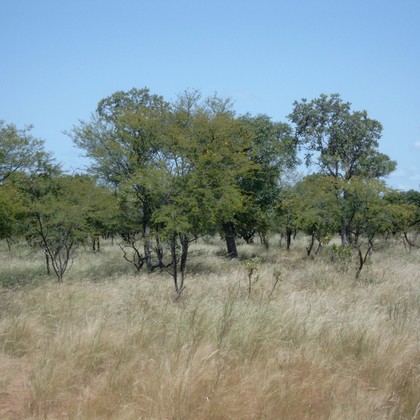
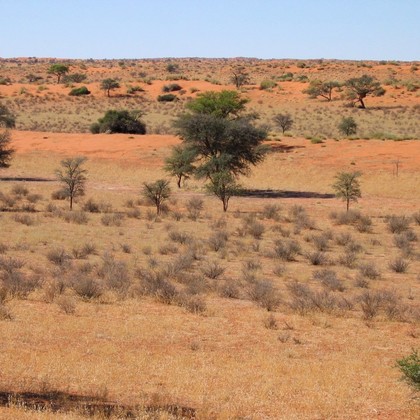
Dry acacia savanna and thornveld, mixed woodland with many acacias, Kalahari thornveld and the edges of mopane woodland; also thorn trees along dry watercourses. It searches acacia crowns for small insects, larvae and spiders, usually in parties of three to six birds that stay close together and sometimes join other species.
Where the bird is most at home, classified by the vegetation units of southern Africa.
Range and movements
Within the region in northern and central Namibia, almost all of Botswana except the far south-west, northern South Africa (Limpopo, North West, Gauteng and the Mpumalanga lowveld, south to northern KwaZulu-Natal), Eswatini, Zimbabwe, southern Mozambique, southern Zambia and southern Angola. Almost confined to southern Africa; beyond it only a few outliers in southern Malawi.
- Resident
- Summer visitor (c. Oct–Mar)
- Winter visitor (c. Apr–Sep)
- Passage (Mar–Apr, Oct–Nov)
- dark = core range, pale = thinly spread
How and when to look
Year-round; best early in the morning in acacia savanna, for example in Kruger, Pilanesberg, Etosha or the thornveld of eastern Botswana. Listen for the high, rapid tee-tee-tee from an acacia crown and wait for the party to come to the edge; then check the eye and the buff breast. The rufous throat spot is only visible close up and from the front.
Conservation status
Not threatened. Fairly common but unobtrusive, and probably often overlooked. Wood-cutting and overgrazing can alter the savanna locally, but the species occurs over a large area and shows no sign of decline.
Scientific name
Eremomela usticollis | Sundevall, 1850
Sundevall described the species in 1850 and placed it straight away in the genus where it still stands. He introduced the genus Eremomela in that same work. Eremomela comes from the Greek erēmos, 'desert', and melos, 'song' — 'desert songster', for the arid regions where the first species were found. usticollis comes from the Latin ustus, 'burnt', and collum, 'neck' — for the rusty-brown throat band. The specimen the first description was based on came from Leroma, former Transvaal, South Africa.