All species › Passerines › Cisticolas › Cinnamon-Breasted Warbler
Cinnamon-Breasted Warbler | Euryptila subcinnamomea
Kopjeszanger | Camaróptera Canela
The Cinnamon-Breasted Warbler is a dark, wren-like warbler of rocky slopes and koppies in the dry western half of southern Africa, with a cinnamon breast band and rump and a black tail often held upright over the back. It forms a genus of its own and is endemic to Namibia and South Africa. Its secretive life among the boulders means it is often overlooked.
Voice
The song is a high, plaintive, whistled pee-ee-ee-ee or tweeee-tweeee, often descending and sung from a boulder; it carries far across the slopes and can recall a sunbird. The alarm is a dry rattling chrrr. Pairs sometimes sing in turn.
Recording: Faansie Peacock — CC BY-NC-SA 4.0 · shortened to the first 60 s, mono · xeno-canto
Identification
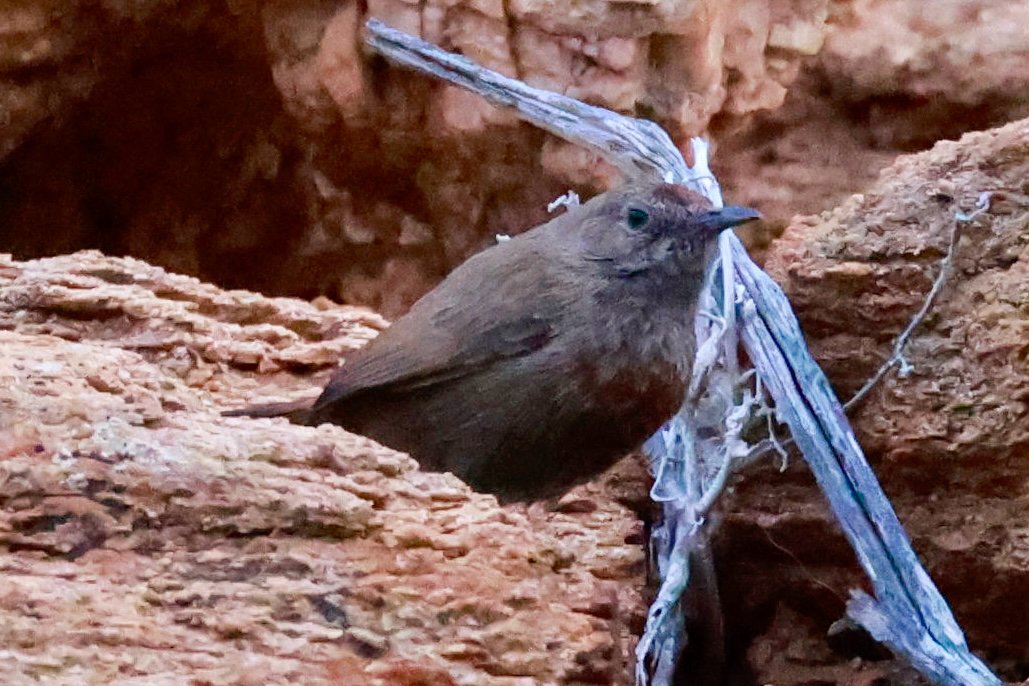
13–14 cm. Head and upperparts are dark grey-brown, the forehead and brow finely speckled white. The throat is white with fine dark streaks. A broad cinnamon band crosses the breast, merging into greyish underparts with cinnamon flanks; rump and uppertail coverts are also cinnamon. The tail is black, rather short and broad, and is often held steeply upright or even over the back. The iris is pale brown, the bill fine and black, the legs dark. The sexes are alike; juveniles are duller, with less cinnamon on the breast. It hops and scrambles mouse-like among rocks and shrubs.
Confusion species
Namaqua Warbler Phragmacia substriata lives in riverine vegetation rather than on rocks, has a long thin tail with pale tips, rufous wings and finely streaked white underparts without a cinnamon band. Rufous-Eared Warbler Malcorus pectoralis has a rufous ear patch, a narrow black breast band and lives in flat Karoo scrub. Karoo Prinia Prinia maculosa is spotted below and has a pale supercilium. Rockrunner Achaetops pycnopygius of the Namibian escarpment shares the rocky habitat and the rufous rump, but is larger, streaked, and has a white supercilium and malar stripe. The cinnamon breast band together with the upright black tail makes Cinnamon-Breasted Warbler recognisable.
Habitat
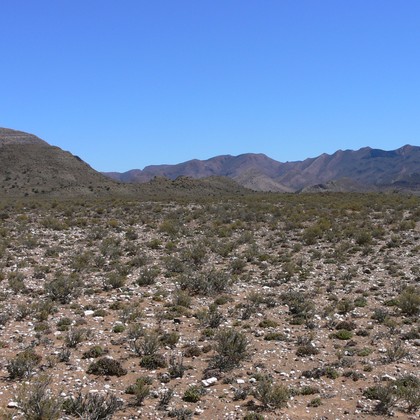
Rocky slopes, koppies, inselbergs and boulder-strewn watercourses with scattered shrubs in the Nama Karoo, the Succulent Karoo and the arid Namibian escarpment. It keeps to shady crevices and gaps between boulders, and forages on the ground and in low shrubs for small insects. Usually in pairs.
Where the bird is most at home, classified by the vegetation units of southern Africa.


Range and movements
Within the region in western South Africa and in Namibia: in South Africa from the Richtersveld and Namaqualand through Bushmanland and the Tankwa Karoo east across the Great Karoo to about the Nuweveld and Sneeuberg ranges; in Namibia in the south and along the escarpment and inselbergs of the central part, from the Huns Mountains and Naukluft north to about the Brandberg and Erongo. It occurs nowhere outside southern Africa.
- Resident
- Summer visitor (c. Oct–Mar)
- Winter visitor (c. Apr–Sep)
- Passage (Mar–Apr, Oct–Nov)
- dark = core range, pale = thinly spread
How and when to look
Year-round; good places are Karoo National Park at Beaufort West, the Tankwa Karoo, Goegap near Springbok, the Richtersveld and, in Namibia, the Naukluft. Walk a rocky slope early in the morning and listen for the high, plaintive whistle; a singing bird then often sits on a boulder, tail upright. Patience is needed, as it quickly slips away among the stones.
Conservation status
Not threatened. Widely distributed but sparse and easily overlooked in a little-disturbed habitat. No major threats are known; overgrazing of the shrub layer among the rocks may play a local role.
Scientific name
Euryptila subcinnamomea | (Smith, 1847)
Smith described the species in 1847 as Drymoica subcinnamomea; because it was later moved to another genus, the author and year stand in brackets. The genus Euryptila was introduced in 1883 by Sharpe. Euryptila comes from the Greek eurus, 'broad', and ptilon, 'feather': 'broad-feathered'. subcinnamomea is Latin for 'somewhat cinnamon-coloured', for the cinnamon breast and rump. The specimen the first description was based on came from Kamiesberg, Namaqualand.