All species › Passerines › Cisticolas › Rufous-Eared Warbler
Rufous-Eared Warbler | Malcorus pectoralis
Roodoorprinia | Prinia Carirrufa
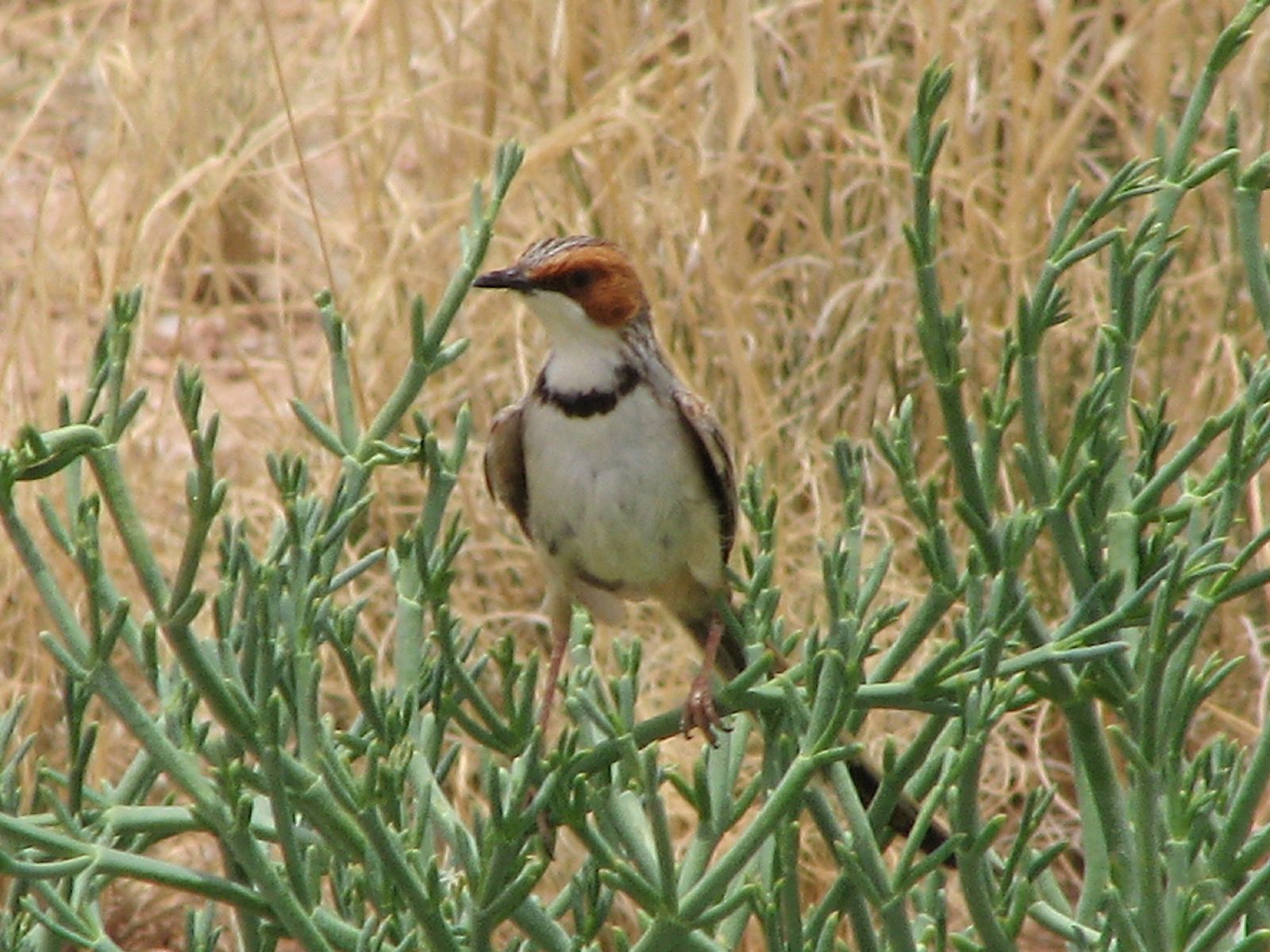
The Rufous-Eared Warbler is a slender, long-tailed warbler of low Karoo scrub, recognisable by its rufous ear patch and narrow black breast band. It runs mouse-like over the ground between the shrubs with its tail cocked and sings a penetrating, monotonous song from the top of a bush. It forms a genus of its own and is endemic to southern Africa.
Voice
The song is a loud, penetrating series of even, slightly nasal notes, tsee-tsee-tsee-tsee or zeep-zeep-zeep, from the top of a bush; pairs often sing in turn. The alarm is a high, drawn-out peeee. In the Karoo it is one of the most frequently heard bird sounds in the early morning.
Recording: Dawie de Swardt — CC BY-NC-SA 4.0 · shortened to the first 60 s, mono · xeno-canto
Identification
14–16 cm, more than half of which is tail. The upperparts are grey-brown with fine dark streaks on crown, nape and mantle. The lores and ear coverts are bright rufous, the throat white. A narrow black band crosses the upper breast, broader and sharper in the male than in the female. The rest of the underparts are greyish-white with a brownish-grey wash on the flanks. The long, narrow tail is dark with pale edges and is often held cocked. The iris is pale brown, the bill fine and dark, the legs pale brown. Juveniles are duller, with less rufous on the ear coverts and a faint or missing breast band. Outside the breeding season the breast band is weaker in both sexes.
Confusion species
Black-Chested Prinia Prinia flavicans has a much broader black breast band in breeding plumage, yellowish underparts and no rufous ear patch, and lives more in thornscrub. Karoo Prinia Prinia maculosa is spotted below and has a pale supercilium. Grey-Backed Cisticola Cisticola subruficapilla lives in the same scrub and has a streaked back, but has a rufous crown, no breast band and a shorter tail. Cinnamon-Breasted Warbler Euryptila subcinnamomea is darker, with a cinnamon breast and rump, and lives on rocks. The rufous ear patch with the narrow black breast band is decisive for Rufous-Eared Warbler.
Habitat
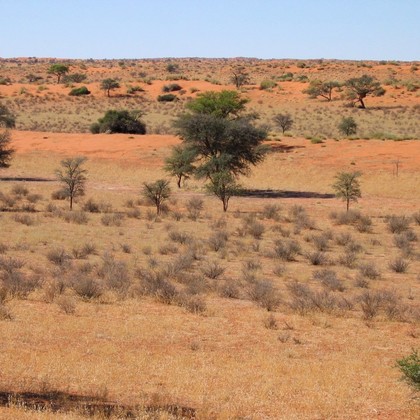
Low, open scrub of the Nama Karoo and Succulent Karoo, with scattered shrubs, grass tufts and bare ground, also transitions to dry grassland, renosterveld and the edges of Kalahari thornveld. It avoids dense thorn bush and true desert. It forages by running over the ground and low in the shrubs for small insects, in pairs or family parties.
Where the bird is most at home, classified by the vegetation units of southern Africa.


Range and movements
Within the region in the dry western half of southern Africa: in South Africa in the Northern Cape, Namaqualand, the Karoo of the Western and Eastern Cape, the western Free State and south-western North West; in Namibia in the south and centre, north to around Etosha, where the subspecies etoshae occurs; in Botswana in the south-west, in the southern Kalahari. Endemic to southern Africa.
- Resident
- Passage (Mar–Apr, Oct–Nov)
- dark = core range, pale = thinly spread
How and when to look
Year-round; common in virtually any open Karoo landscape, for example the Tankwa Karoo, around Calvinia and Brandvlei, in Karoo National Park and in Goegap near Springbok. Drive slowly along a gravel road and watch for birds running between the shrubs with the tail upright; the song of a bird on a bush top can be heard everywhere in the morning.
Conservation status
Not threatened. Common to fairly common in a large, little-changed habitat. Heavy overgrazing has damaged the shrub layer locally, but the species tolerates moderately grazed veld well.
Scientific name
Malcorus pectoralis | Smith, 1829
Smith described the species in 1829 and placed it straight away in the genus where it still stands. He introduced the genus Malcorus in that same work. Malcorus comes from the Greek malakos, 'delicate', and oura, 'tail' — for the long, strongly graduated tail of ten feathers, with the outermost pair very short. pectoralis is Latin for 'of the breast', from pectus, 'breast' — for the narrow black breast band. The specimen the first description was based on came from Karoo north of the Olifants River; later fixed as Bitterfontein, Western Cape.