All species › Passerines › Cisticolas › Roberts's Warbler
Roberts's Warbler | Oreophilais robertsi
Roberts' prinia | Prinia de Roberts
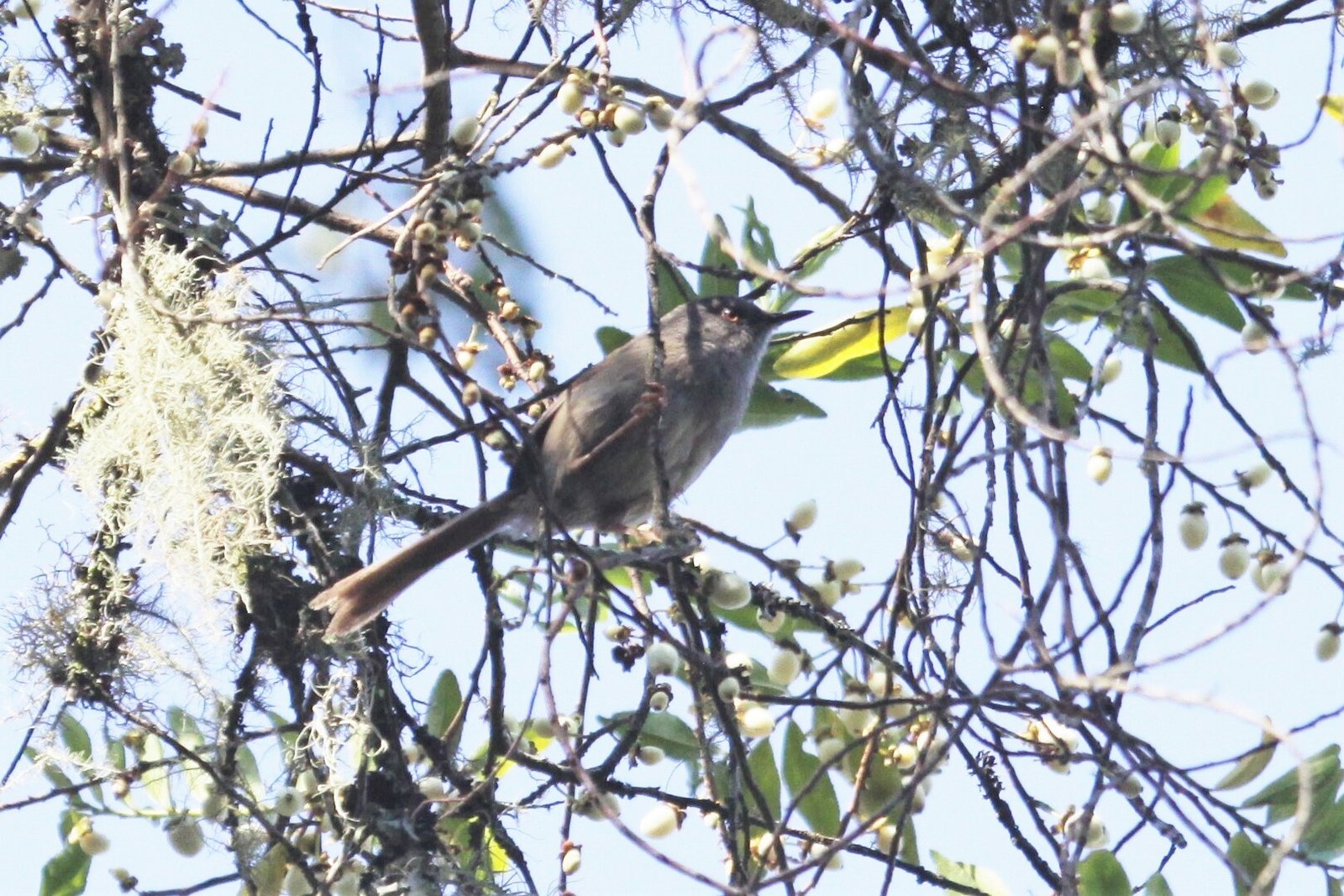
Roberts's Warbler is a long-tailed, grey warbler with a pale iris that moves in small, noisy parties through scrub and bracken at the edges of montane forest. It is endemic to the Eastern Highlands on the border of Zimbabwe and Mozambique and forms a genus of its own. For anyone visiting the highlands it is one of the key target species.
Voice
Noisy: the party gives a high, rattling chrrr-chrrr and a penetrating, rapid duet of hard chip-chip-chip notes and trills, trrree-trrree, the birds answering each other instantly. When alarmed it gives a dry, sharp scolding.
Recording: Simon Elliott — CC BY-NC-SA 3.0 · converted to mono · xeno-canto
Identification
About 14 cm, with a long, graduated tail often held cocked. The upperparts are plain dark slate-grey, the underparts paler grey with an off-white, faintly mottled throat and a buff-brown wash on the flanks and undertail coverts. There is no supercilium. The iris is strikingly pale, cream to straw-yellow, giving the bird a staring look; the bill is dark, the legs pinkish-brown. The sexes are alike; juveniles are browner and have a darker eye. It clambers and hops low through dense cover and rarely flies more than a few metres.
Confusion species
Tawny-Flanked Prinia Prinia subflava occurs at lower altitudes and in grass at the edges, and is brown above with a distinct pale supercilium and tawny flanks. Bar-Throated Apalis Apalis thoracica of the same forest has a narrow black breast-band and a greenish back. Bleating Camaroptera Camaroptera brachyura is also grey but has a short tail and green wings. Barratt's Warbler Bradypterus barratti skulks in the same bracken, but is warm brown with a streaked throat and lives alone. A pale eye in a plain grey, long-tailed bird that lives in parties is diagnostic.
Habitat
Dense scrub, bracken beds, rank growth and heath at the edges of Afromontane forest, clearings and valleys with bushes among montane grassland, also the edges of pine and eucalyptus plantations with undergrowth, from about 1,200 metres to the highest summits. It forages low in the vegetation for insects, in parties of three to eight birds that help each other raise the young.
Where the bird is most at home, classified by the vegetation units of southern Africa.


Range and movements
Endemic to the Eastern Highlands: in Zimbabwe from Nyanga through the Bvumba to the Chimanimani Mountains and the Chirinda area, and in adjacent Mozambique on Tsetserra and the Mozambican side of the Chimanimani. Found nowhere else in the world.
- Resident
- dark = core range, pale = thinly spread
How and when to look
Year-round; good sites are the Bvumba forest (Bunga Forest and the botanical gardens area), the slopes of Nyanga and the edges of Chimanimani. Walk slowly along forest edges with bracken and scrub and listen for the rattling party call; the birds often come to inspect you and then sit briefly on top of a bush. They are most active in the cool of the morning.
Conservation status
Near Threatened. The range is small and fragmented over a few mountain blocks. Conversion of scrub and forest edge to pine and eucalyptus plantations, invasive alien shrubs, overly frequent fires and expanding agriculture reduce the habitat, although the bird also uses rank edges of plantations.
Scientific name
Oreophilais robertsi | (Benson, 1946)
Benson described the species in 1946 as Prinia robertsi; because it was later moved to another genus, the author and year stand in brackets. The genus Oreophilais was introduced in 1991 by Clancey. Oreophilais was coined by Clancey from the Greek oreophilos, 'mountain-loving', and -lais, taken from Hypolais (tree warblers) — a mountain-dwelling little warbler. robertsi honours the South African ornithologist Austin Roberts (1883–1948), after whom the well-known field guide Roberts Birds of Southern Africa is also named. The specimen the first description was based on came from Vumba, near Mutare, Zimbabwe.