All species › Passerines › Cisticolas › Namaqua Warbler
Namaqua Warbler | Phragmacia substriata
Namaquaprinia | Prinia Namaqua
The Namaqua Warbler is a slender, long-tailed warbler of dense thorn scrub and reedbeds along dry watercourses in the Karoo. It is paler and browner than the typical prinias, with fine streaks on the breast and rufous wings. The species is nearly endemic to South Africa and forms a genus of its own.

Voice
A dry, sharp chik or tik-tik-tik as contact call, and a quick song that starts with a few separate notes and ends in a dry trill, tsip-tsip-tsip-tirrrrrr. Pairs often answer each other.
Recording: Walter Wallner — CC BY-NC-SA 4.0 · converted to mono · xeno-canto
Identification
About 14 cm, with a long, thin, graduated tail with pale tips that is often flicked up. The upperparts are grey-brown, the edges of the flight feathers warm rufous-brown, giving a rusty wing panel. A narrow white supercilium runs to behind the eye. The underparts are white with fine dark streaks on the throat and breast, grading to warm buff on the flanks, lower belly and undertail coverts. The iris is pale orange-brown, the bill fine and dark. The sexes are alike; juveniles are more weakly streaked. It moves shyly through the scrub but often perches briefly on a protruding twig.
Confusion species
Karoo Prinia Prinia maculosa often lives nearby but in open scrub and fynbos, has yellow-tinged underparts with bold black drop-shaped spots and lacks the rufous wings. Black-Chested Prinia Prinia flavicans has a black breast-band and yellow underparts. Cinnamon-Breasted Warbler Euryptila subcinnamomea lives on rocky slopes, has a cinnamon breast and rump and a dark tail often held cocked. The combination of fine breast streaks, rusty wings and life in riverine vegetation points to Namaqua Warbler.
Habitat
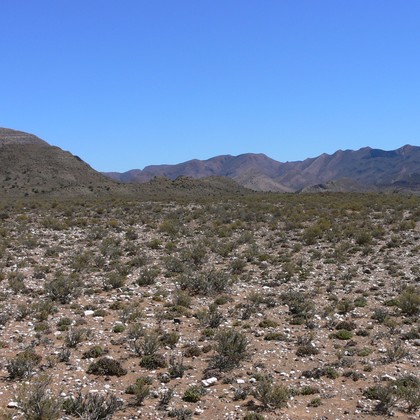
Dense growth along dry and seasonal rivers in the Karoo: thorn scrub of sweet thorn (Vachellia karroo), tamarisk, reedbeds and rank growth around dams, springs and farmsteads. It forages low in the bushes and reeds for small insects, usually in pairs.
Where the bird is most at home, classified by the vegetation units of southern Africa.

Range and movements
Within the region mainly in the Nama Karoo and Succulent Karoo of South Africa: the Northern Cape, the interior of the Western Cape and the western Eastern Cape, east to south-western Free State, and along the Orange River into southern Namibia (including along the Fish River). Rarely away from this dry-country riverine growth; found nowhere outside southern Africa.
- Resident
- Winter visitor (c. Apr–Sep)
- dark = core range, pale = thinly spread
How and when to look
Year-round; search watercourses with thorn scrub and reeds in the Karoo, for example around Calvinia, Williston, Prince Albert, Karoo National Park near Beaufort West or along the Orange River. Walk along the vegetated bank and listen for the dry trill; soft pishing often draws the bird to the edge of the bush. In the heat of the afternoon it stays deep inside the scrub.
Conservation status
Not threatened. Locally fairly common within its limited habitat, and benefits in part from dams, farmyards and planted vegetation along watercourses. Clearing of riverine vegetation and overgrazing can locally remove suitable sites.
Scientific name
Phragmacia substriata | (Smith, 1842)
Smith described the species in 1842 as Drymoica substriata; because it was later moved to another genus, the author and year stand in brackets. The genus Phragmacia was introduced in 1990 by Brooke & Dean. Phragmacia is a portmanteau of the plant genera Phragmites (reed) and Acacia (acacia), the two principal plants of the species' usual habitat (Brooke & Dean 1990). substriata is Latin for 'slightly streaked', for the fine streaking on the breast and flanks. The specimen the first description was based on came from Olifants River, Western Cape.