All species › Passerines › African Warblers › Cape Grassbird
Cape Grassbird | Sphenoeacus afer
Kaapse grasvogel | Yerbera del Cabo
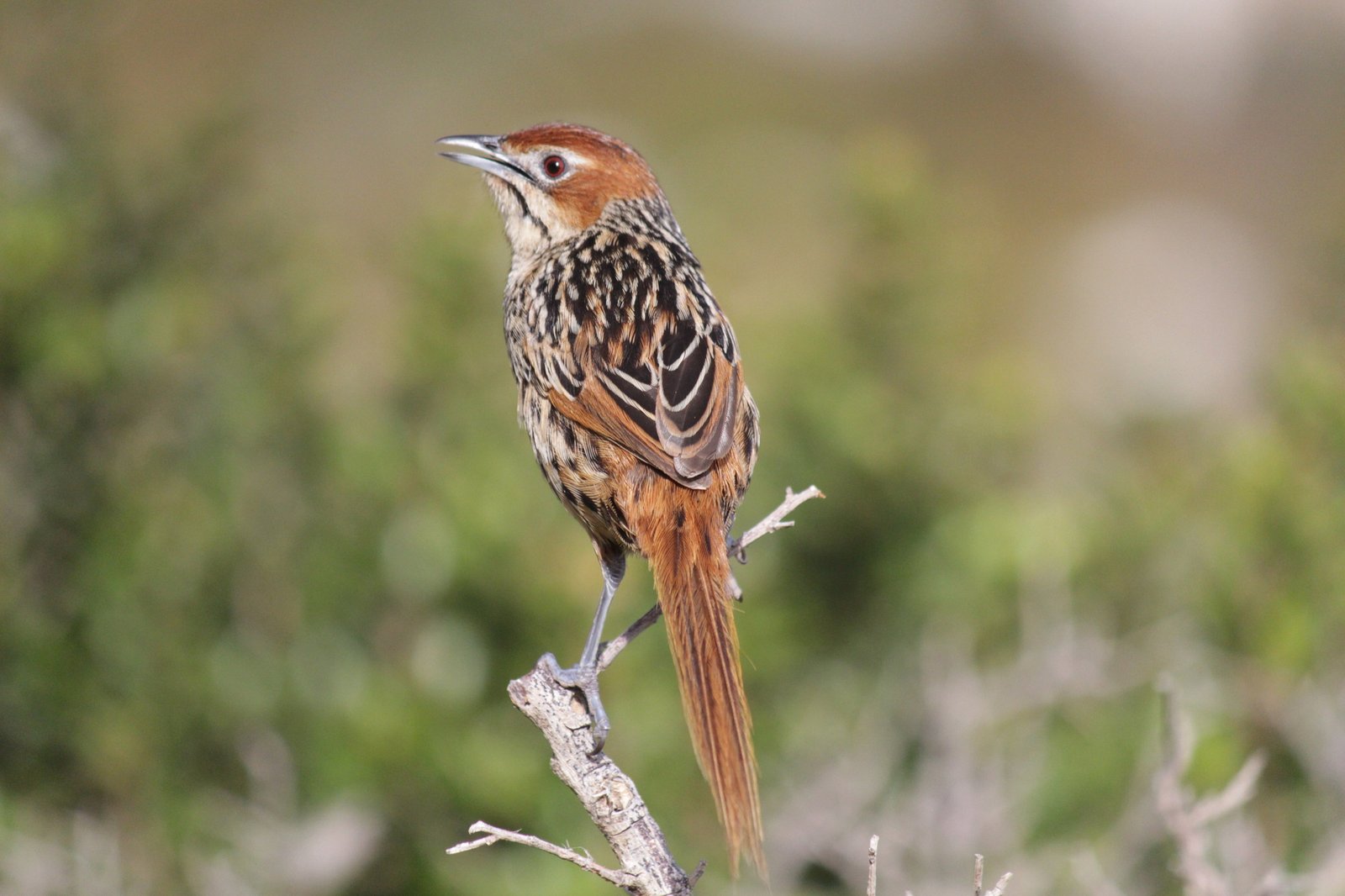
The Cape Grassbird is a large, streaked warbler with a long, ragged tail that delivers its loud, jubilant song from a bush top in fynbos and rank mountain grassland. It is endemic to southern Africa and belongs to the family Macrosphenidae, not to the ‘true’ grassbirds of Asia and Australia.
Voice
A loud, jubilant song of rapid, clear notes that rise in speed and pitch and end in a jumbled cascade, such as chip-chip-chip-chiroo-chiroo-tileleedeedee, sung from a bush top or a tall grass stem. The alarm call is a nasal, plaintive tcheew.
Recording: Niall Perrins — CC BY-NC-SA 4.0 · converted to mono · xeno-canto
Identification
19–23 cm; the tail makes up almost half the length. The crown and nape are rufous, the back and wings buff-brown with heavy black streaks. A pale eyebrow, a dark eye-stripe and a conspicuous black malar stripe frame the white throat. The underparts are buffy white with fine dark streaks on the breast and flanks. The tail is long, graduated and pointed, with ragged, splayed feathers. The female is slightly smaller and shorter-tailed. Juveniles are paler and less rufous on the head.
Confusion species
Moustached Grass Warbler Melocichla mentalis, which overlaps in the eastern highlands of Zimbabwe and Mozambique, has an unstreaked back, a white eyebrow and a broad, rounded tail. Fan-Tailed Grassbird Catriscus brevirostris is smaller and unstreaked above, with a very broad, dark tail with pale tips. Victorin’s Warbler Cryptillas victorini is unstreaked rufous-brown with a yellow eye. Levaillant’s Cisticola Cisticola tinniens is much smaller, with rufous wings and a shorter tail, and keeps to water.
Habitat
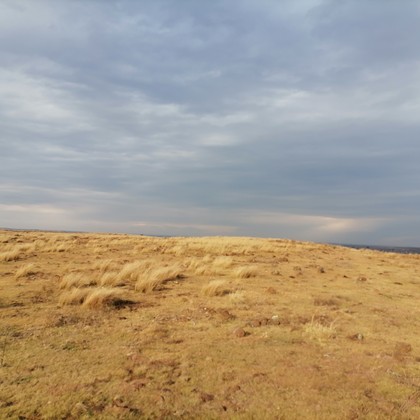
Fynbos, rank grass tufts and bracken on mountain slopes, dense growth along streams and rank montane grassland with bushes, from sea level in the Cape to above 2500 m in Lesotho. It searches for insects low in dense vegetation and climbs up to sing.
Where the bird is most at home, classified by the vegetation units of southern Africa.


Range and movements
In South Africa widespread in the Western and Eastern Cape, and further north-east through KwaZulu-Natal, the Free State and the Mpumalanga escarpment into Limpopo; also in Lesotho and western Eswatini. In addition in the eastern highlands of Zimbabwe (Nyanga, Vumba, Chimanimani) and adjacent Mozambique. Endemic to southern Africa.
- Resident
- Summer visitor (c. Oct–Mar)
- Winter visitor (c. Apr–Sep)
- Passage (Mar–Apr, Oct–Nov)
- dark = core range, pale = thinly spread
How and when to look
Year-round. In the Western Cape on most mountain slopes with fynbos, for example around Cape Point or at Kirstenbosch. Easiest in spring (August–November), when males sing from bush tops; at other times it creeps low through the vegetation.
Conservation status
Not threatened; common in suitable habitat. Locally declined through afforestation with alien trees and ploughing of grassland, but well represented in the Cape mountains and the Drakensberg.
Scientific name
Sphenoeacus afer | (Gmelin, 1789)
Gmelin described the species in 1789 as Muscicapa afra; because it was later moved to another genus, the author and year stand in brackets. The genus Sphenoeacus was introduced in 1841 by Strickland. Sphenoeacus comes from the Greek sphēn, 'wedge', and oiax, 'rudder' — for the long, wedge-shaped tail. afer is Latin for 'African', 'from Africa'. The specimen the first description was based on came from Cape of Good Hope.