All species › Passerines › African Warblers › Green Crombec
Green Crombec | Sylvietta virens
Groene krombek | Crombec Verde
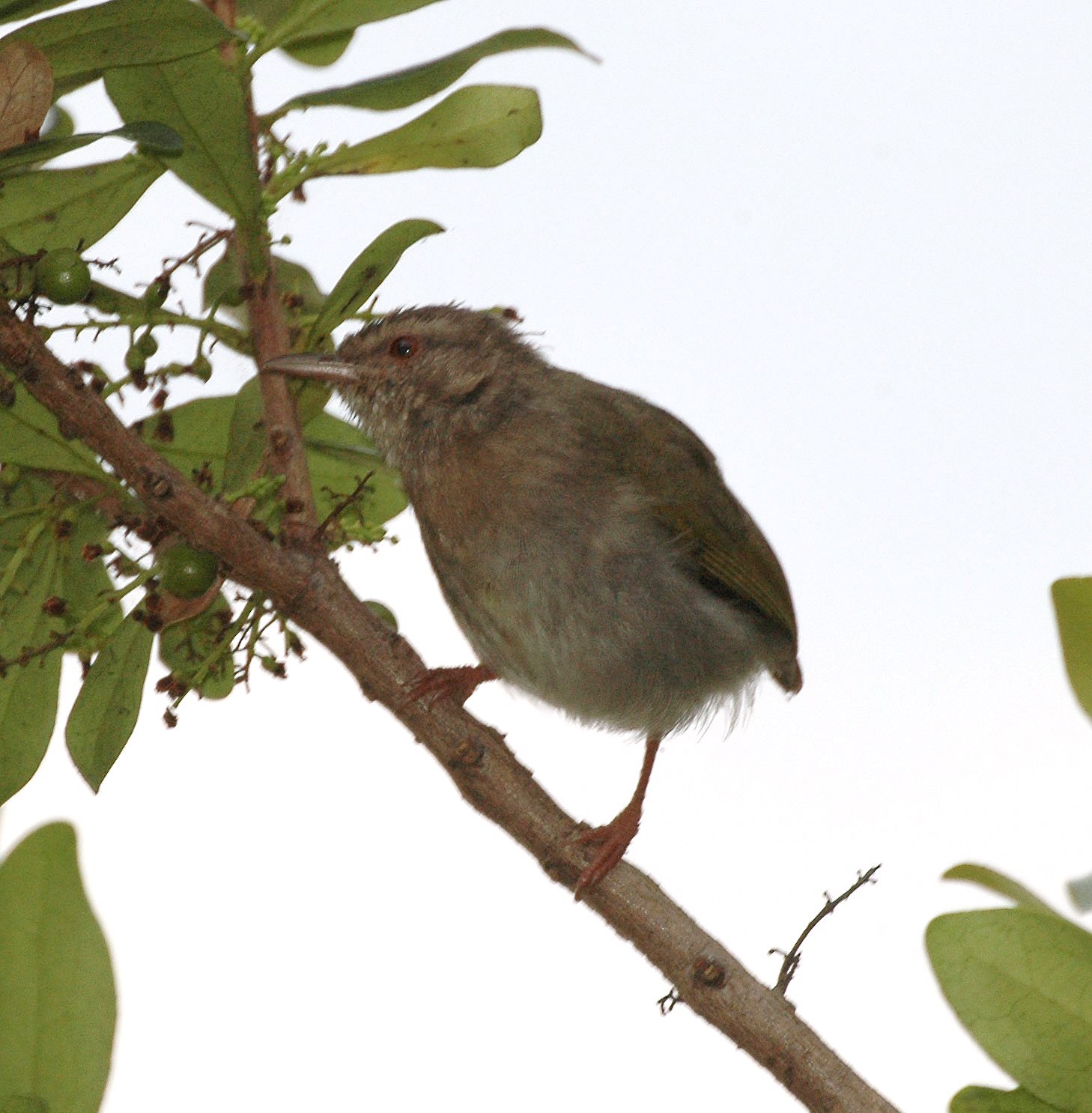
Green Crombec is a rainforest crombec: a tiny, almost tailless bird with an olive-green back and a brownish head, which in the region occurs only in northern Angola. Unlike the grey crombecs of the savanna, it lives at forest edges and in dense secondary scrub.
Voice
A short, high, thin phrase of a few notes, often descending, such as tsee-tsee-tseeu, repeated every few seconds. The contact call is a soft tsik or a dry chirp. It is heard more often than seen.
Recording: Jonathan Onongo — CC BY-NC-SA 4.0 · converted to mono · xeno-canto
Identification
8–9 cm. Crown and hindneck grey-brown to earth-brown, mantle, rump and wing edgings olive-green. The face is buff-brown, with a faint paler supercilium and brown ear-coverts. The throat is light brown to buffy yellow, breast and flanks grey-brown and belly dirty white. The tail is very short, as in all crombecs. The bill is fairly short and fine, dark with a paler lower mandible; legs pinkish-brown. The sexes are alike.
Confusion species
Red-Faced Crombec Sylvietta whytii and Red-Capped Crombec Sylvietta ruficapilla are grey above with no green and live in open woodland, not at forest edges. Long-Billed Crombec Sylvietta rufescens has a much longer bill and is grey with cinnamon underparts. Green Hylia Hylia prasina is larger, with a longer tail and a prominent yellow supercilium. Young camaropteras have a longer, often cocked tail.
Habitat
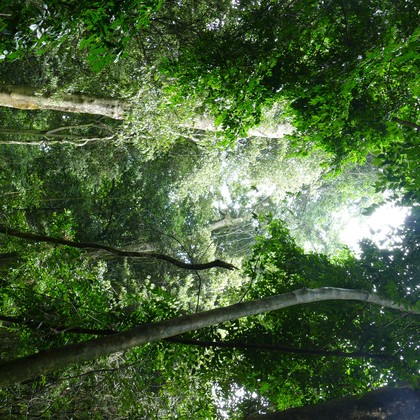
Edges and clearings of moist lowland forest, dense secondary forest, overgrown old cultivation, riverside scrub and gallery forest. It forages restlessly through foliage and creepers at low to middle height, often in mixed flocks, gleaning insects from leaves and twigs.
Where the bird is most at home, classified by the vegetation units of southern Africa.

Range and movements
In the region only in northern and north-western Angola (Cabinda and the forested provinces north of the Cuanza, east to Lunda), where the subspecies tando occurs. Beyond, from Nigeria and Cameroon through Gabon and Congo to eastern DR Congo and western Uganda and Kenya.
- Resident
- dark = core range, pale = thinly spread
How and when to look
Look for it at forest edges and in overgrown gardens in northern Angola, for example around Kalandula and in Uíge province. Listen for the thin repeated phrase and follow a mixed flock along a forest edge. Because of its small size and green tones it is easily lost in the foliage; watch for the short tail and brown head.
Conservation status
Not threatened; common across its large West and Central African range. It tolerates disturbance well and even benefits from secondary growth and forest edges. In Angola it is confined to a small part of the country and poorly studied.
Scientific name
Sylvietta virens | Cassin, 1859
Cassin described the species in 1859 and placed it straight away in the genus where it still stands. The genus Sylvietta was introduced in 1839 by De Lafresnaye. Sylvietta is a diminutive of Sylvia (warbler), after the French sylviette, 'little warbler' — for the tiny, almost tailless crombecs. virens is Latin for 'green', 'verdant' — for the olive-green upperparts. The specimen the first description was based on came from Sette Cama, Gabon.