All species › Passerines › African Warblers › Red-Capped Crombec
Red-Capped Crombec | Sylvietta ruficapilla
Roodkapkrombek | Crombec Orejirrufo
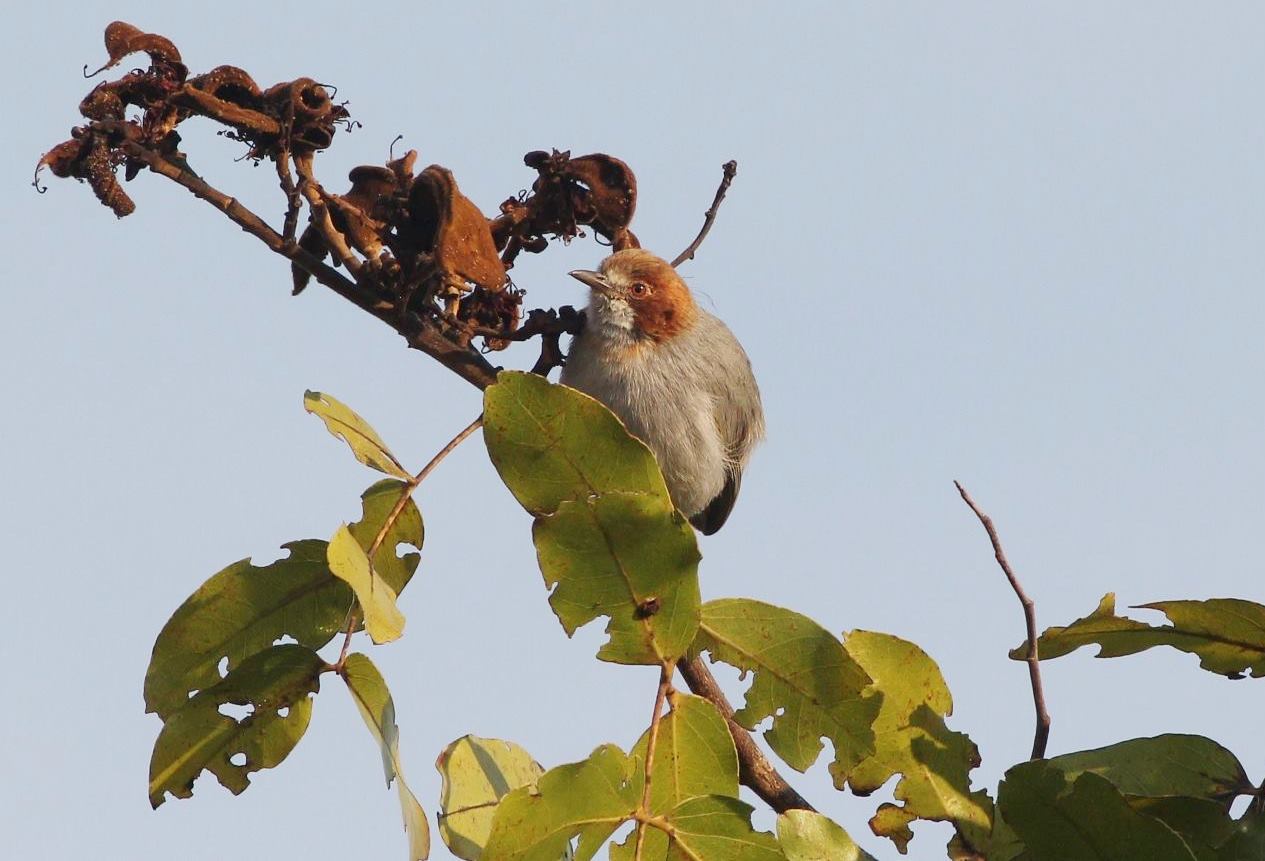
Red-Capped Crombec is the crombec of the miombo of Angola and Zambia: a grey, stub-tailed bird with a rufous cap or rufous cheeks that travels with the mixed flocks moving through the woodland. South of the Zambezi it is almost entirely replaced by Long-Billed Crombec.
Voice
A fast, high, repeated series of clear notes, such as tsirri-tsirri-tsirri or tswi-tswi-tswi-tsweet, more tuneful and less rolling than in Long-Billed Crombec. The contact call is a dry tsik. It sings mainly at the end of the dry season, as breeding begins.
Recording: Dries Van de Loock — CC BY-NC-SA 4.0 · converted to mono · xeno-canto
Identification
10–11 cm. Upperparts ash-grey, wings grey-brown. Crown and ear-coverts rufous to chestnut, but the extent varies by subspecies: in some birds the whole crown is red, in others only the forehead and cheeks. Throat white, breast washed rufous to buff, belly pale yellow to whitish. The tail is very short. The bill is fairly short, straight and pointed, shorter than in Long-Billed Crombec. Legs pinkish-brown. The sexes are alike.
Confusion species
Long-Billed Crombec Sylvietta rufescens has a grey crown, a dark eye-stripe with a pale supercilium, a clearly longer, slightly decurved bill and wholly cinnamon underparts. Red-Faced Crombec Sylvietta whytii, in the east, has a grey crown with only a rufous face and uniform rufous-buff underparts without a white throat. Green-Capped Eremomela Eremomela scotops and Yellow-Bellied Eremomela Eremomela icteropygialis have longer tails and no red on the head; Burnt-Necked Eremomela Eremomela usticollis has a rufous patch on the throat and nape, not on the crown.
Habitat
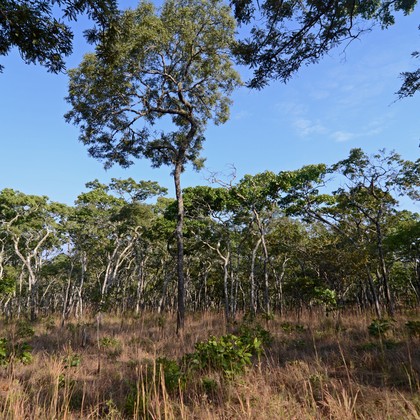
Miombo and other broad-leaved woodland, especially well-developed woodland with a closed canopy, also woodland edges and regenerating clearings. It forages through the foliage and along branches in the middle and upper strata, usually in pairs or as part of mixed flocks with eremomelas, tits and flycatchers.
Where the bird is most at home, classified by the vegetation units of southern Africa.

Range and movements
In the region in the miombo of central and eastern Angola and almost all of Zambia, marginally reaching western Malawi; in Zimbabwe and Mozambique at most marginal. Beyond, in southern DR Congo and Congo-Brazzaville and in western Tanzania.
- Resident
- Summer visitor (c. Oct–Mar)
- Winter visitor (c. Apr–Sep)
- Passage (Mar–Apr, Oct–Nov)
- dark = core range, pale = thinly spread
How and when to look
Best found by following a mixed flock in Zambian miombo, for example in Kafue or around Lusaka and the Copperbelt, and listening for the clear, fast series. Check the red head and short bill to separate it from Long-Billed Crombec, which can occur in the same places in southern and western Zambia.
Conservation status
Not threatened; common in miombo. Large-scale clearing of miombo for charcoal and agriculture reduces habitat locally, but the species is widespread and no clear decline is known.
Scientific name
Sylvietta ruficapilla | Bocage, 1877
Bocage described the species in 1877 and placed it straight away in the genus where it still stands. The genus Sylvietta was introduced in 1839 by De Lafresnaye. Sylvietta is a diminutive of Sylvia (warbler), after the French sylviette, 'little warbler' — for the tiny, almost tailless crombecs. ruficapilla comes from the Latin rufus, 'rufous', and capillus, 'hair of the head' — for the rufous crown. The specimen the first description was based on came from Caconda, Angola.