All species › Passerines › Chats and flycatchers › Cape Robin-Chat
Cape Robin-Chat | Dessonornis caffer
Kaapse lawaaimaker | Cosifa Cafre
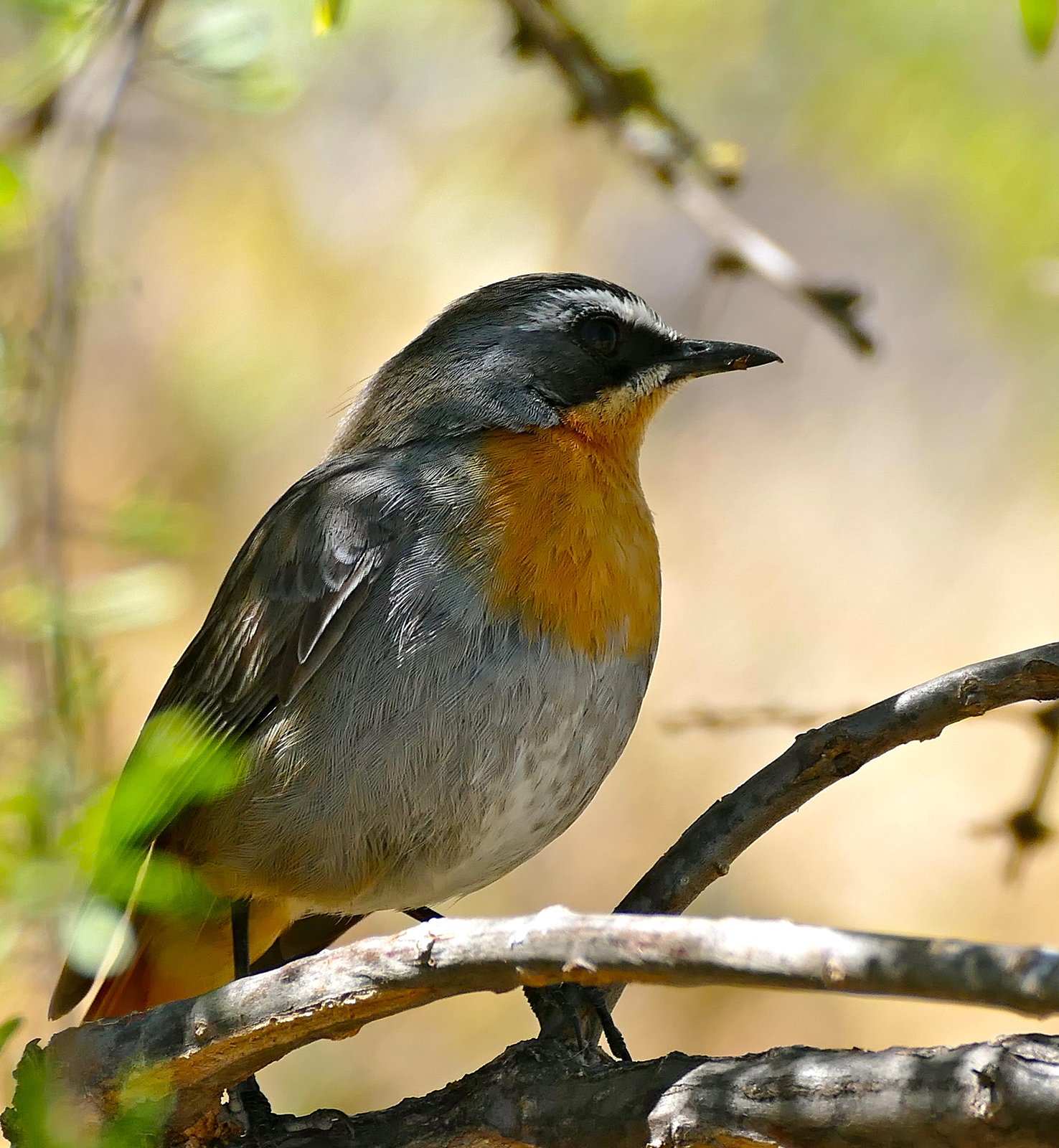
The Cape Robin-Chat is the best-known robin-chat of southern Africa: a confiding, ground-feeding bird of gardens, forest edges and fynbos, with an orange breast and an orange-red tail with a dark centre. Its Afrikaans name, Gewone janfrederik, imitates its song. It is a regular host of the Red-Chested Cuckoo.
Voice
The song is a melodious, repeated series of clear whistles, often rendered cheee-cheee-ree-wee or the Afrikaans jan-fre-de-rik, delivered from a sheltered perch, mainly at dawn and dusk. It sometimes mimics other birds, but far less than White-throated and White-Browed Robin-Chats. The alarm is a grating tsirrr or a low wurr; when agitated also a harsh tsirrt.
No recording with a suitable Creative Commons licence is available for this species yet.
Identification
A medium-sized robin-chat of 16 to 18 cm. Upperparts grey-brown, the head darker with a narrow white supercilium and blackish cheeks. Throat and upper breast orange, grading into a grey lower breast and flanks and a whitish belly; undertail coverts orange-buff. The tail is orange-red with dark brown central feathers, well seen when the bird lands with its tail fanned. Sexes alike. Juveniles are dark brown with buff spots. It hops over the ground, raises the tail and droops the wings.
Confusion species
White-Throated Robin-Chat (Dessonornis humeralis) has a white throat, a narrow white wing bar and orange breast and flanks, and lives in drier bushveld. White-Browed Robin-Chat (Cossypha heuglini) and Red-Capped Robin-Chat (Cossypha natalensis) are entirely orange below; the former has a broad white supercilium and a black crown, the latter a plain orange head. Chorister Robin-Chat (Cossypha dichroa) has a dark grey head without a supercilium and wholly orange underparts. The grey breast and flanks with a sharply defined orange throat are diagnostic of Cape Robin-Chat.
Habitat
Edges and clearings of montane and coastal forest, fynbos, scrub in ravines, riverine thicket, parks and gardens, from sea level to above 3000 m in the Drakensberg. In the northern part of the region only in highland forest and forest edges. Forages on the ground for insects, worms and small fruits, always close to cover.
Where the bird is most at home, classified by the vegetation units of southern Africa.


Range and movements
Widespread and common in South Africa, Lesotho and Eswatini, from the Cape to the Highveld and Drakensberg, but scarce in the arid Northern Cape and Karoo away from valleys with scrub. In Namibia only in the south along the Orange River and locally on the central plateau; in Botswana scarce in the south-east. Also in the eastern highlands of Zimbabwe and adjacent Mozambique, the highlands of Malawi and north-eastern Zambia (Nyika, Mafinga). Beyond the region in the East African highlands north to Ethiopia.
- Resident
- Summer visitor (c. Oct–Mar)
- Winter visitor (c. Apr–Sep)
- Passage (Mar–Apr, Oct–Nov)
- dark = core range, pale = thinly spread
How and when to look
In South African gardens the species is almost unavoidable; check lawns beneath shrubs early in the morning. In the northern highlands (Nyika, Nyanga, Mulanje) it shares forest edges with other robin-chats: note the grey breast and flanks and the short, clear song phrases without mimicry.
Conservation status
Not threatened. A very common and adaptable species that has benefited greatly from gardens, parks and plantations. Locally it suffers from cats and the clearing of dense undergrowth. It is an important host of the Red-Chested Cuckoo and other cuckoos.
Scientific name
Dessonornis caffer | (Linnaeus, 1771)
Linnaeus described the species in 1771 as Motacilla caffra; because it was later moved to another genus, the author and year stand in brackets. The genus Dessonornis was introduced in 1836 by Smith. Dessonornis is a misprint for Bessonornis, from the Greek bēssa, 'wooded glen', and ornis, 'bird'; its author Andrew Smith later corrected the spelling himself, but the original form stands. caffer is a dated, eighteenth-century geographic term for southeastern Africa and the Cape, where the first specimen came from; the term was standard in the scientific naming of the period but is now considered offensive. The specimen the first description was based on came from Cape of Good Hope.