All species › Passerines › Waxbills › Cinderella Waxbill
Cinderella Waxbill | Glaucestrilda thomensis
Cinderella-astrild | Estrilda Cenicienta
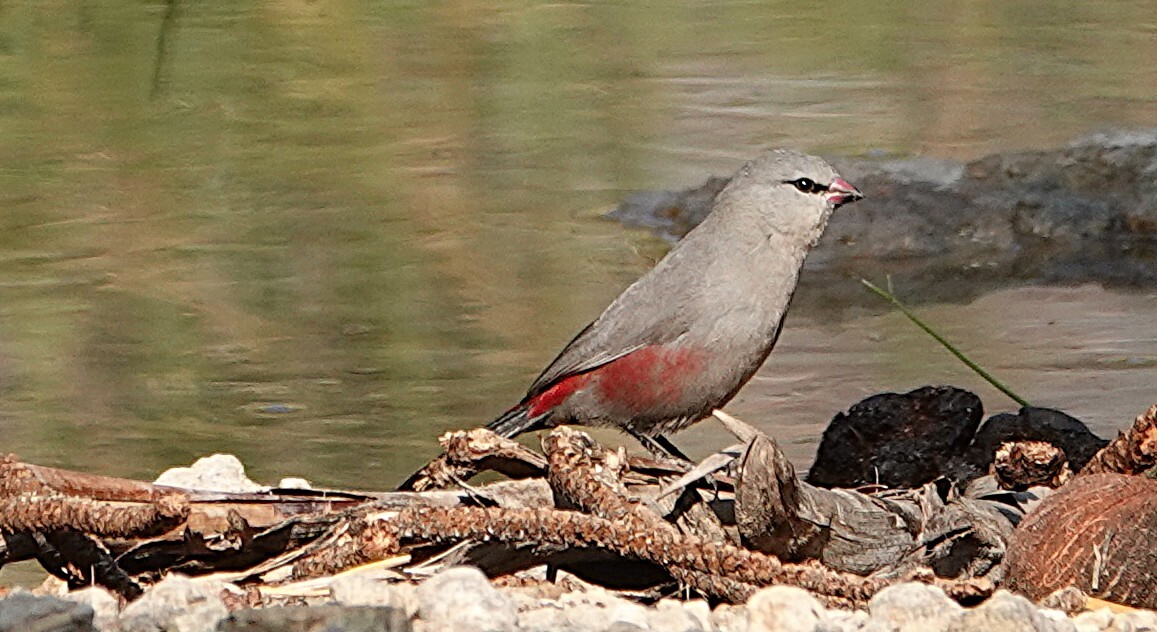
The Cinderella Waxbill is a pale grey waxbill with a red rump and pink flanks that occurs only in south-western Angola and the extreme north-west of Namibia. For birders in Namibia it is one of the prized specialities of the Kunene.
Voice
A thin, high, drawn-out tseeee or sweeee, often in series, much like the call of Grey Waxbill. The song is a soft, whistled warble.
Recording: Niall Perrins — CC BY-NC-SA 4.0 · converted to mono · xeno-canto
Identification
About 11 cm. Head, back and breast are pale bluish grey, the throat almost white; a narrow black line runs through the eye. The flanks are washed pink to wine-red, the rump and uppertail coverts bright crimson, the tail and undertail coverts black. The bill is black with a red base, especially on the lower mandible. The sexes are very similar; the female has less red on the flanks. Juveniles are duller, without pink flanks and with a dark bill.
Confusion species
Grey Waxbill (Glaucestrilda perreini) has the same pattern of red rump and black tail, but is darker grey, without pink flanks and with a dark bill; it does not occur in the same area. Black-Faced Waxbill (Brunhilda erythronotos), which does occur alongside Cinderella Waxbill in the Kaokoveld, has a black face, a finely barred grey-brown back and wine-red flanks with a black belly in the male. Common Waxbill (Estrilda astrild) is brown and barred, with a red eye-stripe.
Habitat
Riverine forest and dense scrub along rivers, especially with figs, makalani palms and mopane, and adjacent dry woodland and rocky hillsides with bushes, usually not far from water. It forages in pairs or small groups on grass seeds in the undergrowth and on the ground, and comes regularly to drink.
Where the bird is most at home, classified by the vegetation units of southern Africa.


Range and movements
Within the region only in south-western Angola (Namibe, Benguela and the edge of the Huíla plateau) and in north-western Namibia, along the Kunene and in the adjacent Kaokoveld, including Epupa and Ruacana. It occurs nowhere else in the world.
- Resident
- Summer visitor (c. Oct–Mar)
- Passage (Mar–Apr, Oct–Nov)
- dark = core range, pale = thinly spread
How and when to look
The easiest site is the Kunene at Epupa: search the riverine forest and the bushes along the river in the early morning, when the birds come to drink. Listen for the thin whistle and watch for a small grey bird with a red rear end flying low into cover. At close range the pink flanks and red bill base are decisive.
Conservation status
Not threatened, but with a small world range and a limited population. Fairly common locally along the Kunene; threats are the degradation of riverine forest by grazing and the building of dams on the river.
Scientific name
Glaucestrilda thomensis | (Sousa, 1888)
Sousa described the species in 1888 as Estrelda thomensis; because it was later moved to another genus, the author and year stand in brackets. The genus Glaucestrilda was introduced in 1922 by Roberts. Glaucestrilda combines the Greek glaukos, 'blue-grey, silvery', with the genus name Estrilda — for the grey waxbills of this genus. thomensis means 'of São Tomé', the supposed but probably mistaken origin of the type; the species lives in Angola and Namibia. The specimen the first description was based on came from São Tomé (doubtful).