All species › Passerines › Waxbills › Violet-Eared Waxbill
Violet-Eared Waxbill | Granatina granatina
Granaatastrild | Granadero Meridional
The Violet-Eared Waxbill is an estrildid finch with a chestnut body, violet cheeks and a blue rump, a bird of dry thornveld. It is the host of the Shaft-Tailed Whydah (Vidua regia), whose nestlings mimic the gape patterns of Violet-Eared Waxbill chicks.

Click a thumbnail to switch the photo above.
Voice
A thin, high tseet-tseet and a soft tu-wee. The male's song is a short, whistled series of chirps and trills, tu-tu-chee-weet, which is mimicked by the Shaft-Tailed Whydah.
Recording: Tony Archer — CC BY-NC-SA 4.0 · converted to mono · xeno-canto
Identification
13–15 cm, with a long, black, graduated tail. The male is deep chestnut with violet cheek patches, a cobalt-blue forehead, a black chin, a blue rump, black undertail coverts and a red bill. The female is paler, sandy brown above and ochre to pale below, with smaller, duller violet cheek patches, a pale blue forehead, a blue rump and also a red bill. Juveniles are plain brown with a blue rump and a dark bill, and soon acquire the violet cheek.
Confusion species
Hardly confusable in good light. The Blue Waxbill (Uraeginthus angolensis) has a blue face, breast and tail, without chestnut and violet. At a distance females and juveniles can suggest a Common Waxbill (Estrilda astrild), but the blue rump and violet cheek are decisive. The female Shaft-Tailed Whydah (Vidua regia) has a streaked back, a shorter tail and a red bill and legs.
Habitat
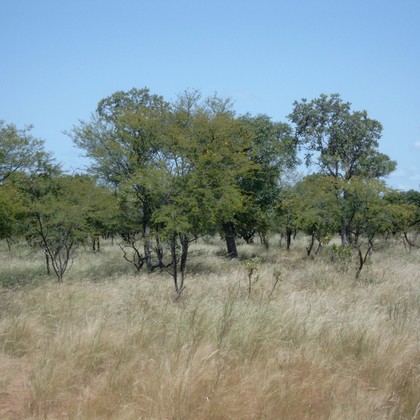
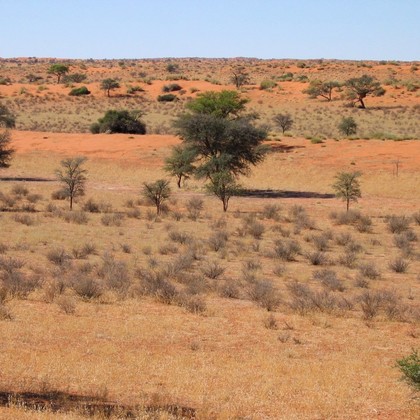
Dry thorn savanna, Kalahari thornveld and dry scrub with dense thorn bushes, also along dry riverbeds. It forages in pairs or family parties on the ground beneath bushes for grass seeds and regularly comes to water. Pairs stay together all year.
Where the bird is most at home, classified by the vegetation units of southern Africa.
Range and movements
The dry west and north of the region: Namibia (not in the Namib itself), Botswana, southern Angola, western and southern Zimbabwe, and in South Africa the Northern Cape (mainly the north), North West, Limpopo and the northern Free State, locally also northern KwaZulu-Natal and southern Mozambique. Not found outside the region.
- Resident
- Summer visitor (c. Oct–Mar)
- Winter visitor (c. Apr–Sep)
- Passage (Mar–Apr, Oct–Nov)
- dark = core range, pale = thinly spread
How and when to look
Sit quietly at a waterhole in the Kgalagadi, Etosha, Pilanesberg or Mapungubwe; pairs often emerge briefly and shyly from the bushes. Where there are Violet-Eared Waxbills, the Shaft-Tailed Whydah can be expected in the breeding season (roughly December–April): the male, with long wire-like tail feathers with broadened tips, sings from a lookout within its host's territories.
Conservation status
Not threatened. Fairly common in suitable habitat. Sensitive to overgrazing and the clearing of thorn scrub; also trapped for the cage-bird trade.
Scientific name
Granatina granatina | (Linnaeus, 1766)
Linnaeus described the species in 1766 as Fringilla granatina; because it was later moved to another genus, the author and year stand in brackets. The genus Granatina was introduced in 1890 by Sharpe. Granatina comes from the Latin granatinus, 'garnet-coloured' — for the deep wine-red and violet of the plumage. granatina is Latin for 'garnet-coloured' — for the deep wine-red of the male. The specimen the first description was based on came from Huíla, Angola.