All species › Passerines › Waxbills › Pink-Throated Twinspot
Pink-Throated Twinspot | Hypargos margaritatus
Parelastrild | Estrilda Golirrosa
The Pink-Throated Twinspot is a waxbill of the region with a wine-pink face and breast and a black belly scattered with white spots. It is endemic to the lowlands of Maputaland, eastern Eswatini and southern Mozambique.

Click a thumbnail to switch the photo above.
Voice
A soft, insect-like trill, tsirrr, as a contact call and a sharper chit in alarm. The song is a soft series of chattering notes and trills that often ends in a fine buzz.
Recording: Maarten Sluijter — CC BY-NC-SA 4.0 · shortened to the first 60 s, mono · xeno-canto
Identification
12–13 cm, with a blue-grey bill. The male has a wine-pink face, throat and breast, a brown crown, nape and back, pink rump and uppertail coverts and a dark tail. Belly and flanks are black with round white spots, the undertail coverts black. The female has a grey face and throat, a grey-brown breast with at most a pink wash and a grey belly with white spots. Juveniles are plain brown without spots, with a pink-tinged rump. It lives hidden in dense undergrowth and comes out only briefly at the edge.
Confusion species
Red-Throated Twinspot (Hypargos niveoguttatus) has a bright crimson rather than wine-pink face and breast in the male and a grey crown; the female has an orange-red breast. The ranges barely touch: in Maputaland and southern Mozambique only Pink-throated is to be expected. Green Twinspot (Mandingoa nitidula) is smaller and green above, with a red (male) or orange (female) face.
Habitat
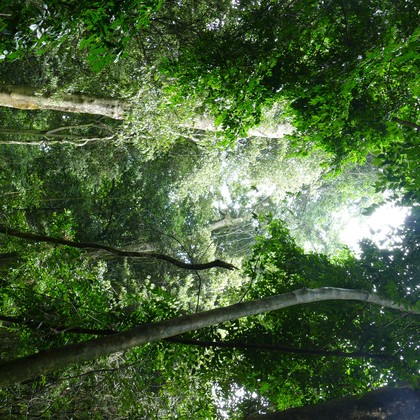
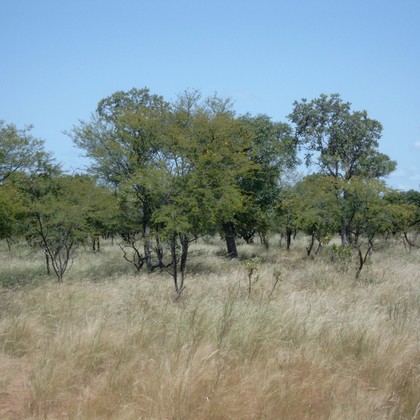
Sand forest, dense thicket, thorn scrub and rank growth along forest edges in the warm coastal lowlands, also riverine scrub. It forages in pairs or small groups on the ground under cover for grass seeds and small insects, often in the company of African Firefinches.
Where the bird is most at home, classified by the vegetation units of southern Africa.
Range and movements
Endemic to the region: north-eastern KwaZulu-Natal (Maputaland, from Hluhluwe and Mkhuze north to Ndumo and Tembe), the lowveld of eastern Eswatini and southern Mozambique, north to about the Save River. Not found outside the region.
- Resident
- Summer visitor (c. Oct–Mar)
- dark = core range, pale = thinly spread
How and when to look
The sand forest of Tembe Elephant Park and Mkhuze Game Reserve offers the best chances, as does the Ndumo area; in Eswatini, Hlane and Mlawula. Birds come to waterholes at hides and to feeding stations in camps; wait quietly in the shade and listen for the soft trill in the undergrowth.
Conservation status
Not threatened; locally fairly common within its small range. Loss of sand forest and thicket to farming and wood-cutting in southern Mozambique is the main threat; in the protected areas of KwaZulu-Natal and Eswatini the population is stable.
Scientific name
Hypargos margaritatus | (Strickland, 1844)
Strickland described the species in 1844 as Spermophaga margaritata; because it was later moved to another genus, the author and year stand in brackets. The genus Hypargos was introduced in 1862 by Reichenbach. Hypargos combines the Greek hupo, 'beneath', with Argus, the hundred-eyed giant of Greek mythology — for the many white 'eyes' on the underparts. margaritatus is Latin for 'pearled', from margarita, 'pearl' — for the white pearl-like spots on the flanks. The specimen the first description was based on came from Coguno, Inhambane district, Mozambique (originally given in error as 'Madagascar').