All species › Passerines › Waxbills › Red-Throated Twinspot
Red-Throated Twinspot | Hypargos niveoguttatus
Rode druppelastrild | Estrilda Golirroja
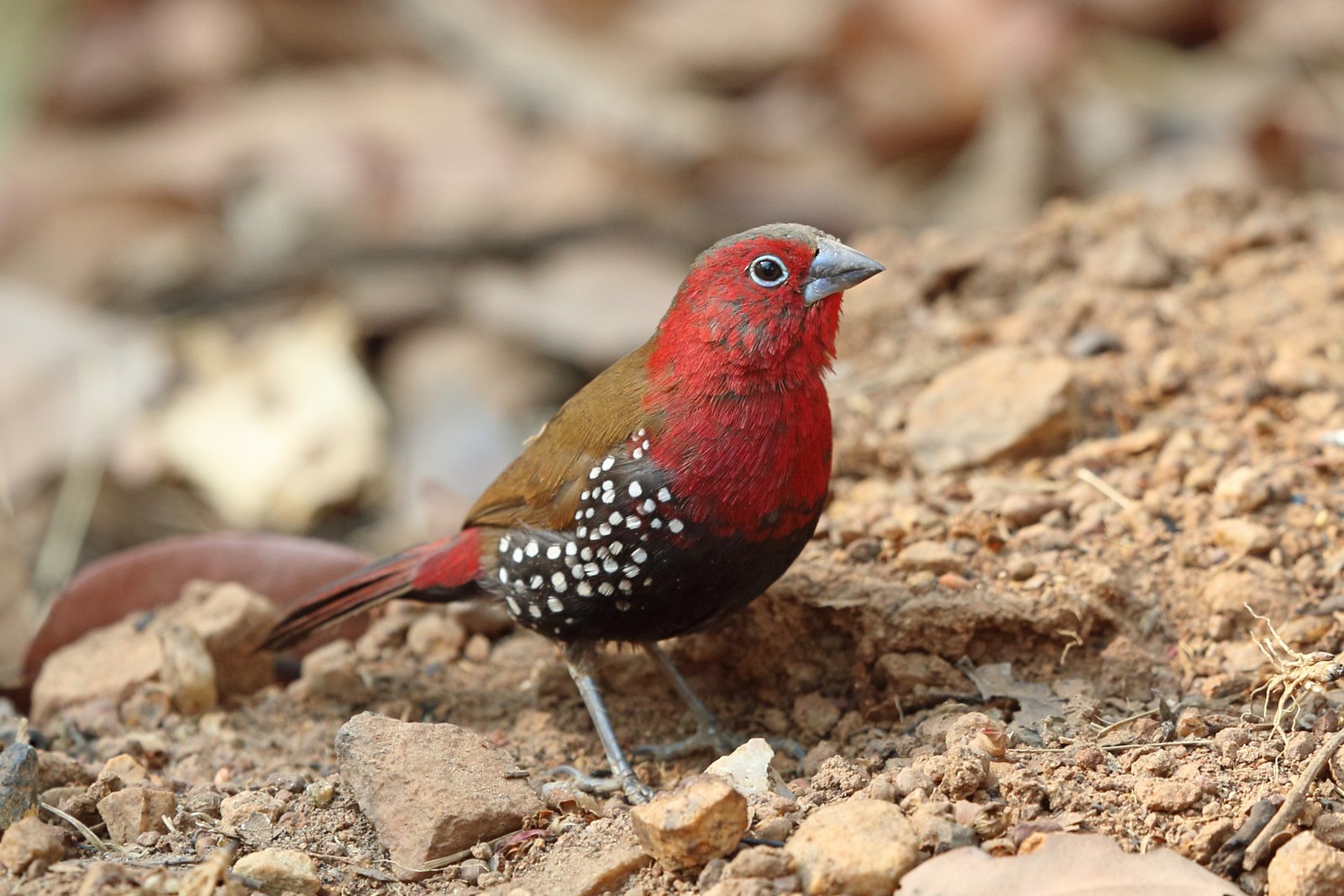
The Red-Throated Twinspot is a shy waxbill of thickets at forest edges, the male with a crimson face and breast and a black, white-spotted belly. In the region it is a bird of the north-east, from Zambia and Malawi to eastern Zimbabwe and Mozambique.
Voice
A high, insect-like trill, tsirrrrit, as a contact call, often the first sign of its presence. The song is a soft, sustained series of whistles and trills, delivered from a sheltered branch.
Recording: isaac kilusu — CC BY-NC-SA 4.0 · converted to mono · xeno-canto
Identification
12–13 cm, with a blue-grey bill. The male has a grey crown and nape, a bright crimson face, throat and breast and warm brown back and wings; rump and uppertail coverts are crimson, the tail dark. Belly and flanks are black with conspicuous white spots. The female has a grey-brown face, a dull orange-red breast and a greyer belly, also spotted white. Juveniles are plain olive-brown with a reddish rump. It stays low in dense undergrowth and comes into the open only early in the morning or at a waterhole.
Confusion species
Pink-Throated Twinspot (Hypargos margaritatus) has a wine-pink rather than crimson face and a brown crown, and lives further south, in Maputaland and southern Mozambique. Green Twinspot (Mandingoa nitidula) is smaller, olive-green above and has red only on the face. Firefinches such as African Firefinch (Lagonosticta rubricata) lack the black, white-spotted belly.
Habitat
Dense undergrowth and thicket at the edges of riverine, lowland and coastal forest, rank growth in clearings, overgrown gardens and forest edges in hill country up to about 1,700 m. It forages in pairs on the ground for grass seeds and small insects, often in the company of African Firefinches.
Where the bird is most at home, classified by the vegetation units of southern Africa.


Range and movements
Eastern Zimbabwe (lower slopes of the Eastern Highlands, including the Burma and Honde valleys), central and northern Mozambique, Malawi and northern and eastern Zambia. There are no documented records from Botswana, Namibia or Angola. Beyond the region from south-eastern DR Congo, Rwanda and Burundi through Tanzania to coastal Kenya and southern Somalia.
- Resident
- Summer visitor (c. Oct–Mar)
- Winter visitor (c. Apr–Sep)
- Passage (Mar–Apr, Oct–Nov)
- dark = core range, pale = thinly spread
How and when to look
In Zimbabwe the Vumba, the Burma Valley and the Honde Valley are classic sites, in Mozambique the Gorongosa area. Listen at the edge of dense bushes for the insect-like trill and wait by a clearing or a path: the birds come out briefly to feed. They are most active early in the morning and after rain.
Conservation status
Not threatened; fairly common in suitable habitat, but easily overlooked because of its secretive habits. It is trapped locally for the cage-bird trade.
Scientific name
Hypargos niveoguttatus | (Peters, 1868)
Peters described the species in 1868 as Spermophaga niveoguttata; because it was later moved to another genus, the author and year stand in brackets. The genus Hypargos was introduced in 1862 by Reichenbach. Hypargos combines the Greek hupo, 'beneath', with Argus, the hundred-eyed giant of Greek mythology — for the many white 'eyes' on the underparts. niveoguttatus comes from the Latin niveus, 'snow-white', and guttatus, 'spotted' — for the white spots on the black underparts. The specimen the first description was based on came from Inhambane, Mozambique.