All species › Passerines › Starlings › Common Myna
Common Myna | Acridotheres tristis
Treurmaina | Miná Común
The Common Myna is a bold, noisy starling from South Asia that was introduced to Durban around 1888. From KwaZulu-Natal it has spread along roads, villages and towns across north-eastern South Africa, and it is regarded as one of the most invasive birds in the world.
Voice
Very noisy and varied. Cackling, gurgling and croaking notes, chok-chok, keek-keek-keek and whistled churrs, often delivered with head-bobbing and fluffed feathers; a high rasping alarm when alarmed. It mimics other birds and sounds. Large roosts make a deafening din at sunset.
Recording: David Darrell-Lambert — CC BY-NC-SA 4.0 · converted to mono · xeno-canto
Identification
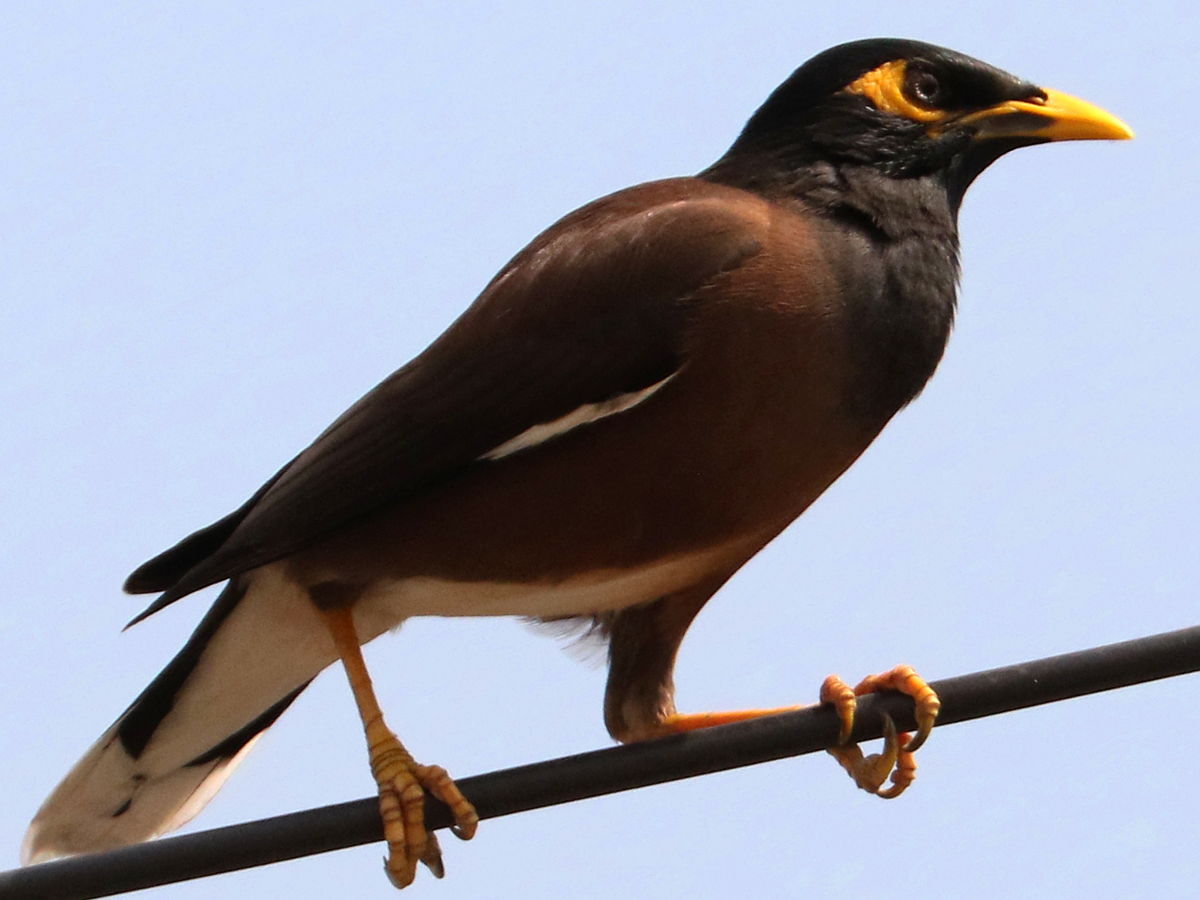
23–25 cm. The body is warm chocolate-brown, the head, neck and upper breast glossy black. A bare yellow skin patch runs back from below the eye. Bill and legs are bright yellow. In flight a large white patch at the base of the primaries, white underwing-coverts and white tail tips stand out; the undertail-coverts and belly are white. The sexes are alike. Juveniles are duller, with a browner head and less bare yellow skin.
Confusion species
Common Starling Sturnus vulgaris is smaller, blackish or spotted, without white wing patches or yellow skin at the eye. Red-Winged Starling Onychognathus morio has rufous, not white, wing panels and a long tail. Pale-Winged Starling Onychognathus nabouroup has pale wing panels, but is glossy black with an orange eye and lives in dry rocky country, not in towns.
Habitat
Cities, villages, suburbs, filling stations, markets, sports fields and farmyards; rarely far from human habitation. It walks over the ground and eats insects, fruit, seeds and scraps. It breeds in cavities in buildings, street lights and trees, displacing native hole-nesters in the process.
Where the bird is most at home, classified by the vegetation units of southern Africa.


Range and movements
In the region mainly in South Africa: numerous in KwaZulu-Natal, Gauteng, Mpumalanga and North West, and spreading in the Free State, Limpopo and the eastern Eastern Cape; also in Eswatini, with scattered footholds in border towns of neighbouring countries. Native from Iran and Central Asia to India and South-East Asia; introduced elsewhere, including Australia, islands in the Indian and Pacific Oceans and the Middle East.
- Resident
- Summer visitor (c. Oct–Mar)
- Passage (Mar–Apr, Oct–Nov)
- dark = core range, pale = thinly spread
How and when to look
All year in towns and villages of north-eastern South Africa, often first seen at car parks and fast-food outlets. Outside its known range a sighting is worth reporting, as the spread is being monitored. In flight the white wing patches are the best feature.
Conservation status
Not threatened globally. In South Africa an invasive alien that displaces native hole-nesters and is still spreading; it is on the list of the world's hundred worst invasive species.
Scientific name
Acridotheres tristis | (Linnaeus, 1766)
Linnaeus described the species in 1766 as Paradisea tristis; because it was later moved to another genus, the author and year stand in brackets. The genus Acridotheres was introduced in 1816 by Vieillot. Acridotheres is Greek, from akris, genitive akridos, 'locust', and thērēs, 'hunter'. tristis is Latin for 'sad' or 'gloomy'. The specimen the first description was based on came from Pondicherry, India.