All species › Passerines › Sylvia warblers › Layard's Warbler
Layard's Warbler | Curruca layardi
Layards meeszanger | Curruca de Layard
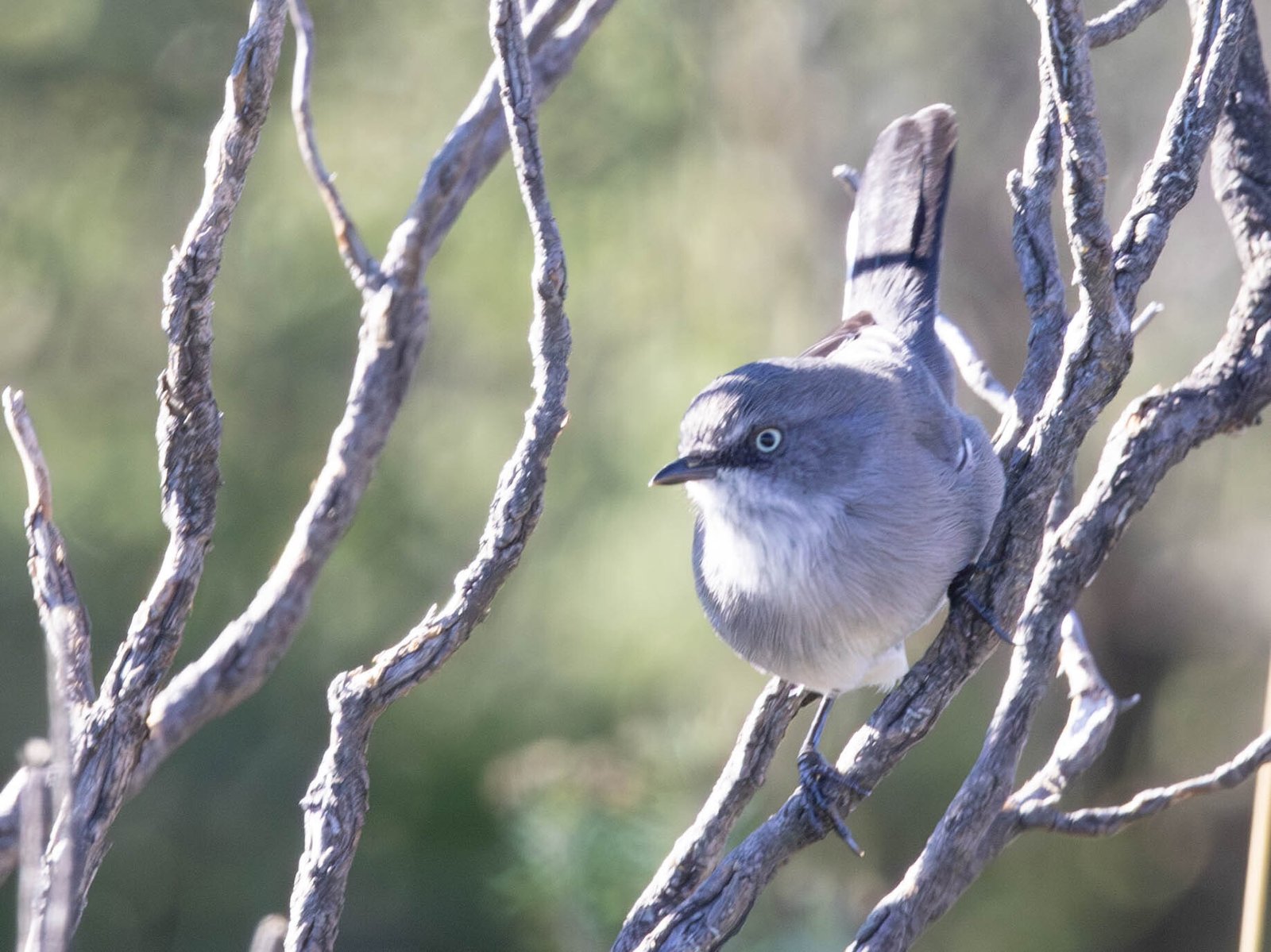
Layard's Warbler is a grey, pale-eyed Curruca warbler of fynbos and Karoo scrub in the south-west of the region and the Lesotho highlands. It is the less familiar counterpart of the Chestnut-Vented Warbler, with the same streaked throat and pale iris, but with white rather than chestnut undertail coverts.
Voice
The song is a clear, fast series of whistled and chirping notes, for example chee-chee-cheri-cheri, slightly higher and less full than that of Chestnut-Vented Warbler. The call is a dry, grating cherr or a repeated chik.
Recording: Lynette Rudman — CC BY-NC-SA 4.0 · converted to mono · xeno-canto
Identification
14–15 cm, grey above, off-white below with a grey wash on the breast and flanks. The throat is white with short black streaks forming a ‘beard’, often slightly weaker in this species than in Chestnut-Vented Warbler. The iris is conspicuously white to pale yellow. The undertail coverts are white or at most pale cream. The tail is blackish with white outer feathers and white tips, obvious when the bird fans it. The bill is thin and dark, the legs dark grey. The sexes are alike; juveniles have a darker iris and an almost unstreaked throat. It works actively through bushes, flicking and fanning the tail.
Confusion species
Chestnut-Vented Warbler Curruca subcoerulea is the most likely confusion species and overlaps in parts of the region; it has chestnut undertail coverts, usually a more heavily streaked throat and a somewhat different, richer song. In poor views concentrate on the undertail: in Layard's Warbler it is white. Fairy Flycatcher Stenostira scita is smaller, with a black mask and white supercilium, a white wing stripe and a pink wash on the belly. Grey Tit Melaniparus afer has a black cap and throat.
Habitat
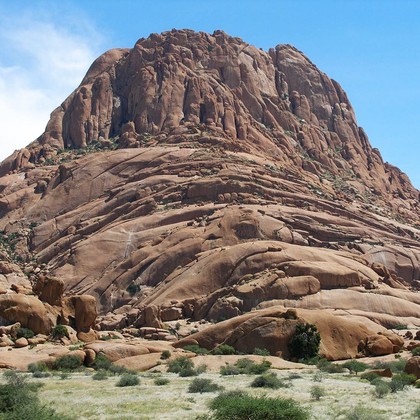
Mountain fynbos, Karoo scrub and succulent shrubland, often on rocky slopes and in ravines; in Lesotho in high-altitude scrub on mountain slopes to above 2,500 m. It forages low in bushes and among rocks for insects, and also takes berries.
Where the bird is most at home, classified by the vegetation units of southern Africa.


Range and movements
In South Africa in the Western Cape, the Northern Cape (Namaqualand, Richtersveld and the western Karoo), the west of the Eastern Cape and the highlands along the edge of the Drakensberg; also in Lesotho and in southern Namibia, mainly in the mountains of Great Namaqualand. It does not occur outside the region.
- Resident
- Summer visitor (c. Oct–Mar)
- Winter visitor (c. Apr–Sep)
- Passage (Mar–Apr, Oct–Nov)
- dark = core range, pale = thinly spread
How and when to look
All year; best in spring (August–October) when the bird sings from the top of a bush. Good places are the Cederberg, the Tankwa Karoo area, Namaqualand and Sani Pass and the Lesotho highlands. Where both species occur, as in the western Karoo, the colour of the undertail is the deciding feature.
Conservation status
Not threatened. The species is locally common in a large, largely intact area and numbers appear stable; overgrazing and burning of scrub degrade the habitat locally.
Scientific name
Curruca layardi | (Hartlaub, 1862)
Hartlaub described the species in 1862 as Parisoma layardi; because it was later moved to another genus, the author and year stand in brackets. The genus Curruca was introduced in 1802 by Bechstein. Curruca is Latin, the name of an unidentified small bird mentioned by the Roman poet Juvenal. layardi honours the British naturalist Edgar Leopold Layard (1824–1900), curator of the South African Museum in Cape Town. The specimen the first description was based on came from Swartland (Malmesbury district), Western Cape, South Africa.