All species › Cuckoos › Cuckoos › Coppery-Tailed Coucal
Coppery-Tailed Coucal | Centropus cupreicaudus
Koperstaartspoorkoekoek | Cucal Colicobrizo
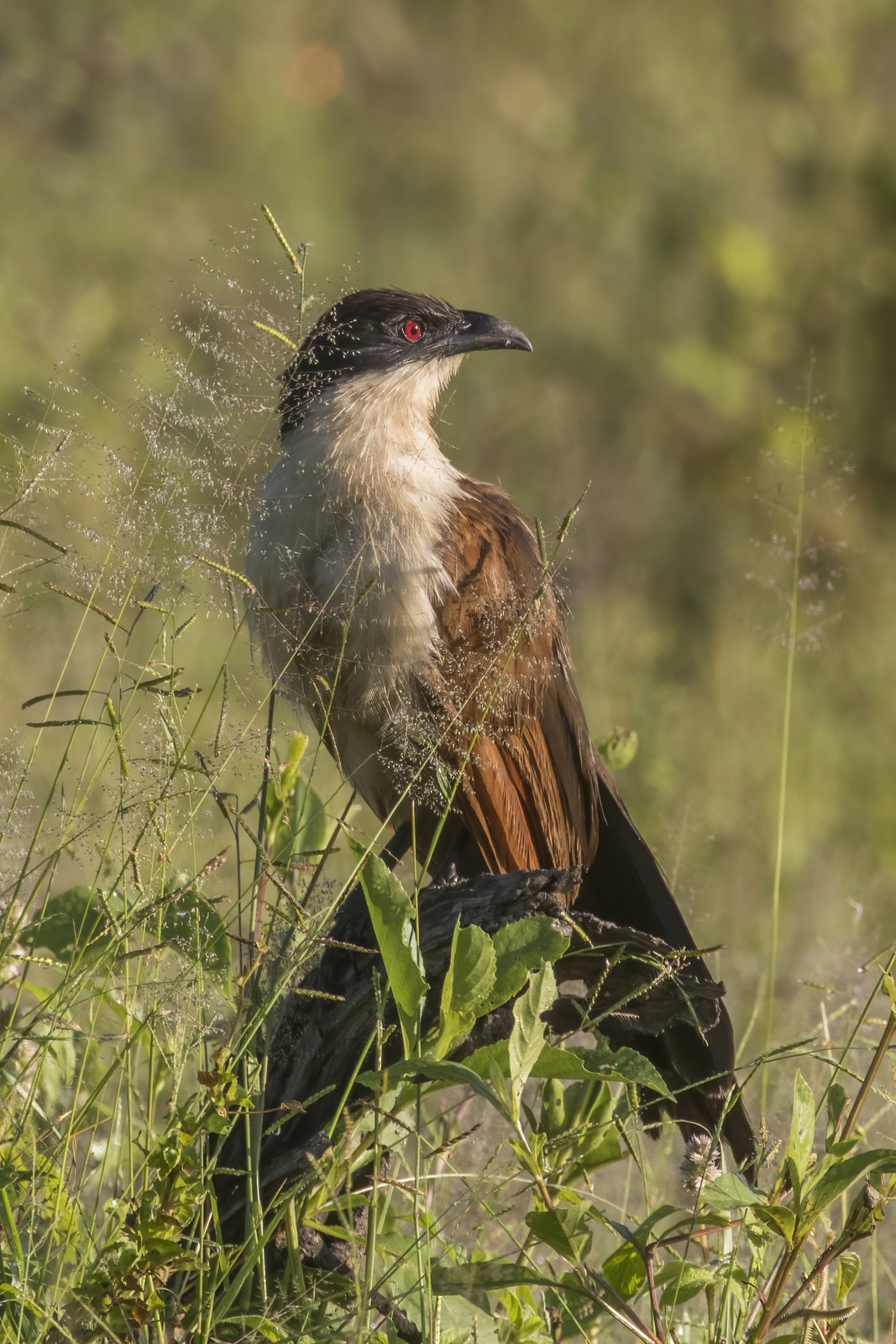
The Coppery-Tailed Coucal is the largest and darkest coucal of the region, a typical inhabitant of the papyrus and reed swamps of the Okavango, the Chobe and the upper Zambezi. Its deep, bubbling call is a familiar dawn sound in the delta.
Voice
A deep, slow, bubbling series of hollow notes, boo-boo-boo-boo-boo, falling and then rising again, noticeably lower and fuller than in the other coucals; often in duet and in chorus with neighbouring pairs. Also a sharp, rasping chek when alarmed.
Recording: Dries Van de Loock — CC BY-NC-SA 4.0 · converted to mono · xeno-canto
Identification
44–50 cm, large and heavily built, with a stout bill. The head and hindneck are dull black with a faint blue gloss; the mantle is dark olive-brown to blackish-brown, the wings dark rufous-brown. The underparts are cream to dirty white. The long, broad tail is black with a distinct coppery to bronze gloss, visible in good light. Heavy black bill, red eye, black legs. Juveniles have barred upperparts, a pale supercilium and a dark eye.
Confusion species
The Senegal Coucal (Centropus senegalensis) is smaller and slimmer, with a paler, bright rufous mantle, a finer bill and a tail without the coppery gloss. The White-Browed Coucal (Centropus superciliosus) is smaller, with a white supercilium or, in the southern form, a finely barred rump. The Blue-Headed Coucal (Centropus monachus) occurs only in northern Angola and has a brighter rufous back. The Black Coucal (Centropus grillii) is much smaller and in breeding plumage has wholly black underparts.
Habitat
Papyrus and reed swamps, rank waterside vegetation, floodplains with tall grass and thickets along rivers, lagoons and islands in deltas. Strongly tied to permanent water. It eats large insects, frogs, fish, snails, small birds, rodents and snakes, and sometimes raids the nests of herons and weavers for eggs and young.
Where the bird is most at home, classified by the vegetation units of southern Africa.

Range and movements
In the region in eastern Angola, western and central Zambia (upper Zambezi, Kafue Flats, Bangweulu), northern Botswana (Okavango Delta, Linyanti, Chobe), the Zambezi Region and Kavango in Namibia and the extreme north-west of Zimbabwe around Victoria Falls. Beyond the region in southern DR Congo, western Tanzania and Burundi.
- Resident
- Summer visitor (c. Oct–Mar)
- Winter visitor (c. Apr–Sep)
- Passage (Mar–Apr, Oct–Nov)
- dark = core range, pale = thinly spread
How and when to look
At dawn, from a mokoro or a camp on the edge of the Okavango Delta or the Chobe, listen for the low, bubbling call. Early in the day the birds sit on top of papyrus or bushes to dry off; the coppery sheen of the tail is then easy to see.
Conservation status
Not threatened and common in the large wetlands of the region. The species depends on permanent swamps; water abstraction, drainage and altered river flood regimes are the main long-term threats.
Scientific name
Centropus cupreicaudus | Reichenow, 1896
Reichenow described the species in 1896 and placed it straight away in the genus where it still stands. The genus Centropus was introduced in 1811 by Illiger. Centropus comes from the Greek kentron, 'spur, goad', and pous, 'foot' — for the long, straight hind claw, a feature of all coucals. cupreicaudus comes from the Latin cupreus, 'coppery', and cauda, 'tail' — for the coppery sheen on the long tail. The specimen the first description was based on came from Okavango region and Angola.