All species › Cuckoos › Cuckoos › Blue-Headed Coucal
Blue-Headed Coucal | Centropus monachus
Monniksspoorkoekoek | Cucal Monje
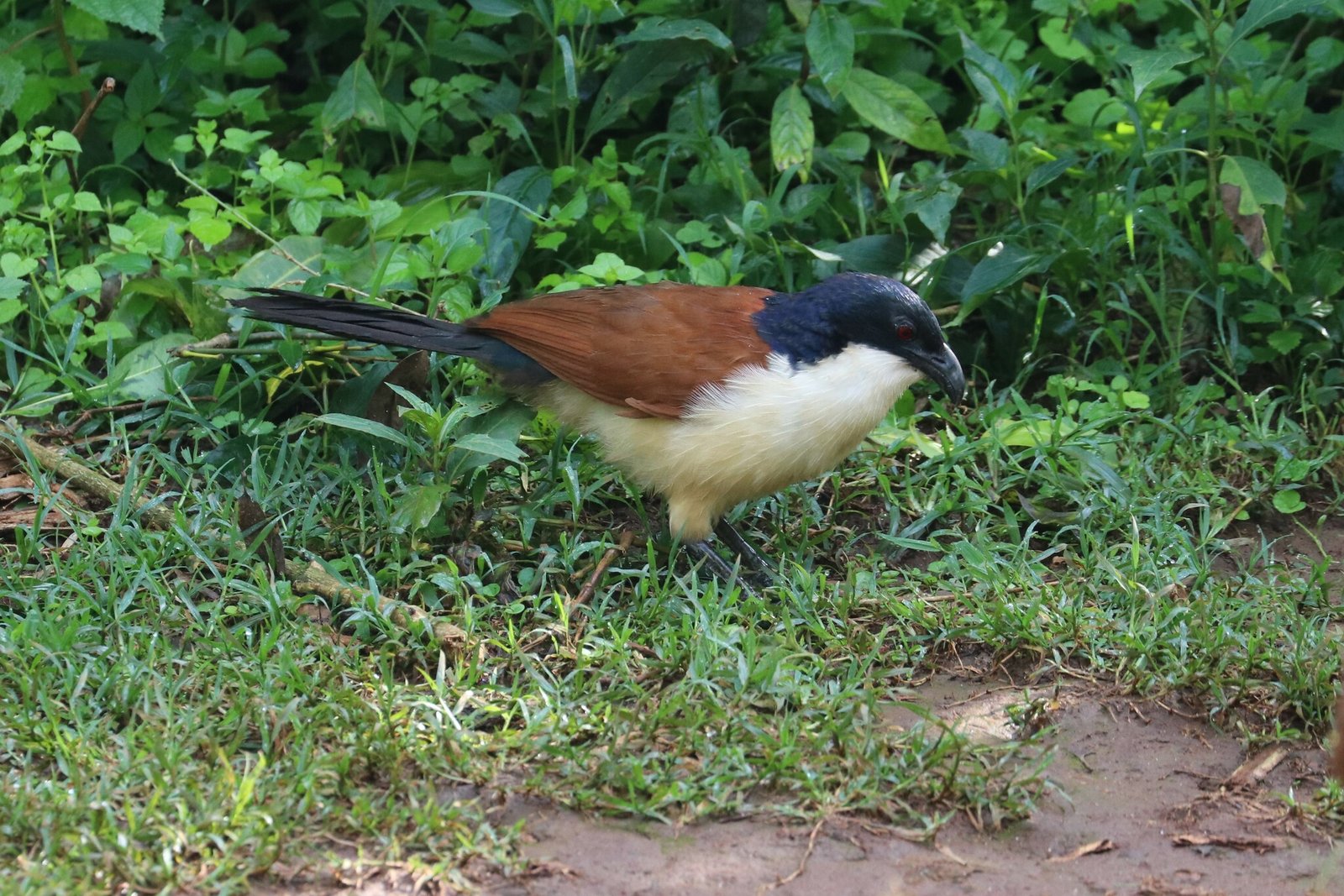
The Blue-Headed Coucal is a large coucal of marshes, reedbeds and rank waterside vegetation in Central and East Africa, reaching the region only in northern Angola. The blue-black cap, lying like a monk's hood over the head and nape, gave it its Dutch and Spanish names.
Voice
A deep, bubbling series of hollow notes, hoo-hoo-hoo-hoo-hoo, falling and then rising again, lower and slower than in the Senegal Coucal; often in duet. Also a harsh, rasping chak when alarmed.
Recording: Jaap van der Waarde — CC BY-NC-SA 4.0 · converted to mono · xeno-canto
Identification
45–50 cm. The crown, sides of the head and hindneck are glossy blue-black, with no supercilium. The mantle is dark olive-brown, the wings bright chestnut. The underparts are white to cream, slightly buffish on the flanks. The rump and uppertail coverts are blackish; the long tail is black with a blue-green gloss. Heavy black bill, red eye, blackish legs. Juveniles are duller, with dark barring on the upperparts and a dark eye.
Confusion species
The Senegal Coucal (Centropus senegalensis) is smaller, with a paler, rufous-brown mantle and a black rather than blue-black cap, and lives in drier savanna. The Gabon Coucal (Centropus anselli) is darker, with an olive-brown back and buff underparts, and is found mainly at forest edges. The Coppery-Tailed Coucal (Centropus cupreicaudus) is larger and darker, with a coppery gloss on the tail. The White-Browed Coucal (Centropus superciliosus) has a white supercilium.
Habitat
Marshes, papyrus and reedbeds, rank tall grass and scrub along rivers and lakes, overgrown banks, wet forest edges and fields in damp hollows. It clambers low through dense vegetation and walks on the ground. It eats large insects, snails, frogs, small reptiles, rodents and nestlings.
Where the bird is most at home, classified by the vegetation units of southern Africa.


Range and movements
Within the region only in northern and north-western Angola. Beyond the region from Guinea and Sierra Leone east through West and Central Africa to Ethiopia, Kenya, Uganda and north-western Tanzania.
- Resident
- dark = core range, pale = thinly spread
How and when to look
In northern Angola listen at dawn along reed fringes, marsh edges and rank banks for the low, bubbling call. After a shower the birds often sit with spread wings on top of a bush or in the reeds, when they are easiest to see.
Conservation status
Not threatened and common across much of its range. The loss of wetlands to drainage and agriculture reduces its habitat locally; little is known about numbers within the region.
Scientific name
Centropus monachus | Rüppell, 1837
Rüppell described the species in 1837 and placed it straight away in the genus where it still stands. The genus Centropus was introduced in 1811 by Illiger. Centropus comes from the Greek kentron, 'spur, goad', and pous, 'foot' — for the long, straight hind claw, a feature of all coucals. monachus is Latin for 'monk' — for the dark head, like a monk's hood. The specimen the first description was based on came from Kulla, northern Ethiopia.