All species › Cuckoos › Cuckoos › Senegal Coucal
Senegal Coucal | Centropus senegalensis
Senegalese spoorkoekoek | Cucal Senegalés
The Senegal Coucal is the coucal of the drier savannas: smaller and more lightly built than its relatives, and more often in woodland, scrub and gardens than in marshes. Like all coucals it is a heavy, low-flying bird that prefers clambering through vegetation to flying, and it gives itself away mainly by its bubbling call.
Voice
A bubbling series of hollow notes, doo-doo-doo-doo-doo, that first falls in pitch and accelerates and then rises and slows again, like water pouring from a bottle; somewhat faster and higher than in the Coppery-Tailed Coucal. Often in duet, mainly in the morning, the evening and before a shower.
Recording: Julien Birard — CC BY-NC-SA 4.0 · shortened to the first 60 s, mono · xeno-canto
Identification
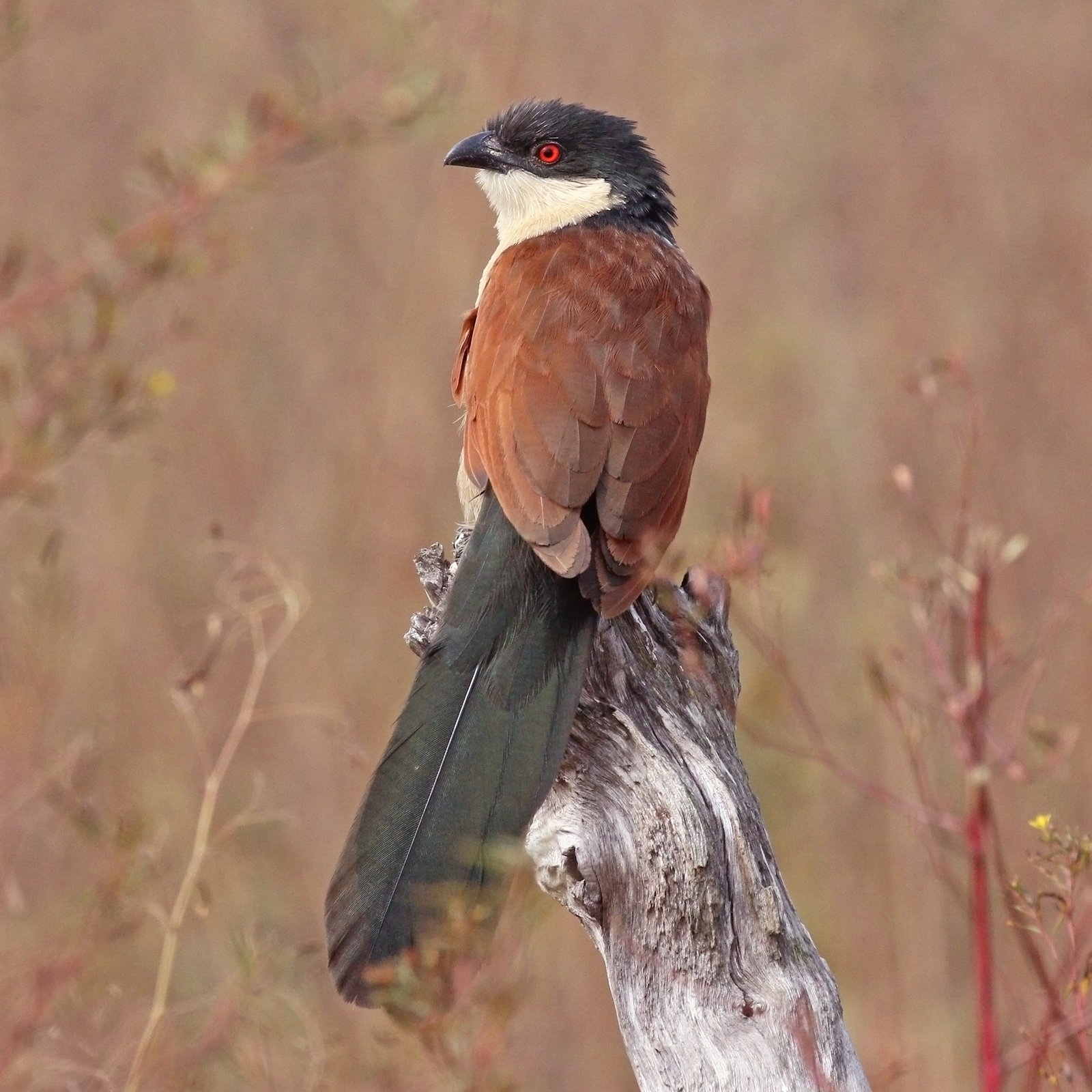
38–42 cm. The crown, hindneck and sides of the head are glossy black, with no supercilium. The mantle is rufous-brown, the wings bright chestnut with dark tips. The underparts are white to cream. The rump and uppertail coverts are blackish and unbarred; the long, broad tail is black with a green gloss. Black bill, red eye, grey legs. Juveniles have finely barred upperparts, a pale supercilium and a dark eye, and thus resemble a White-Browed Coucal.
Confusion species
The White-Browed Coucal (Centropus superciliosus) has a white supercilium and a head and nape finely streaked with white; the southern form without an obvious brow has finely barred rump and uppertail coverts. The Coppery-Tailed Coucal (Centropus cupreicaudus) is clearly larger, with a heavier bill, a darker, less rufous back and a coppery gloss on the tail. The Blue-Headed Coucal (Centropus monachus) is larger, with a blue-black head, and lives in wet vegetation.
Habitat
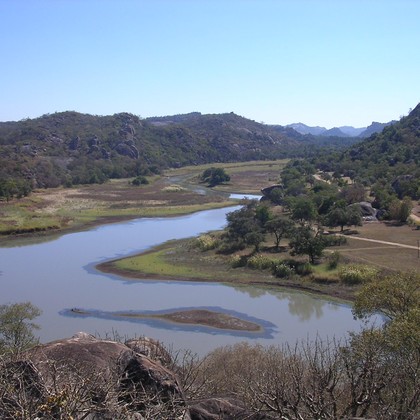
Dry to semi-moist woodland with dense bushes and tall grass, thorn scrub, mopane, riverine woodland and rank areas around villages, fields and gardens. Less tied to water than the other coucals of the region, but also found in reed fringes. It eats large insects, lizards, frogs, small rodents and the eggs and young of other birds.
Where the bird is most at home, classified by the vegetation units of southern Africa.


Range and movements
The north and centre of the region: most of Angola except the dry coastal plain, Zambia, Malawi, central and northern Mozambique, Zimbabwe (mainly the north and east, such as the Zambezi Valley), northern Botswana and the Zambezi Region and Kavango in Namibia. Beyond the region from Senegal east to Ethiopia and Kenya, with an isolated population in the Nile Delta in Egypt.
- Resident
- Summer visitor (c. Oct–Mar)
- Winter visitor (c. Apr–Sep)
- Passage (Mar–Apr, Oct–Nov)
- dark = core range, pale = thinly spread
How and when to look
In the early morning or after a shower look for birds sunning themselves with spread wings on a bush or termite mound. Good places are the Zambezi Valley (Mana Pools, Lower Zambezi), Chobe and Kafue National Park. Check head, rump and tail carefully on every coucal.
Conservation status
Not threatened, widespread and locally common. It adapts well to untidy farmland and occurs right into villages and gardens.
Scientific name
Centropus senegalensis | (Linnaeus, 1766)
Linnaeus described the species in 1766 as Cuculus senegalensis; because it was later moved to another genus, the author and year stand in brackets. The genus Centropus was introduced in 1811 by Illiger. Centropus comes from the Greek kentron, 'spur, goad', and pous, 'foot' — for the long, straight hind claw, a feature of all coucals. senegalensis means 'from Senegal', where the first specimen came from. The specimen the first description was based on came from Senegal.