All species › Cuckoos › Cuckoos › Gabon Coucal
Gabon Coucal | Centropus anselli
Gabonspoorkoekoek | Cucal de Gabón
The Gabon Coucal is a large, dark coucal of forest edges and thickets in the Congo Basin, reaching the region only in northern Angola. It is shy and keeps to dense vegetation, so it is heard far more often than seen; within the region it is one of the least known coucals.

Voice
A series of deep, hollow notes, hoo-hoo-hoo-hoo, first descending and then rising again, slower and lower than in other coucals; often in duet, the female joining with higher notes. Heard mainly in the early morning, at dusk and before rain.
Recording: Deville Tanguy — CC BY-NC-SA 4.0 · converted to mono · xeno-canto
Identification
45–48 cm, with a long, broad tail. The head and hindneck are glossy blue-black, the mantle and wing coverts dark olive-brown, the flight feathers a deeper chestnut. The underparts are cream to pale buff, slightly darker on the flanks. The rump and uppertail coverts are dark and faintly barred; the tail is black with a greenish gloss. Heavy black bill, red eye, dark grey legs. Juveniles are duller, with barred upperparts and a dark eye.
Confusion species
The Blue-Headed Coucal (Centropus monachus) is very similar, but has brighter rufous-brown back and wings and whiter underparts, and lives mainly in wet, open vegetation. The Senegal Coucal (Centropus senegalensis) is smaller, with a paler rufous back and white underparts, and favours drier savanna. The White-Browed Coucal (Centropus superciliosus) has a white supercilium and a finely streaked head.
Habitat
Forest edges, overgrown clearings, secondary forest and dense thickets along rivers in the forest–savanna mosaic, also tall grass and scrub close to forest. It forages low in the vegetation and on the ground. It eats large insects such as grasshoppers and caterpillars, as well as snails, frogs, small reptiles and the nestlings of other birds.
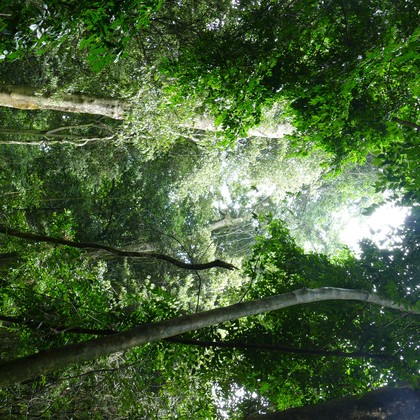
Where the bird is most at home, classified by the vegetation units of southern Africa.

Range and movements
Within the region only in northern Angola, mainly in Cabinda and the north-western provinces, locally also in the north-east (Lunda). Beyond the region in Gabon, Congo-Brazzaville, the extreme south-west of the Central African Republic and western and southern DR Congo.
- Resident
- dark = core range, pale = thinly spread
How and when to look
Best found by listening for the deep, hollow call along forest edges in northern Angola in the early morning. It occasionally shows itself when it sits drying in the sun on top of a bush after rain; look for a large, dark coucal with pale underparts.
Conservation status
Not threatened. The species is locally common and partly benefits from clearings and secondary growth after logging. Within the region knowledge of its numbers and distribution is limited.
Scientific name
Centropus anselli | Sharpe, 1874
Sharpe described the species in 1874 and placed it straight away in the genus where it still stands. The genus Centropus was introduced in 1811 by Illiger. Centropus comes from the Greek kentron, 'spur, goad', and pous, 'foot' — for the long, straight hind claw, a feature of all coucals. anselli honours the British merchant Henry F. Ansell (1835–1875), who collected birds in Gabon. The specimen the first description was based on came from Danger River, Gabon.