All species › Passerines › Bushshrikes › Crimson-Breasted Shrike
Crimson-Breasted Shrike | Laniarius atrococcineus
Burchells fiskaal | Bubú Pechirrojo
Crimson-Breasted Shrike is one of the most striking birds of the Kalahari thornveld: glossy black above, with a white wing stripe, and brilliant scarlet below. In dry, dusty acacia country it looks almost unreal. Like its relatives, it usually makes itself heard first, with a duet from a thorn bush.

Voice
Duets in which the male whistles a liquid, clear kwik-kweeoo or kwee-kwip and the female answers instantly with a dry, harsh tzzzk or a click. It also gives a hard, harsh alarm rattle and soft, throaty calls between the pair.
Recording: Ehren Eksteen — CC BY-NC-SA 4.0 · converted to mono · xeno-canto
Identification
22–23 cm. Head, back, wings and tail are glossy black, with a long white stripe along the wing. The entire underparts, from chin to undertail coverts, are bright crimson to scarlet. The bill is heavy, black and hooked, and the eye is dark. The sexes are alike. A rare variant has yellow instead of red underparts. Juveniles are grey-brown and finely barred, with a few pink or red feathers that increase during the first year. It forages much on the ground beneath bushes but also perches openly in an acacia.
Confusion species
No other bird in the region combines black upperparts with red underparts. Swamp Boubou Laniarius bicolor and Tropical Boubou Laniarius major share the pattern but are white below; the yellow morph can recall either at first glance. Juveniles without red resemble a young Southern Boubou Laniarius ferrugineus. Southern Fiscal Lanius collaris is white below, with a long tail, and perches in the open on wires and posts.
Habitat
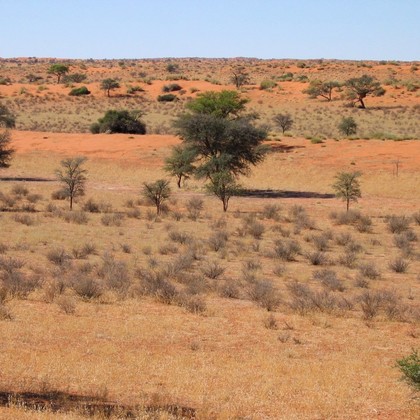
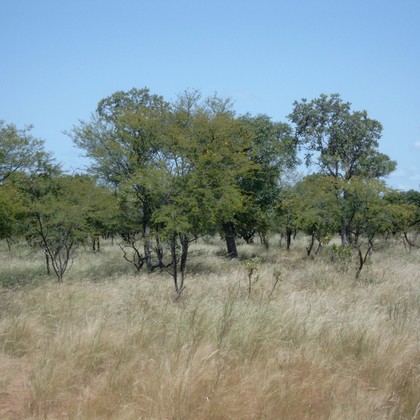
Dry acacia savanna and thorn scrub, especially in the Kalahari and on sandy soils with camel thorn and other acacias, also along dry riverbeds with tall trees and in farmland and gardens with thorn bushes. It forages for insects on the ground and in low bushes.
Where the bird is most at home, classified by the vegetation units of southern Africa.
Range and movements
Almost confined to the dry interior of southern Africa: most of Namibia except the bare coastal desert, almost all of Botswana, northern and north-western South Africa (Northern Cape, North West, western Limpopo, north-western Free State), south-western Zimbabwe, southern Angola and the far south-west of Zambia.
- Resident
- Summer visitor (c. Oct–Mar)
- Winter visitor (c. Apr–Sep)
- Passage (Mar–Apr, Oct–Nov)
- dark = core range, pale = thinly spread
How and when to look
Year-round. Easy to see in Kgalagadi Transfrontier Park, the Central Kalahari and Etosha, often around camps and waterholes. Listen for the duet and look low beneath the acacias; the red breast is unmistakable even at a distance once the bird turns.
Conservation status
Not threatened; common within its range. The species tolerates livestock farming and woodland thickened by bush encroachment, and no large-scale threats are known.
Scientific name
Laniarius atrococcineus | (Burchell, 1822)
Burchell described the species in 1822 as Lanius atrococcineus; because it was later moved to another genus, the author and year stand in brackets. The genus Laniarius was introduced in 1816 by Vieillot. Laniarius comes from the Latin lanius, 'butcher', the same root as for the true shrikes — for the hooked bill and the habit of impaling prey on thorns. atrococcineus comes from the Latin ater, 'black', and coccineus, 'scarlet' — for the black upperparts and bright red underparts. The specimen the first description was based on came from near the confluence of the Vaal and Orange rivers, South Africa.