All species › Birds of prey › Hawks, eagles and kites › Dark Chanting Goshawk
Dark Chanting Goshawk | Melierax metabates
Donkere zanghavik | Azor Lagartijero Oscuro
The Dark Chanting Goshawk is a slender, long-legged grey hawk of moister woodland, the eastern counterpart of the Pale Chanting Goshawk. It takes its name from the melodious, fluting song it gives from a treetop at dawn in the breeding season. It hunts from a perch on lizards, large insects, small mammals and birds, and also walks on the ground.

Voice
In the breeding season a melodious, fluting kloo-kloo-kloo-kloo or klee-klee-klu-klu-klu, often repeated at length from a treetop at dawn, which gives the bird its name. Also a sharp, high keep.
Recording: Robert Davis — CC BY-NC-SA 4.0 · converted to mono · xeno-canto
Identification
50–56 cm, wingspan 95–110 cm. Adults are mid-grey above and on the head and breast, darker than Pale Chanting Goshawk; the belly is finely barred grey and white. The rump is finely barred grey and looks grey, not white, in the field. The secondaries are grey, so the upperwing shows little contrast with the black primaries. Cere and long legs are bright orange-red, the eyes dark. The tail is long and barred. The female is larger. Juveniles are brown, with a streaked breast, barred belly, yellow legs and a yellow cere.
Confusion species
Pale Chanting Goshawk Melierax canorus is paler grey, has a white rump and white secondaries that form a large pale wing panel in flight; it lives in drier, more open country, but the two overlap in western Zimbabwe and eastern Botswana. Gabar Goshawk Micronisus gabar is much smaller, with a white rump in adults. Lizard Buzzard Kaupifalco monogrammicus is smaller and stockier, with a black throat stripe and a white tail band. Juveniles resemble young African Goshawks Aerospiza tachiro, which however have shorter legs and live in denser forest.
Habitat
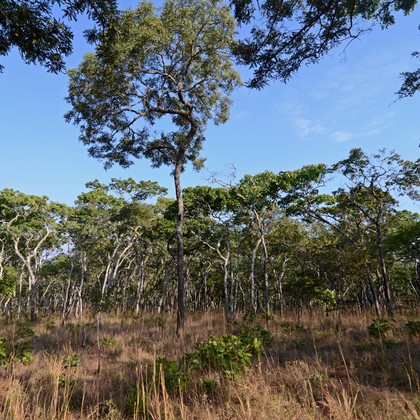
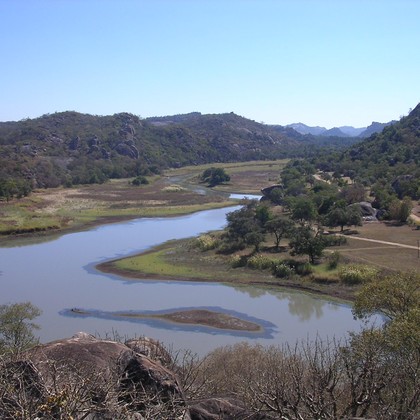
Moister and denser woodland than Pale Chanting Goshawk: miombo, mixed broadleaf woodland, mopane and broad-leaved savanna, also around farmland with tall trees. It often sits upright on a prominent treetop or pole and drops onto prey on the ground; it sometimes follows honey badgers or snake eagles to grab flushed prey. The nest is placed in a tree fork at mid-height.
Where the bird is most at home, classified by the vegetation units of southern Africa.

Range and movements
In the north and east of the region: Angola, Zambia, Malawi, Mozambique, Zimbabwe, northern and eastern Botswana, northern Namibia including the Caprivi Strip and north-eastern South Africa (Limpopo and the Mpumalanga lowveld). Beyond the region it occurs in the savannas of sub-Saharan Africa, from Senegal to Ethiopia and Tanzania, with an isolated population in south-western Morocco and in south-western Arabia.
- Resident
- Summer visitor (c. Oct–Mar)
- Winter visitor (c. Apr–Sep)
- Passage (Mar–Apr, Oct–Nov)
- dark = core range, pale = thinly spread
How and when to look
In the breeding season, August–November, drive through miombo or mixed woodland early in the morning and listen for the fluting song. A large grey hawk on a roadside pole in Zimbabwe, Zambia or Malawi is usually this species; in western Zimbabwe and eastern Botswana check the rump to separate it from Pale Chanting Goshawk.
Conservation status
Not threatened; fairly common in suitable woodland. Locally less numerous because of deforestation, poisoned bait and persecution, but the species also uses semi-open farmland and the population is considered stable.
Scientific name
Melierax metabates | Heuglin, 1861
Heuglin described the species in 1861 and placed it straight away in the genus where it still stands. The genus Melierax was introduced in 1840 by Gray. Melierax comes from the Greek melos, 'song', and hierax, 'hawk' — for the melodious, piping calls of chanting goshawks in the breeding season. metabates comes from the Greek metabatēs, 'leaper, vaulter', from meta, 'change', and batēs, 'treader' (from bainō, 'to walk'). The specimen the first description was based on came from the White Nile between 6° and 7° N, South Sudan.