All species › Passerines › Cisticolas › Desert Cisticola
Desert Cisticola | Cisticola aridulus
Kalaharigraszanger | Cistícola del Kalahari
Desert Cisticola is a pale, sandy cisticola of short, dry grassland in the interior, from the Kalahari to the Highveld. It closely resembles Zitting Cisticola but lives in shorter, sparser grass and has its own song with wing-snapping and a low, jerky song flight.

Voice
A high, repeated zeep-zeep-zeep or zink-zink-zink, sometimes with a rattling tuk-tuk-tuk, given from a perch or in a low, jerky song flight with audible wing-snapping. The alarm is a sharp chik.
Recording: Dries Van de Loock — CC BY-NC-SA 4.0 · converted to mono · xeno-canto
Identification
About 10–11 cm, small and rather long-legged. The upperparts are pale sandy to buff with fine, narrow black streaks on crown and mantle, less heavily streaked than Zitting. The rump is plain pale buff. The tail is fairly long for a grassland cisticola, grey below with a dark subterminal band and pale tips, without Zitting's sharp black-and-white pattern. The face is plain, with a pale supercilium; the underparts are white with pale buff flanks. In non-breeding plumage the bird is slightly warmer and more heavily streaked. The sexes are alike. It sings from a grass stem, post, or in a low, jerky song flight over the grass.
Confusion species
Zitting Cisticola Cisticola juncidis is darker and more heavily streaked, has a shorter tail with clear black spots and white tips, lives in taller, moister grass and sings a measured zit…zit in an undulating song flight without wing-snapping. Cloud Cisticola Cisticola textrix, Wing-Snapping Cisticola Cisticola ayresii and Pale-Crowned Cisticola Cisticola cinnamomeus are smaller and very short-tailed and sing high up, often out of sight; Wing-snapping also snaps its wings, but mainly during the dive after a high song flight. Habitat (short, dry grass), pale colour, relatively long tail and the low song flight with zeep notes and wing-snapping together point to Desert Cisticola.
Habitat
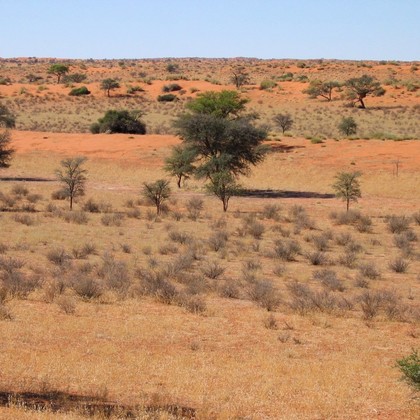
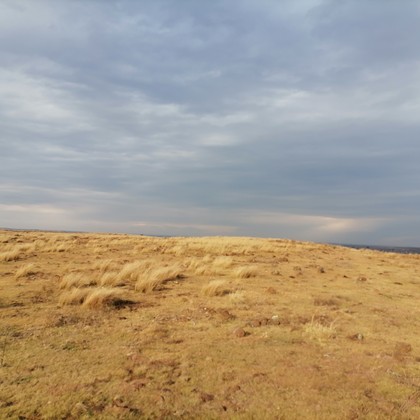
Short, sparse grassland, sandy flats with grass tufts, the edges of pans and salt pans, dried-out floodplains and fallow land in dry savanna and on the Highveld; also in short grass around airstrips and along roads. It forages on the ground and low in the grass for small insects. The nest is a purse of grass and cobweb low in a grass tuft.
Where the bird is most at home, classified by the vegetation units of southern Africa.
Range and movements
Within the region in the dry interior: in South Africa in the Northern Cape (mainly the Kalahari and the north-east), North West, the Free State, Gauteng, the Mpumalanga Highveld and western Limpopo; also across most of Botswana, in Namibia except the Namib and the far south, in western and south-western Zimbabwe, on the floodplains of western Zambia and in southern Angola. Absent from the wet east coast, Lesotho and most of Mozambique. Beyond the region in the Sahel from Mali to Sudan and locally in East Africa.
- Resident
- Summer visitor (c. Oct–Mar)
- Winter visitor (c. Apr–Sep)
- Passage (Mar–Apr, Oct–Nov)
- dark = core range, pale = thinly spread
How and when to look
Year-round; best in summer after the first rains when the males sing. Search short, sparse grass on the Highveld (for example around pans in the Free State) or in the Kalahari, such as Kgalagadi Transfrontier Park and the Central Kalahari. Listen for wing-snapping in a low, jerky flight: that separates it from Zitting Cisticola, which sings in an undulating flight over taller grass without snapping.
Conservation status
Not threatened and fairly common in suitable habitat. It benefits locally from overgrazed, short grassland but disappears where grassland is ploughed. Numbers fluctuate with rainfall.
Scientific name
Cisticola aridulus | Witherby, 1900
Witherby described the species in 1900 and placed it straight away in the genus where it still stands. The genus Cisticola was introduced in 1829 by Kaup. Cisticola combines the Ancient Greek kisthos 'rock-rose' with the Latin colere 'to dwell'. aridulus is a Latin diminutive of aridus, 'dry' — for the dry, open grasslands it inhabits. The specimen the first description was based on came from White Nile, south of Khartoum, Sudan.