All species › Passerines › Cisticolas › Cloud Cisticola
Cloud Cisticola | Cisticola textrix
Tinktinkgraszanger | Cistícola Pinc-pinc
The Cloud Cisticola is a tiny, short-tailed cisticola of open, short grassland, best known for its display flight: the male climbs so high that he is barely visible from the ground and sings there for minutes on end while circling. It is almost confined to southern Africa and is one of the five ‘cloud-scrapers’ among the cisticolas, which can be told apart reliably only by song and display.
Voice
The display song is a short series of three or four high, pure whistles followed by a string of dry clicks, see-see-see-chik-chik-chik, repeated over and over as the male circles high in the sky. During the dive an accelerating chik-chik-chik-chik is given. The call is a sharp tink.
Recording: Ehren Eksteen — CC BY-NC-SA 4.0 · converted to mono · xeno-canto
Identification
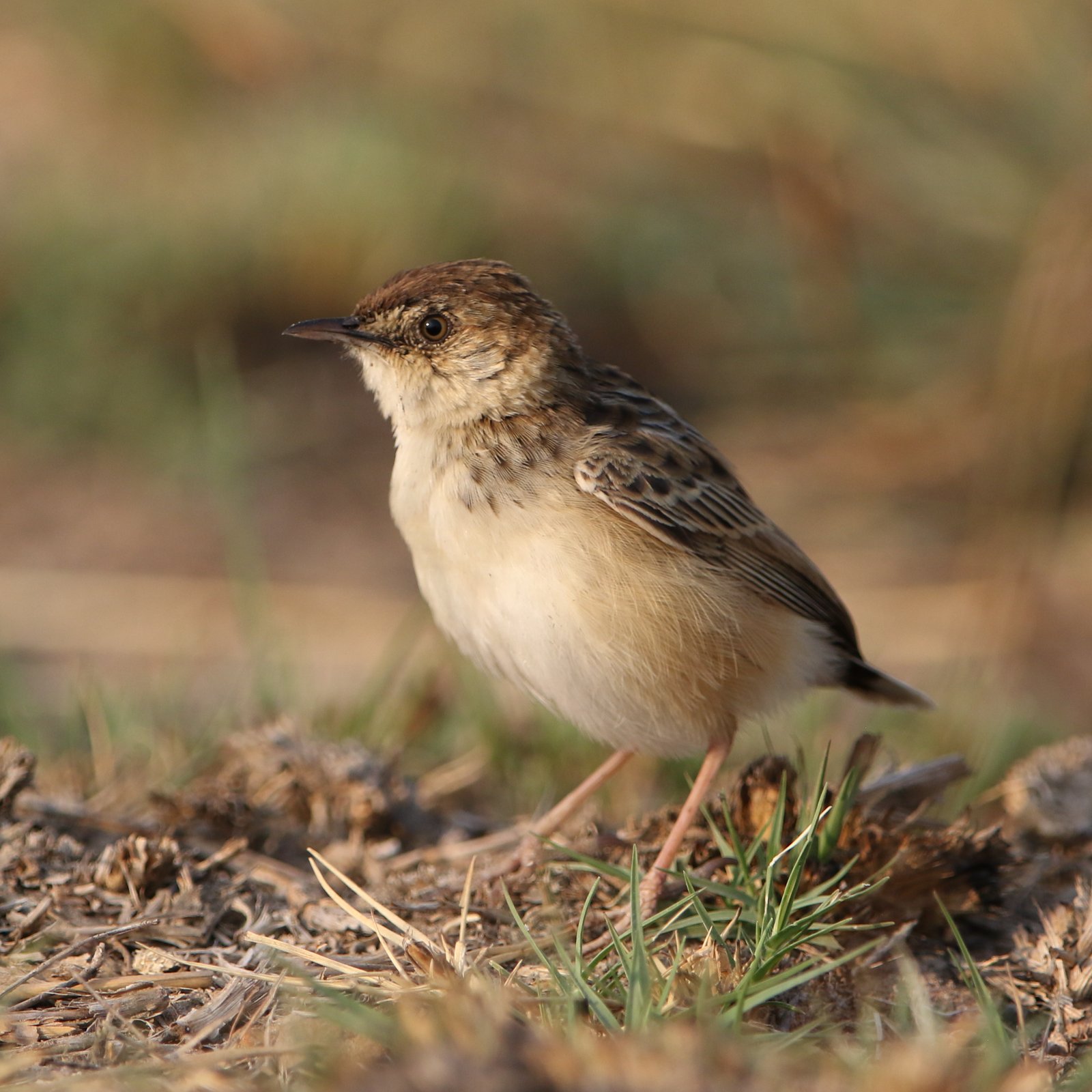
About 10 cm, compact, with a strikingly short tail and relatively long, pale pink legs. The crown is brown with fine dark streaks, the back and mantle heavily streaked black on a pale buff ground; the rump is rusty brown. The underparts are pale buff to off-white, with distinct dark streaks on the breast in the south-western form (Western Cape) but unstreaked elsewhere. The tail has a black subterminal spot and pale tips. Outside the breeding season the tail is slightly longer and the head warmer brown. The sexes are almost alike. The field character is the display: a climb into the clouds, circling while singing, and a vertical dive without wing-snapping, accompanied by an accelerating series of dry clicks and broken off just above the grass.
Confusion species
Wing-Snapping Cisticola Cisticola ayresii is even smaller and darker and sings a monotonous series of high whistles; its display is accompanied by loud, cracking wing-snaps, also during the dive. Pale-Crowned Cisticola Cisticola cinnamomeus lives in wetter grassland around vleis; the breeding male has an unstreaked, pale cinnamon crown and black lores. Desert Cisticola Cisticola aridulus of dry, open grassland is paler, longer-tailed and sings a few zink notes in low, undulating flights. Zitting Cisticola Cisticola juncidis chooses taller, denser grass and performs a bouncing display with a rhythmic zit…zit…zit. Outside the breeding season, when the birds are silent, the species often cannot be named with certainty.
Habitat
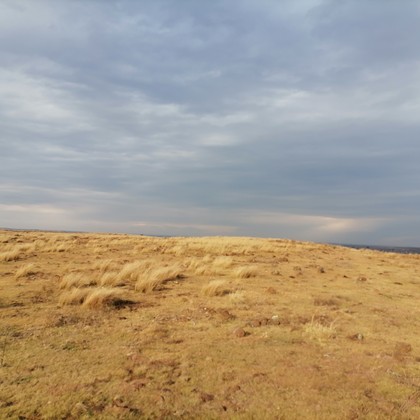
Open, short grassland on the highveld and in hill country, coastal-plain grasslands and the renosterveld of the Western Cape, old fallow fields and grassland kept short by grazing or burning. It avoids tall, dense grass and scrub. The nest is a ball with a side entrance, low among grass tufts.
Where the bird is most at home, classified by the vegetation units of southern Africa.


Range and movements
Almost endemic to southern Africa. In South Africa in the lowlands of the Western Cape, in the Eastern Cape, KwaZulu-Natal, Free State, Gauteng and Mpumalanga, also in Lesotho and Eswatini, and locally on the coastal plain of southern Mozambique. It does not occur beyond this area; older records from Angola and Zambia refer to Dambo Cisticola, formerly included in this species.
- Resident
- Summer visitor (c. Oct–Mar)
- Winter visitor (c. Apr–Sep)
- Passage (Mar–Apr, Oct–Nov)
- dark = core range, pale = thinly spread
How and when to look
Best from October to February on calm, sunny mornings, when the males display; in the Western Cape from August. Look not at the grass but at the sky and listen for the tinkling rhythm: the male often hangs so high that only binoculars will find him. Follow the dive to the landing point, where the bird often perches briefly on a grass tuft. In winter the silent birds, like Wing-snapping and Desert Cisticolas, are usually impossible to name.
Conservation status
Not threatened. Locally common in suitable grassland, but the conversion of grassland and renosterveld to cropland, plantations and housing has strongly fragmented its habitat, especially in the Western Cape and on the highveld.
Scientific name
Cisticola textrix | (Vieillot, 1817)
Vieillot described the species in 1817 as Sylvia textrix; because it was later moved to another genus, the author and year stand in brackets. The genus Cisticola was introduced in 1829 by Kaup. Cisticola combines the Ancient Greek kisthos 'rock-rose' with the Latin colere 'to dwell'. textrix is Latin for 'female weaver', for the nest skilfully woven from grasses. The specimen the first description was based on came from Cape Province, South Africa (not specified further).